The Art of Peace
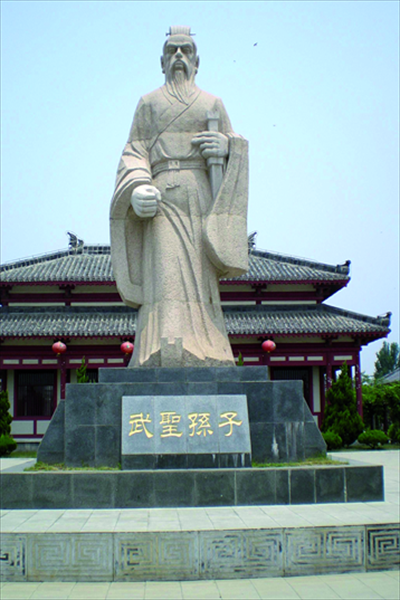
The statue of Sun Tzu in Huimin county in Shandong Province Photo: CFP
As one of the oldest and greatest military treatises in the world, the ancient Chinese book The Art of War is required reading at both West Point and Harvard Business School for those who wish to go on to high-level management jobs. The how-to book has influenced many business tycoons all around the world, including Panasonic founder Konosuke Matsushita, Honda founder Soichiro Honda, former chairman and CEO of General Motors Roger Smith, and NFL coach Bill Belichick. Chinese President Hu Jintao presented a copy as a gift to former US president George W. Bush. According to some experts, 2.5 billion people have been exposed to the ideas in The Art of War.
Written by the great ancient Chinese strategist Sun Tzu (Sun Wu), this book began its fame when Sun presented it as a gift to the king of the State of Wu during the Spring and Autumn Period (771-476 BC) upon their first meeting. It is estimated that the book was written between 515 and 512 BC, about 2,300 years earlier than Carl von Clausewitz's On War. It was the French Catholic missionary Jean Joseph Marie Amiot (known in Chinese as Qian Deming) (1718-93) who first introduced The Art of War to Europe, translating it to French in 1782. Soon researchers from other European countries translated it into English, Dutch, Italian, Latin, Greek, Spanish, and so on.
The whole book is divided into 13 chapters, discussing military situations, transformations, and opposing concepts involving war, like friend and foe, host and guest, majority and minority, strength and weakness, offense and defense, victory and defeat, gains and losses, and so forth. Today the wisdom of the book has not only been adopted in military fields but also widely used in many other aspects of modern society, especially in the business and financial sectors.
According to chinanews.com, Lu Mingde, president of Hong Kong International Institute of Sun Tzu and former doctoral supervisor of Hong Kong Polytechnic University, supports the estimate that about 2.5 billion people have studied the ideas in The Art of War.
Lu explained that he did not come up with this figure. It was first proposed by Western scholars, who postulated that since the book's publication, Sun's take on military strategy has already had 2.5 billion readers. This large number estimated by Western scholars stimulated Lu's interest, and he decided to examine the figure measuring the phenomenon and influence of the book. He studied carefully, drawing from a large amount of materials from both Chinese and Western scholars regarding The Art of War.
After careful analysis, Lu agreed that the calculation seemed to add up. Although, in his opinion, 2.5 billion may in fact be a conservative estimate.
At present there are hundreds of versions of The Art of War throughout the world in nearly 30 languages. Furthermore, there are currently more than 10 thousand books worldwide that have been written on The Art of War. Lu used the following calculation to help him arrive at his conclusion: With an average of 1,000 copies for every title, these 10 thousand books would collectively have 10 million copies. If each copy is read by an average of 10 people, a conservative estimate compared to circulation numbers in public institutions like libraries, there are 1 billion people who have read secondary documents on this famous tome today.
While this suggests the book has had an astounding impact on the world, Lu believes that in this technologically advanced time, Sun's ideas can have an even greater influence. Documentaries, TV programs and educational cartoons on The Art of War have been warmly welcomed by domestic audiences. Further use of modern media could increase the work's influence by more than 100 million people, Lu estimated.
The book's appeal abroad is not flagging either. News coverage of Chinese Premier Wen Jiabao talking with US Secretary of State Hillary Clinton about The Art of War, explaining the origin and meaning of the Chinese saying "Tong zhou gong ji" (people in the same situation should help each other), was seen by millions worldwide.
Today, more people are studying The Art of War and its ideas, which promote not aggression, but conflict resolution, not the breaking of peace, but the keeping of peace. According to Lu, the book is becoming an important ambassador of Chinese culture, with a crucial role similar to that of the Confucius Institute abroad.
Global Times