Mao money
Hunan symphony orchestra performs "East is Red" on Mao's 118th birthday on December 26, 2011. Photo: Courtesy of Shaoshan People's Government
In Chairman Mao Zedong's hometown, a former backwater in Central China's Hunan Province, locals take every worldly precaution to protect the other-worldly life of the Great Helmsman.
When Mao's six-meter statue had to be repositioned in 1993 in the massive square that welcomes millions of pilgrims, locals prayed throughout the night before the move, assuring him that he need not take offence.
Not only were the people of Shaoshan showing great reverence to the "Great Helmsmen," they were ensuring the continuing mystic appeal of Mao, which attracted more than 7 million visitors who spent 1.85 billion yuan ($292.68 million) last year.
The folktales and legends of mysterious happenings here add power to the pull Mao still has on people seeking spiritual guidance and blessings from beyond.
When the torch relay for the 2008 Beijing Olympic Games passed Shaoshan, it's said the sun erupted in a solar corona. When Mao's statue was unveiled almost three decades ago, azaleas on the nearby mountains burst into brilliant bloom months earlier than usual.
Every tour guide and villager in Shaoshan will tell a pumped-up story of a mysterious happening that all will swear to be true.
"It's a unique phenomenon that many Chinese people regard Chairman Mao as a god," Hu Dechang, vice director of Shaoshan Administration Bureau, under the Hunan provincial government, said.
"Numerous coincidences have happened here, especially after the statue was moved in 1993. People still believe that Chairman Mao is up there, watching out for us."
Just about every one of the 1,400 villagers in Shaoshan village is involved in the business of revering Mao more than 30 years after his death, his birthplace has become the epicenter of the "red tourism" industry.
Shaoshan village (old name Shaoshanchong) is administered by Shaoshan, a county-level city with a population of less than 100,000.
Mao worship
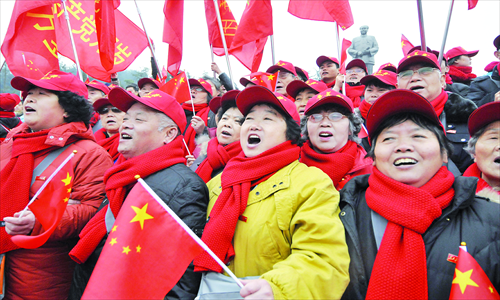
Many of the red pilgrims who trek to Shaoshan burn incense, bow and pray before Mao's statue at the head of Chairman Mao Square. Some also buy "protection cards" that are said to bear Mao's spirit and assure the purchaser's safety during their travels.
Wang Zhilin, a Hunan businessman living in Beijing, again spent part of his Spring Festival holiday travelling to Shaoshan to pay respects. "I worship Mao as a god. He didn't just found our nation, he established our system of morality."
Wang said he made a wish last year at the foot of Mao's statue and it came true. He wouldn't say what his wish was, but he's convinced Mao's divine intervention made it happen.
"My gratitude to Chairman Mao propelled me to express my reverence," said Wang, his voice loud and confident.
By the time Wang made his way to the square, it was already packed with visitors waiting their turn to bow three times in tribute to one of the greatest leaders of the 20th century. They can be seen whispering prayers asking Mao, who was a devout atheist, to protect them.
Some visitors rent a flower arrangement and pay for a two-man military escort to lead them to the foot of Mao's statue. Their flowers are later collected and sold again the next day.
"Our business is good during Spring Festival, we sell dozens of floral stands a day," Zhang Wei, the manager of the authorized flower shop, told the Global Times.
"I regard him as God of Fortune," said Yao Wenyuan, a visitor from Xiangtan in Hunan Province who paid 399 yuan for the stand of flowers and another 1,000 yuan for the escort.
Seven years ago, Yao spent 750 yuan on a gilded Mao badge, which he has worn every day since.
"Back then I was down on my luck. I believe Chairman Mao is one of the luckiest figures in the world, so I bought his badge to bring me good luck," Yao told the Global Times as he waited to pay his respects in front of the statue. Yao believes his Mao badge helped him win 5,000 yuan during a game of mahjong the day he bought it.
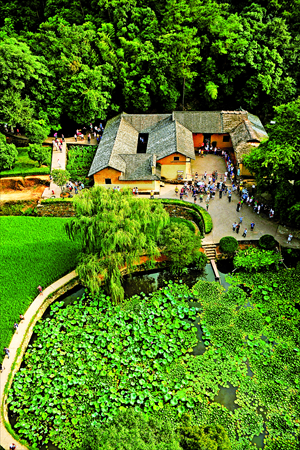
Mao's hometown has had a lot of help with its main source of income. The central and local governments invested 980 million yuan to launch a massive renovation and expansion of Shaoshan scenic area, which was completed in 2008. A new highway was built to connect Changsha, the provincial capital, and the town. Chairman Mao Square was expanded and his family's mud-brick home was rebuilt. A Martyr's Park was set up to commemorate the 148 townspeople who died during the revolution, including six of Mao's relatives, and a museum and library were built.
Last year, Shaoshan's core scenic spots, including the square and Mao's former residence were upgraded to a national 5A class tourist attraction, the country's top rating.
The massive investment has paid off handsomely with the number of visitors doubling since 2007.
Firecrackers crackle throughout the town and a fattened calf is butchered in a show of respect for the holiday and Mao. His 118th birthday on December 26 attracted more than 300,000 visitors to Shaoshan.
"It is not superstition. It's a spontaneous activity in which people express their feelings," said Shaoshan village Party Secretary Mao Yushi, "People want to express their gratitude and pray to Chairman Mao for his blessing and protection."
Of course not all visitors come to seek the Chairman's protection from the beyond.
"Chairman Mao was great but I don't regard him as God. I came here to commemorate him, and I also hope I can learn from him and become as great a man as he was," Tang Yuxing, an excited 20-year-old college student, told the Global Times. His parents bought a floral stand and paid for the two-man military escort.
"Older people who lived during Mao's rule have more complicated feelings about him, and they tend to see him as a type of god to ask for blessings and protection," said a security guard on the square surnamed Liu.
The red economy
Many locals must see their good fortune of being born in the same town as Mao as some sort of godsend. Ironically almost everyone is involved in some sort of capitalist venture. They sell Mao books, brooches, tie clips, watches, badges, and pendants with holograms of the leader's portrait. Cigarette lighters embossed with Mao's picture noisily play the "East is Red," tacky shopping bags, cuff links, barometers, glow-in-the-dark busts are for sale everywhere.
One of the mystiques of Mao's life was his own struggle out of poverty. When he was a boy Shaoshan was home to indentured farmers. Now the townspeople greet each other with a wish to get rich from Mao (fa Maozhuxi de cai).
Mao, Shaoshan village's Party Secretary, has witnessed the phenomenal growth of his town over his 17-year tenure.
"Our life is getting better and better. We can earn money by opening eateries, inns and shops selling souvenirs. More importantly, youngsters needn't leave home for big cities to find jobs," said Mao, sitting comfortably in his two-story house.
Like many of the villagers (many are surnamed Mao), Mao and his son opened a restaurant seven years ago and now they each earn 100,000 yuan a year.
"Thanks to Chairman Mao, it is not difficult to make a living here," taxi driver Zhao Xingbin said, pointing to the picture of Mao dangling from the rearview mirror, an apparent custom of just about all drivers in Shaoshan who say his portrait offers protection.
Zhao said he can earn as much as 800 yuan a day during Spring Festival, three times more than most other times of the year.
The average per capita income of the villagers increased to 15,000 yuan last year and more than 80 percent are engaged in the catering business or sell trinkets at stalls lining the approaches to Mao's house.
One of the earliest and most famous eateries is of course named the Mao Family Restaurant. Located on a hill overlooking the Mao homestead, the restaurant is run by 82-year-old Tang Ruiren, a distant relative of Chairman Mao. She rose to great fame after she was photographed with Mao in 1959.
Tang has developed her business into a national chain of restaurants with branches around the country.
"Chairman Mao is a god. He is a savior. Without him, we wouldn't even be able to dream of today's happy life," said Tang in her strong local accent, fixing her eyes on an embroidered portrait Mao hanging on the wall.
Sometimes, the silver-haired woman will mingle with guests and once again tell her story about her encounter with Chairman Mao.
Tang is obviously a loyal worshipper of Mao, whose portraits hang on every wall of her home. Her living room includes a shrine with a bronze bust of Mao which shares the alter with the God of Wealth. Tang said she and her family burn incense and bow to him almost every day.
Party secretary Mao said everyone in Shaoshan is grateful for the prosperity Mao has brought them.
"Chairman Mao is the God of Fortune. He has saved and benefited us. If it were not for Mao Zedong, no one would know anything about Shaoshan," said the secretary.