Crosstalk crossroads
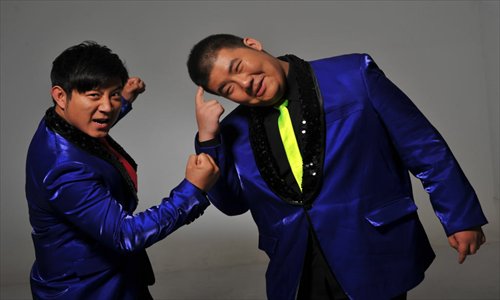
Crosstalk, or xiangsheng, is a traditional Chinese form of comic dialogue that originated during the Qing Dynasty (1644-1911) in northern China. For hundreds of years, it was a popular type of street theater, and in recent decades it has become a regular feature on TV, including the annual Spring Festival Evening Gala, the most-watched TV show during China's most important holiday.
However, lately, a number of scholars and crosstalk artists have been expressing worry about the future of this cultural tradition, with well-known crosstalk performer Guo Degang, 39, even saying after his recent New Year's Eve performance that: "Upon my death, Chinese crosstalk will come to an end."
Even though many feel Guo was inflating his own influence on the traditional art, many agree that the future of crosstalk is uncertain.
State of the art
The 1980s witnessed a heyday of crosstalk appreciation, after the government lifted restrictions that were in place during the Cultural Revolution (1966-76). The comic style flourished once again, a number of books on crosstalk were printed, and professional schools teaching crosstalk were founded.
But the spring of crosstalk was short-lived. In recent years, both performers and audiences have felt that the quality of the genre has been compromised.
A report from China Reform, a monthly magazine that studies reform in Chinese society, said: "Crosstalk performers underestimated the counterattack ability of those they ridiculed, and they also overestimated their influence on the public.
"After new restrictions were placed on several art forms between 1989 and 1992, frequent guests of radio programs, TV shows, and galas lost creative control. The quality of new crosstalk skits plummeted, and books on crosstalk nearly disappeared."
"Such a change of destiny once again revealed the dependent status of quyi [Chinese folk art]: it is a product within a system, reaching the audience through system-controlled TV and radio."
Many insiders feel that the crosstalk community is also responsible for its decline.
Playwright Chen Hongxu, who is also a member of China Quyi Artists, listed six problems currently plaguing crosstalk: out-dated teaching concepts; toxic competition between performers from different schools; an inability to mirror real life; the performances of genuine masters being debased by those of the unskilled; an overly rigid form; and skits being cut to fit time slots on TV.
However, some, like Gao Xiaopan, a crosstalk performer born in the 1980s and president of Xiha Crosstalk Club, think many performers today do not take the art form seriously enough, seeing it as a way to increase their fame.
"Some perform or learn crosstalk not because they love it and are willing to study it intensively, but rather they use it as a springboard," Gao said to the Global Times.
Modern twist
Crosstalk usually consists of two performers dressed in traditional robes, speaking from behind a table with a few props like fans or handkerchiefs. One of the pair talks at length while the other takes a supportive role, with plenty of jokes along the way.
But as people born in the 1980s are starting to enter the stage, crosstalk is receiving a bit of a makeover. In addition to more modern topics and phrases being folded into the traditional dialogue style, elements from pop culture are making their way into the sketches. Dragon TV's Tonight 80th Show has combined crosstalk with a talk show format and even introduced rock music onto the stage.
"New kinds of crosstalk, drawing on talk shows and rock music, are finding ways to expand on carrying the human voice. These additions to the genre are already related to crosstalk, so they can render each other," said Ye Feng, general director of Tonight 80th Show.
Ye said that his show, together with another crosstalk show launched by the same TV station, has received a warm welcome from audiences. "Tonight 80th Show ranked second among all satellite TV programs during prime time [7 pm to 10 pm] on January 23, while the other ranked first during the same hours the following day," Ye told the Global Times.
"The program is a success, which proves that this fusion allows crosstalk to shine more brilliantly. This combination has become Tonight 80th Show's trademark," he added.
However, not everyone agrees with the new format. Zhang Haitao, principal of Northern China Quyi School in Tianjin, said although different types of art can learn from each other, he does not advocate crosstalk being expressed by rock music. "Crosstalk is an art of speaking, not singing," he said.
"You may call it by another name, but it's of course not crosstalk. Though I agree with Hegel that whatever is true is reasonable," he added.
Theory versus practice
Although people disagree about the best way to present crosstalk today, almost everyone believes that having truly skilled performers is the key. And that is why Gao, in cooperation with Northern China Quyi School, opened a two- to three-year crosstalk training program this year.
"Crosstalk requires professional training and study," said Gao, adding that the best solution would be for the government to implement a policy supporting such professional training.
Zhang is also in favor of the training of more skilled performers, and he further remarked that good crosstalk skills are not acquired by academic training alone.
"Those with a master's degree or even a doctorate in crosstalk may not be able to perform well," he said. "Perhaps they are scholars of the art, but to perform crosstalk well, one needs real practice."
However, Jiang Kun, another well-known crosstalk performer, believes a stronger emphasis should be placed on developing theory.
"Compared with other art forms, crosstalk has very little theory. Therefore, to better develop crosstalk, we must cultivate talents who are experts on theory," Jiang said in a report from Liaoning Daily.