Not in my backyard
Technicians monitor the air for radiation during a nuclear accident drill in Zhuhai, Guangdong Province following the Fukushima disaster in Japan last March. Photo: CFP
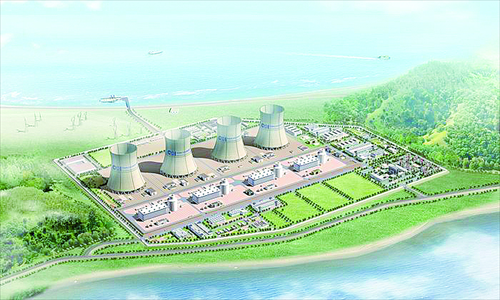
An inter-provincial squabble over a nuclear power plant being built near the southern bank of the Yangtze River, and not far from the shores of Taibo Lake in Jiangxi Province, has raised questions about China's ambitious expansion of its nuclear power program.
While Anhui Province appears to be the environmentally progressive opponent of the Jiangxi nuclear plant, it too has plans to build four of its own nuclear power plants.
The debate, which has included some mudslinging by both provinces, has experts outside the region suggesting neither province should build nuclear reactors.
Just two years ago China announced an ambitious plan to up the percentage of electricity supplied by nuclear power to 5 percent of total power by 2020. This would see the country's nuclear generating capacity increase more than seven times to over 80 gigawatts.
The plant in the center of the brewing controversy is located in Pengze county in Jiangxi. Across the river the government of Wangjiang county in Anhui wants the project shelved, saying they don't want the nuke plant so close to their backyard.
A report submitted by Wangjiang officials accuses its neighbor of lying about the population density in the area. They claim more than 150,000 people from Wangjiang alone live within a 10-kilometer radius of the plant. State regulations require that no more than 100,000 people should be living within a 10-kilometer radius of a planned nuclear power plant.
The Wangjiang report also claims the proposed plant is in or near an earthquake zone. They point to a 2011 quake that shook the city of Jiujiang about 80 kilometers away which measured 4.6 on the Richter scale, and another in 2005 that measured 5.7.
The planned nuclear power plant is expected to work wonders for Jiangxi's economy. The six reactors will generate more electricity than is currently produced in the entire province. It will have an installed capacity of 8 gigawatts allowing it to generate 56 billion kwh of electricity each year. The first reactor is expected to be operational by 2015, official records show.
At a total cost of 100 billion yuan ($15.87 billion), even the construction of the plant will give the local economy an enormous kick. Along with the huge potential for economic spinoffs the county government expects to rake in 50 million yuan in taxes during construction and 3 billion yuan a year in tax revenue when the project is completed. Currently Pengze county collects barely one-sixth of the projected tax revenues, according to a China Business Journal report in December.
Point counterpoint
While Pengze county officials might be forgiven for seeing its nuclear power plant as a cash cow, across the river Wangjiang country officials worry their agricultural-based economy is being threatened.
"We worry about two things: So many people are living close by and the potential for earthquakes. What if something happens? What are they going to do about it?" asked Yu Zehong, director of the development and reform commission for Wangjiang county.
Hu Bin, director of the nuclear project office in Pengze, said he has no idea what's caused the sudden objections from the neighbors a few kilometers downstream. He told the Oriental Morning Post that Jiangxi officials have strictly followed regulations and communicated with the local governments in Anhui.
Yu counters Hu's assertions, saying Anhui has never been fully consulted and was only informed the project was going ahead last year.
Yet Pengze authorities say they polled 500 neighboring residents in Wangjiang about their views of the plant and 96 percent of respondents approved of the project. To this Wangjiang officials say the questionnaire was skewed to promote a positive response and it failed to inform people of the potential dangers of nuclear power.
Some residents in Wangjiang contacted by the Global Times said they haven't heard about the project. One woman in Mopan village, less than five kilometers from the proposed plant, said she had no idea what a nuclear power plant actually does, nor had she heard of the accident in Japan last year. Some residents in Madang township near where the plant will be built said they knew about the big project but hadn't been told of any potential dangers.
While the tit-for-tat war of words between the counties in the two provinces isn't likely to abate soon, experts on the national stage are firing up a larger debate about China's nuclear power strategy.
He Zuoxiu, a leading theoretical physicist, isn't only concerned about one nuclear plant near the banks of the Yangtze.
"China shouldn't build any nuclear power plant in the inland regions," said He, 85, who worked on China's first nuclear bomb.
"People have failed to consider the potential for accidents like an earthquake or terrorist attacks, or asteroid hit," said He.
Safest technology available
The nuclear power plant at Pengze will employ so-called third-generation technology that is supposed to be safer and suitable for areas far from the ocean. He says he's not convinced and points out that no plant using the proposed technology has yet been built anywhere in the world.
"Although the probability of severe accidents might be low, we can't ignore the fact that if anything happens, the result would be irreparable for tens of thousands of years," He said, suggesting that a catastrophe would render China's heartland virtually uninhabitable.
"As far as I know, AP1000 technology is the safest and most secure ever designed by humans," said Mi Sen, a senior economist and chief representative at the Shanghai office of China Nuclear Engineering Group Co.
"You can't ask us to design something to resist doomsday disasters," said Mi, adding that he has full confidence in the government's strict requirements and cautious approval procedures.
The near doomsday nightmare at the nuclear power plant at Fukushima of Japan last March caused China to impose a moratorium on the approval of new nuclear power plants. Those currently under construction continue to be built.
Mi says the pause for a sober second thought has been good for China's nuclear power industry.
"After the tsunami, which was what really caused the disaster in Japan, not the earthquake, we have learned from it and improved safety measures," said Mi.
Jiang Kejun, a professor at the Energy System Analysis Center of NDRC, said coal-fired power plants have caused more damage and harmed more people than nuclear power plants have.
While Jiang acknowledges that a leak of nuclear waste at the Pengze plant could contaminate the Yangtze and vast areas of agricultural land, he still believes nuclear power is the only way China can meet its energy needs while reducing carbon emission.
"We are concerned, yes, but considering the entirety of China's energy structure we have no better choice than nuclear. There's no perfect solution," said Professor Jiang.
All the companies involved in nuclear power plant construction in China are State-owned. Though the government doesn't invest directly in the plants, the industry is backed by the government and funding has never been an issue.
Many inland cities have jumped on the nuclear bandwagon hoping to spur their economies with power plant construction projects and the promised surge in economic activity that increased power supplies are supposed to bring.
Two provinces, six power plants
While local officials in Wangjiang might worry about the plant across the river in Jiangxi Province, their own province, Anhui, is proposing to build four nuclear power plants, which are at various stages in the approval process. One of the planned plants is set for the city of Anqing, near the border of Jiangxi.
The plant at Pengze is one of two nuclear power plants planned in Jiangxi. Local governments in Jiangxi, eager to see the projects completed, have already planned industrial zones, infrastructure facilities, and even tourist sites that will be powered by the new nuclear power projects.
While the inter-provincial squabble appears to involve concerns for safety and an element of competition, experts agree that the pace of development of nuclear power should be reexamined.
Many experts worry that local governments all over China are seeing nuclear power as a panacea and moving too fast. They point to the wind turbine industry as an example of an energy sector that received major incentives that spurred rapid development only to end up producing more electricity than the power grid could absorb.
One of China's first-generation nuclear physicist remembers all too well when the country attempted a poorly planned expansion of its steel industry. "I'm not against nuclear power, but I oppose the 'great leap forward' style of development," said He.