Strings unlimited
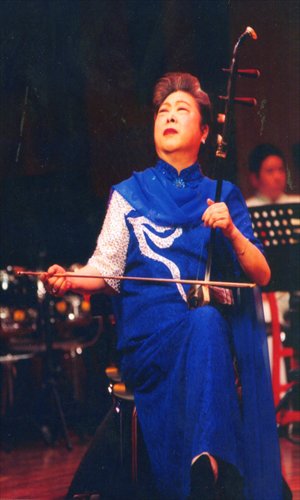
Despite her advanced years, 60-something Min Huifen, regarded as China's "Erhu Queen," is still busy traveling around the country. And her journeys are not just about playing the erhu; she is also getting ready for what she refers to as the "Olympic Games" of traditional Chinese music.
This is an annual music festival that started in 2004. It has been held in various places dotted around the Yangtze River Delta region, and the participants consist of both professionals and amateurs, embracing all ages.
Suitable venues
And for each of the past eight years, Min Huifen, has devoted a large part of her life to raising money and looking for suitable venues to host this unique non-governmental event which is usually held at the end of the year.
"'That people just participate is the founding principle of this festival," Min told the Global Times. "It's never been a competition as such, but a platform where people can enjoy and exchange ideas about traditional Chinese music. And besides playing the erhu, this festival has given me the most pleasure. I know that people are always predicting the decline of traditional Chinese music. But in fact that there are tens of thousands of people in China today learning to play the erhu."
Min pointed out that most people's knowledge of the erhu goes no further than the late blind musician Hua Yanjun, nicknamed Abing (1893-1950) who was famous for the classic Two Springs Reflect the Moon.
She added that the essential point is that this piece absorbs the vocal music tradition of Chinese operas, particularly Xiju Opera from Wuxi, Jiangsu Province, which was Abing's hometown.
Min started to learn the erhu at the age of 8. And during her long career, she has performed all over China as well as in dozens of overseas venues.
In the 1970s, when the internationally famous Japanese conductor Ozawa Seiji was in Shanghai, he said he was moved to tears while listening to Min performing the famous River Waters (a traditional erhu piece of music).
"I couldn't understand everything he was saying, but he looked very excited and was shaking my shoulders ceaselessly," Min recalled. "Later, his translator told me that the sadness of the piece really touched his heart deeply. And this is another feature of erhu music: the way it can stimulate people's emotions."
Min said that people often compares the erhu to the Western violin because they are both stringed instruments. "However, from my point of view, the erhu is emotionally more moving than the violin. Although the violin is much better than the erhu for developing muscular coordination."
In one of his articles about Min's erhu art, Zhang Qian, a professor at the Central Conservatory of Music in Beijing said that he thinks Min's most outstanding achievement is the way she transforms the vocalizations of traditional Chinese operas and folk songs, including Peking Opera, Yueju Opera, Kunqu Opera and Huju Opera into music for the erhu.
Zhang said that, "to strengthen and enrich erhu's power to express, Min kept going into the thick of life to learn Peking Opera and study folk music, including South Yangtze Delta silk and bamboo music, and Chaozhou music. She is among those erhu performers with a vast repertoire, which derives from her all-embracing attitude towards art."
All-embracing
Min said: "I did no more than following the singing and all-embracing nature of erhu, which the late erhu musicians, Abing and Liu Tianhua also contributed so much to." Min told the Global Times that when Yang Yinliu, the music historian who was a close friend with Abing and who recorded the score of Two Springs Reflect the Moon, was still alive, he once asked Min, "as an erhu player, Abing knew thousands of Chinese folk songs - how about you?"
Min pointed out that Liu Tianhua (1895-1932), another erhu master, was able to play more than 10 Chinese folk instruments proficiently, as well as some Western instruments.
"When I was young I also learned how to sing Peking Opera, Yueju Opera and Kunqu Opera. Although I never learnt to sing them on stage, it was part of my regular training for learning the erhu."
Many of Min's famous erhu numbers are transplanted and adapted from traditional Chinese operas, like Xiu Hebao (Embroidering the Small Bag) from Huju Opera, Baoyu Kuling (Baoyu Crying for the Death of Daiyu) from Yueju Opera, and Zhaojun Chusai (Zhaojun Exiting the Fortress) from Cantonese Opera.
Min said that although many young erhu players are aware of erhu music's vocal quality, they don't really know how to learn from it. "They wrongly believe that the more and the better you can play erhu pieces, the more successful you will be. Even today, there is a type of erhu player who just likes to show you how fast he or she can play. It is really ridiculous!"
Min added that today, more and more overseas people are learning the erhu. "During a past festival, we welcomed an erhu team from Australia. They were wearing ancient Chinese silk costumes and playing Two Springs Reflect the Moon, which looked very unusual."