HOME >> METRO SHANGHAI
Dancing with lions
By Wang Yufeng Source:Global Times Published: 2012-2-19 17:03:34
Despite the sluggish market demand, lion dance troupes in Shanghai keep practicing. Photo: CFP
Deng Jianwen runs a lion dance troupe in Pudong New Area. Just a few days after the Lantern Festival, the 15th day of the Chinese lunar calendar, and the peak business period for his troupe, he is worried that soon his colorful, fearsome, rhythmic and acrobatic lion will have to stop dancing for a while.
Traditional lion dancing originated in Guangdong Province and is performed at festivals and celebrations. Young athletes, usually from a martial arts school, don the elaborate head and the body of a lion and, accompanied by drums and gongs, dance around buildings, streets or public areas.
Though it is not as popular in Shanghai as it is in Guangdong, the demand for lion dances is growing in the city with many businessmen from Guangdong, Hong Kong and Taiwan setting up here in recent years. Young couples are also booking lion dances for their weddings.
But the demand is growing only slightly and lion dance companies and performers are feeling the pinch. Outside the festivals, professional lion dancers are struggling to make ends meet. Most of the city dancers live in outer suburbs to save money on rent.
Starting young
Twenty-six-year-old Deng is almost a veteran and has been involved in lion dancing for nearly 20 years. Coming from a village in the Guangxi Zhuang Autonomous Region next to Guangdong, he began learning martial arts when he was just 6 like many of the children in his hometown. Two years after he had studied the moves that make up lion dances, he joined a lion dance troupe.
"Our village was not far from Guangdong, so lion dancing was popular. The exciting movements of the performers fascinated me. They wore colorful lion costumes, jumped and crouched - just like dancing. But for me it was powerful masculine dancing. What fired my passion for lion dancing were the films that involved lion dancing where two expert teams would challenge one another to lion dance contests," Deng told the Global Times.
When he finished middle school, Deng joined the legendary Bilintang Lion and Dragon Dance Troupe in Guangdong, a troupe that was originally a martial arts club and could trace its history back two centuries. Four years ago Deng came to Shanghai to manage a branch troupe of Bilintang in the city.
Lü Zhicheng runs another lion dance troupe in Pudong with 12 full-time employees. Usually four of the troupe dance as two lions and the others play drums and hit gongs to provide rhythm and add to the excitement.
"If we are performing for a new business, the first thing that happens is that the senior executives will use a Chinese writing brush dipped in red ink to color the eyes of the lions. This symbolizes that the sleeping lions will begin to wake and bring wealth to the business," Lü said. Then the businessmen will put red envelopes with money in them into the lions' mouths to bring luck - usually at least 88 yuan ($13.97) is given.
Shanghai companies apparently prefer the Southern lion dance styles to the Northern styles, according to Lü. "Northern lion dancing comes from Hebei and Henan provinces. Lions from the North look more ferocious. They are not so popular in Shanghai. The design of the Southern lions includes elements of cartoons these days. They are cute and make people happy. And the Southern lions are more acrobatic," Lü said.
If customers pay an extra 500 yuan, the lions can climb up a slippery 4-meter pole to reach a lettuce, which in Putonghua sounds like the phrase for making wealth.
A dance of danger
If customers pay a further 5,000 yuan, the lions will perform a spectacular and dangerous plum blossom pole dance. Here the protagonists leap from the tops of poles anchored to the ground in a series of moves that require dexterity and a supreme sense of balance.
"We have 21 poles in two lines that ascend in height. The tops of the poles are 18 centimeters wide and the poles range in height from 1.5 meters to 2.8 meters. We can walk from the lowest to the highest along a 3.3 meter tightwire stretched between them and then return. It is very difficult to jump this far and land correctly. I have to stand on another performer's shoulders for part of this performance," said Su Weihai, a member of Deng's troupe.
Most lion dance troupes in Shanghai have two or three performers who can handle the plum blossom pole dance. This dance takes at least three years to learn but in fact only performers who have years of experience try it. Twenty-six-year-old Su started to practice this when he was 10. The poles he leapt upon were shorter then but grew taller as he did.
The poles have round iron plates on the top, slightly larger than the 18-centimeter-wide poles themselves, but the performance is dangerous. Accidents are quite common. The scar on Su's forehead came from a tumble in a performance. Two months ago he broke an arm when he was practicing.
"We have to keep our balance standing on the poles. We practice, stretch and exercise before we perform and we have safety cushions, but there is always a risk involved," Su said. He has mixed feelings about plum blossom pole dancing. It is dangerous but he enjoys the challenge.
Unfortunately the companies they perform for don't seem to welcome a challenge as much. Few request plum blossom pole dances. "They are worried that they might have to pay compensation if there is an accident. Only one in a hundred customers ask us to perform this," Su said.
Traditional lion dancing originated in Guangdong Province and is performed at festivals and celebrations. Young athletes, usually from a martial arts school, don the elaborate head and the body of a lion and, accompanied by drums and gongs, dance around buildings, streets or public areas.
Though it is not as popular in Shanghai as it is in Guangdong, the demand for lion dances is growing in the city with many businessmen from Guangdong, Hong Kong and Taiwan setting up here in recent years. Young couples are also booking lion dances for their weddings.
But the demand is growing only slightly and lion dance companies and performers are feeling the pinch. Outside the festivals, professional lion dancers are struggling to make ends meet. Most of the city dancers live in outer suburbs to save money on rent.
Starting young
Twenty-six-year-old Deng is almost a veteran and has been involved in lion dancing for nearly 20 years. Coming from a village in the Guangxi Zhuang Autonomous Region next to Guangdong, he began learning martial arts when he was just 6 like many of the children in his hometown. Two years after he had studied the moves that make up lion dances, he joined a lion dance troupe.
"Our village was not far from Guangdong, so lion dancing was popular. The exciting movements of the performers fascinated me. They wore colorful lion costumes, jumped and crouched - just like dancing. But for me it was powerful masculine dancing. What fired my passion for lion dancing were the films that involved lion dancing where two expert teams would challenge one another to lion dance contests," Deng told the Global Times.
When he finished middle school, Deng joined the legendary Bilintang Lion and Dragon Dance Troupe in Guangdong, a troupe that was originally a martial arts club and could trace its history back two centuries. Four years ago Deng came to Shanghai to manage a branch troupe of Bilintang in the city.
Lü Zhicheng runs another lion dance troupe in Pudong with 12 full-time employees. Usually four of the troupe dance as two lions and the others play drums and hit gongs to provide rhythm and add to the excitement.
"If we are performing for a new business, the first thing that happens is that the senior executives will use a Chinese writing brush dipped in red ink to color the eyes of the lions. This symbolizes that the sleeping lions will begin to wake and bring wealth to the business," Lü said. Then the businessmen will put red envelopes with money in them into the lions' mouths to bring luck - usually at least 88 yuan ($13.97) is given.
Shanghai companies apparently prefer the Southern lion dance styles to the Northern styles, according to Lü. "Northern lion dancing comes from Hebei and Henan provinces. Lions from the North look more ferocious. They are not so popular in Shanghai. The design of the Southern lions includes elements of cartoons these days. They are cute and make people happy. And the Southern lions are more acrobatic," Lü said.
If customers pay an extra 500 yuan, the lions can climb up a slippery 4-meter pole to reach a lettuce, which in Putonghua sounds like the phrase for making wealth.
A dance of danger
If customers pay a further 5,000 yuan, the lions will perform a spectacular and dangerous plum blossom pole dance. Here the protagonists leap from the tops of poles anchored to the ground in a series of moves that require dexterity and a supreme sense of balance.
"We have 21 poles in two lines that ascend in height. The tops of the poles are 18 centimeters wide and the poles range in height from 1.5 meters to 2.8 meters. We can walk from the lowest to the highest along a 3.3 meter tightwire stretched between them and then return. It is very difficult to jump this far and land correctly. I have to stand on another performer's shoulders for part of this performance," said Su Weihai, a member of Deng's troupe.
Most lion dance troupes in Shanghai have two or three performers who can handle the plum blossom pole dance. This dance takes at least three years to learn but in fact only performers who have years of experience try it. Twenty-six-year-old Su started to practice this when he was 10. The poles he leapt upon were shorter then but grew taller as he did.
The poles have round iron plates on the top, slightly larger than the 18-centimeter-wide poles themselves, but the performance is dangerous. Accidents are quite common. The scar on Su's forehead came from a tumble in a performance. Two months ago he broke an arm when he was practicing.
"We have to keep our balance standing on the poles. We practice, stretch and exercise before we perform and we have safety cushions, but there is always a risk involved," Su said. He has mixed feelings about plum blossom pole dancing. It is dangerous but he enjoys the challenge.
Unfortunately the companies they perform for don't seem to welcome a challenge as much. Few request plum blossom pole dances. "They are worried that they might have to pay compensation if there is an accident. Only one in a hundred customers ask us to perform this," Su said.
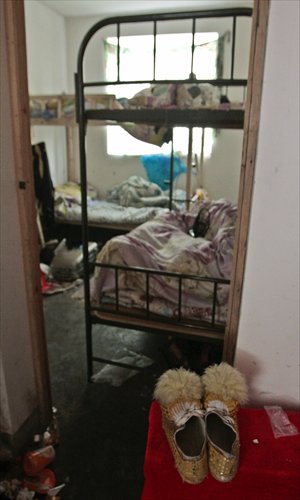
Deng Jianwen's lion dance performers live in this 80-square-meter apartment in Pudong, Shanghai. Photo: CFP
Motivating staff
"Our company is not from Guangdong, but whenever we open a new store we have a lion dance. The excitement of the show helps motivate the staff and passers-by are attracted," said Tang, a sales manager with Haier, the home appliances producer from Shandong Province. Its Shanghai office has been working with Lü's lion dance troupe for more than three years.
During the month leading up to the Spring Festival, some businesses ask for lion dances at their end-of-year parties. "We had invitations to perform for more than 50 companies in January," said Deng. In that period he and his troupe were flat out rushing to perform dances all over the city and they had no time to return to their hometowns for their own family reunions.
But the busiest time, their happiest time, does not last long. After the Lantern Festival, Deng's troupe averages seven invitations a month for the rest of the year.
"My eight employees get paid about 2,500 yuan a month. We charge 1,500 yuan for each performance. The return barely helps us make ends meet," Deng said. In his four years in Shanghai, his troupe has had to move its base four times because of soaring rents.
They have finally settled in an 80-square-meter apartment in a remote area in Pudong. The small apartment has three sets of bunks and performance props are scattered around, but Deng is happy. The property management office there allows them to put their poles in the ground to practice plum blossom pole dancing.
Though they make little money, Deng and his troupe practice every day, improving their own skills and cheering the locals who watch them rehearse.
Hard times
Unlike Deng, Lü has begun diversifying his business to survive. "We only make 20,000 yuan from lion dance performance each month, but the expenses are double that with the rent, salaries and advertising costs," Lü said.
He's now involved in theater scenery construction, providing specialist fireworks and renting wedding vehicles. These days lion dancing makes just 25 percent of his income.
To reduce costs, Lü moved to Sanlin town in Pudong, which has been anointed "China's Dragon and Lion Sports Hometown" by the country's General Administration of Sports.
"The local government gives us preferential tax discounts. We can save about 10,000 yuan a year," Lü said.
Cai Fengming, a researcher of intangible cultural relics at the Shanghai Academy of Social Sciences, said that lion dancing should be made a type of cultural heritage. "With a history of thousands of years, it is about an early form of totem worship. The aggressive animal, the lion, symbolizes a kind of power that helps protect human beings. It's now regarded as an omen that can bring money and good luck. Though not as popular as in its home cities and provinces, it has been in Shanghai for a couple of centuries," Cai told the Global Times.
Cai said that lion dances were growing in popularity with businesses, but efforts should be made to encourage ordinary people to get to know the culture and accept it as a way of entertainment that can be integrated into daily life.
"Our company is not from Guangdong, but whenever we open a new store we have a lion dance. The excitement of the show helps motivate the staff and passers-by are attracted," said Tang, a sales manager with Haier, the home appliances producer from Shandong Province. Its Shanghai office has been working with Lü's lion dance troupe for more than three years.
During the month leading up to the Spring Festival, some businesses ask for lion dances at their end-of-year parties. "We had invitations to perform for more than 50 companies in January," said Deng. In that period he and his troupe were flat out rushing to perform dances all over the city and they had no time to return to their hometowns for their own family reunions.
But the busiest time, their happiest time, does not last long. After the Lantern Festival, Deng's troupe averages seven invitations a month for the rest of the year.
"My eight employees get paid about 2,500 yuan a month. We charge 1,500 yuan for each performance. The return barely helps us make ends meet," Deng said. In his four years in Shanghai, his troupe has had to move its base four times because of soaring rents.
They have finally settled in an 80-square-meter apartment in a remote area in Pudong. The small apartment has three sets of bunks and performance props are scattered around, but Deng is happy. The property management office there allows them to put their poles in the ground to practice plum blossom pole dancing.
Though they make little money, Deng and his troupe practice every day, improving their own skills and cheering the locals who watch them rehearse.
Hard times
Unlike Deng, Lü has begun diversifying his business to survive. "We only make 20,000 yuan from lion dance performance each month, but the expenses are double that with the rent, salaries and advertising costs," Lü said.
He's now involved in theater scenery construction, providing specialist fireworks and renting wedding vehicles. These days lion dancing makes just 25 percent of his income.
To reduce costs, Lü moved to Sanlin town in Pudong, which has been anointed "China's Dragon and Lion Sports Hometown" by the country's General Administration of Sports.
"The local government gives us preferential tax discounts. We can save about 10,000 yuan a year," Lü said.
Cai Fengming, a researcher of intangible cultural relics at the Shanghai Academy of Social Sciences, said that lion dancing should be made a type of cultural heritage. "With a history of thousands of years, it is about an early form of totem worship. The aggressive animal, the lion, symbolizes a kind of power that helps protect human beings. It's now regarded as an omen that can bring money and good luck. Though not as popular as in its home cities and provinces, it has been in Shanghai for a couple of centuries," Cai told the Global Times.
Cai said that lion dances were growing in popularity with businesses, but efforts should be made to encourage ordinary people to get to know the culture and accept it as a way of entertainment that can be integrated into daily life.
The dragons also enjoy stepping out
Like lion dancing, dragon dancing also comes from Guangdong Province and dates back thousands of years. It is also a form of a traditional sport combining martial arts, dancing and drums.
Researcher Cai Fengming said that in ancient times dragon dancing was performed to pray for rains to produce a good harvest. In modern times it has lost its original meaning. "Unlike lion dancing, dragon dancing does not symbolize wealth. It is just for entertainment and this is part of the reason why it is less popular than lion dancing in Shanghai," he added.
"Although several companies have asked us to perform dragon dances this year for it is the Year of Dragon, they are still not as popular as lion dances," Lü said.
Dragon dances are often mistaken for lion dances. One way to tell the difference is that lion dances have two performers while dragon dancers need several performers, usually at least 10. One of the troupe leads the dragon along by waving a stick with a ball on it.
In lion dances you never see the performers' faces but often in dragon dances the performers can be seen as they lift the dragon's body on poles above their heads.
"More performers are needed for a dragon dance so a much larger area is required," Lü said.
The government of Sanlin town funds a professional dragon dance team which takes part in domestic and international competitions. In Sanlin town there are another 20 or so smaller dragon dance teams.
In 1994, China's General Administration of Sports set up the Chinese Dragon-Lion Association, which listed dragon and lion dances as national sports. Later Sanlin was named "China's Hometown of Dragon Dancing" by the Ministry of Culture.
Like lion dancing, dragon dancing also comes from Guangdong Province and dates back thousands of years. It is also a form of a traditional sport combining martial arts, dancing and drums.
Researcher Cai Fengming said that in ancient times dragon dancing was performed to pray for rains to produce a good harvest. In modern times it has lost its original meaning. "Unlike lion dancing, dragon dancing does not symbolize wealth. It is just for entertainment and this is part of the reason why it is less popular than lion dancing in Shanghai," he added.
"Although several companies have asked us to perform dragon dances this year for it is the Year of Dragon, they are still not as popular as lion dances," Lü said.
Dragon dances are often mistaken for lion dances. One way to tell the difference is that lion dances have two performers while dragon dancers need several performers, usually at least 10. One of the troupe leads the dragon along by waving a stick with a ball on it.
In lion dances you never see the performers' faces but often in dragon dances the performers can be seen as they lift the dragon's body on poles above their heads.
"More performers are needed for a dragon dance so a much larger area is required," Lü said.
The government of Sanlin town funds a professional dragon dance team which takes part in domestic and international competitions. In Sanlin town there are another 20 or so smaller dragon dance teams.
In 1994, China's General Administration of Sports set up the Chinese Dragon-Lion Association, which listed dragon and lion dances as national sports. Later Sanlin was named "China's Hometown of Dragon Dancing" by the Ministry of Culture.
Posted in: Metro Shanghai