HOME >> PHOTOS
The redemptive journey of a Japanese monk
Source:Globaltimes.cn Published: 2012-2-23 18:42:58
70-year-old Japanese monk Iwata Ryuzo kneels down and chants prayers for the 179 mine workers of the Liaoyuan Mine who died during Japan's occupation of Northeast China, in front of the 179 skeletons in Liaoyuan, Jilin Province on May 8, 2006. He travels to China at his own expense and prays for the victims as a means of redemption for the cruelty and crimes the Japanese army committed in China. Photo: Sina.com
Iwata Ryuzo, a Japanese monk born in 1936 in Taipei, Taiwan, worked for six years in a bank in Nagasaki after graduating from Nagasaki University with a degree in economics. He later took his tonsure and became a monk in 1981 at the age of 45. Photos: sina.com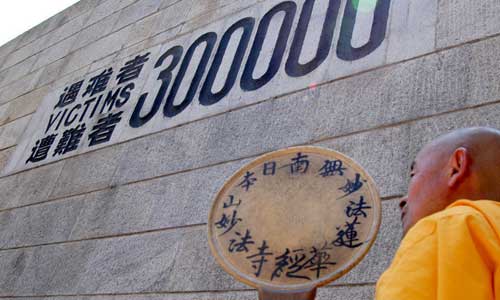
69-year-old Japanese monk Iwata Ryuzo chants prayers on August 15, 2005, for the 300,000 victims who died during the Nanjing Massacre in 1945, as a way to apologize for the crimes the Japanese army committed in China. Photo: Sina.com
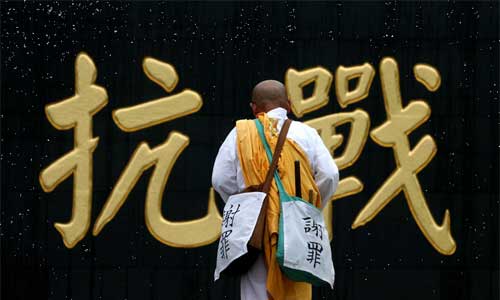
Iwata Ryuzo travels to Wuhan Jiufeng Anti-Japanese Martyr Cemetery on April 25, 2006, to show his resolution to redeem the crimes Japan inflicted on China during the war.
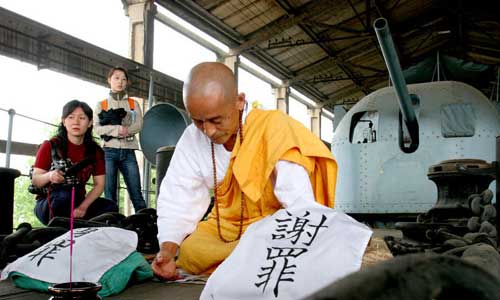
Iwata Ryuzo travels to the Wuhan Zhongshan Warship on April 25, 2006, to show his resolution to redeem the crimes Japan inflicted on China during the war.
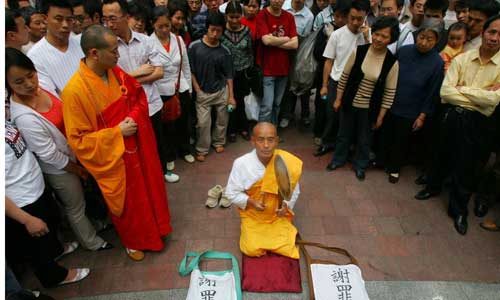

Iwata Ryuzo chants prayers at the Chongqing Jiefangbei in Yuzhong district on April 28, 2006, to show his resolution to redeem the crimes Japan inflicted on China during the war.
Iwata Ryuzo chants prayers at a mass grave in Luoyang, Henan Province on May 2, 2006, to show his resolution to redeem the crimes Japan inflicted on China during the war.
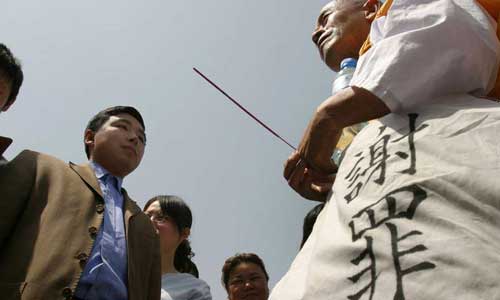


Iwata stays in Changchun for four days upon his arrival on May 7, 2006. He will fast for three days to show his resolution to redeem the crimes Japan inflicted on China during the war.
Iwata chants at the mass grave at the Fengman Labor Memorial in Jilin, Jilin Province on May 8, 2006.
==========
==========

Iwata bows before the dead Chinese laborers in Harbin on the morning of May 11, 2006.
Iwata talks with Jiang Li, the author of Guandong Massacre: The Cruelty of Japan in Northeast China on May 15, 2006.

Iwata visits Lugou Bridge on May 28, 2010 in an effort to redeem the atrocities the Japanese army inflicted on the Chinese.

75-year-old Iwata visits the 9`18 History Museum and bows before the deceased five times before chanting prayers on April 27, 2011.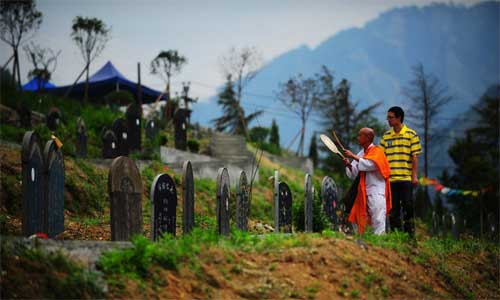
75-year-old Iwata visits the 9`18 History Museum and bows before the deceased five times before chanting prayers on April 27, 2011.
75-year-old Iwata visits the mass graves in Yingxiu, Wenchuan county, Sichuan Province to pray for the victims of the Wenchuan earthquake in 2008. He beat the drum with Buddhist scriptures, wearing two cloth bags with the word Apology written over his shoulders.
Posted in: China