HOME >> ARTS, METRO SHANGHAI
Whiter than white
By Hu Bei Source:Global Times Published: 2012-3-13 18:48:39
Against a white backdrop sits a white display platform featuring a white exhibit. Art shows don't come much whiter than this, and the artist involved, Kenya Hara, admits that, for him, white is not simply a color but also a design concept.
The 54-year-old Japanese graphic designer has enjoyed a successful international career, lauded for his sensitivity and awareness in making use of Japanese culture and aesthetics. Since 2001, he has also held the post of art director at the Japanese chain store Muji, where his design concepts have helped the company become an industry leader in creative retailing.
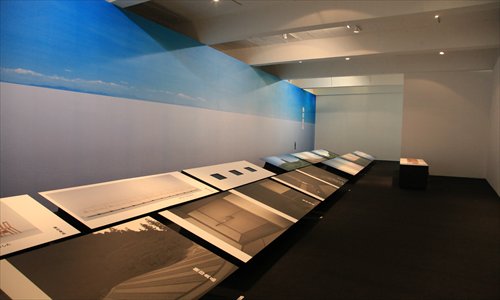
Design works by Kenya Hara on show at the exhibition. Photos: Courtesy of the art space
Multimedia
After exhibiting in Beijing last year, Hara is now presenting the same show in Shanghai which will run until April 10.
Hara's design works cover various genres, including posters, packaging, signage, brochures and corporate branding. All of these are rooted in traditional Japanese culture, and the exhibition includes 59 "products," 51 design works and three video works.
The exhibition takes place at Zendai Contemporary Art Space.
From 2001 to 2003, Hara carried out an overhaul of the Matsuya Department Store in Tokyo's Ginza district - everything from the building's exterior and interior spaces to the wrapping paper, shopping bags and advertising. And everything Hara worked on was unified by the color white.
"My goal in this renovation was to reconstruct the store as a tangible medium by incorporating materiality into every aspect of the design, and to allow for a rich stimulation of the sense of touch, so that visitors could experience the texture of space," said Hara.
In 1998, Hara designed the signage system used at the Umeda Hospital on the Japanese island of Honshu in Yamaguchi Prefecture. All the signs are made in washable white cotton with small red Japanese characters printed on the surface.
"The Umeda Hospital is a specialty hospital for obstetrics and pediatrics, and I used the white cotton because mothers and visitors would appreciate the connotations of comfort and cleanliness. It is the same principle that applies when a top-class restaurant uses bright white linen tablecloths to impress customers," he added.
After exhibiting in Beijing last year, Hara is now presenting the same show in Shanghai which will run until April 10.
Hara's design works cover various genres, including posters, packaging, signage, brochures and corporate branding. All of these are rooted in traditional Japanese culture, and the exhibition includes 59 "products," 51 design works and three video works.
The exhibition takes place at Zendai Contemporary Art Space.
From 2001 to 2003, Hara carried out an overhaul of the Matsuya Department Store in Tokyo's Ginza district - everything from the building's exterior and interior spaces to the wrapping paper, shopping bags and advertising. And everything Hara worked on was unified by the color white.
"My goal in this renovation was to reconstruct the store as a tangible medium by incorporating materiality into every aspect of the design, and to allow for a rich stimulation of the sense of touch, so that visitors could experience the texture of space," said Hara.
In 1998, Hara designed the signage system used at the Umeda Hospital on the Japanese island of Honshu in Yamaguchi Prefecture. All the signs are made in washable white cotton with small red Japanese characters printed on the surface.
"The Umeda Hospital is a specialty hospital for obstetrics and pediatrics, and I used the white cotton because mothers and visitors would appreciate the connotations of comfort and cleanliness. It is the same principle that applies when a top-class restaurant uses bright white linen tablecloths to impress customers," he added.
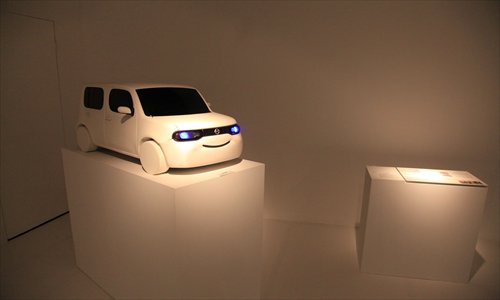
Design works by Kenya Hara on show at the exhibition.
Snow and ice
The program brochure for the opening ceremony of the Nagano Winter Olympic Games in 1998 was also designed by Hara. The white program cover and its texture evoked the feeling of snow and ice. The center of the front cover of the brochure featured the imprint of a brilliant red flame in lustrous foil.
According to Hara, white is not only a color, but also the absence of color, or an empty color. It has ready associations with the Japanese flag which resembles the logo of the Red Cross on a white background.
He claims that these red images appear all the more powerful when surrounded by pure white. The color white is actually closely related to the origin of all Japanese aesthetics, and it symbolizes "emptiness," "simplicity" and "subtlety."
Emptiness and simplicity also define Hara's core understanding of Japanese culture and aesthetics. He compares design work to an empty container. "Also the cross or circle on a white background looks like an empty container, permitting every signification and not limiting the imagination. The Japanese written character for 'white' actually forms a radical of the character for 'emptiness,'" he added.
The program brochure for the opening ceremony of the Nagano Winter Olympic Games in 1998 was also designed by Hara. The white program cover and its texture evoked the feeling of snow and ice. The center of the front cover of the brochure featured the imprint of a brilliant red flame in lustrous foil.
According to Hara, white is not only a color, but also the absence of color, or an empty color. It has ready associations with the Japanese flag which resembles the logo of the Red Cross on a white background.
He claims that these red images appear all the more powerful when surrounded by pure white. The color white is actually closely related to the origin of all Japanese aesthetics, and it symbolizes "emptiness," "simplicity" and "subtlety."
Emptiness and simplicity also define Hara's core understanding of Japanese culture and aesthetics. He compares design work to an empty container. "Also the cross or circle on a white background looks like an empty container, permitting every signification and not limiting the imagination. The Japanese written character for 'white' actually forms a radical of the character for 'emptiness,'" he added.
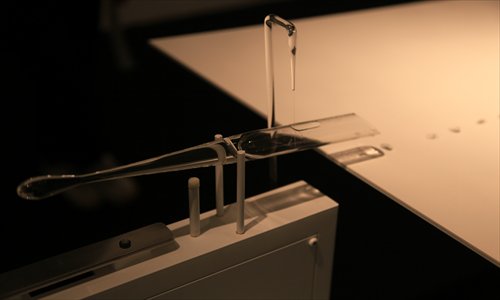
Design works by Kenya Hara on show at the exhibition.
Oriental culture
One exhibit is an adapted pinball machine containing a symbolic map of Eurasia.
"In history, many foreign civilizations, including Rome, India, China and Russia, arrived in Japan via various channels. However, after the Onin War (a civil war in Japan from 1467 to 1477), most of the imported aspects of Japanese civilization were destroyed and this was when Japanese society changed a lot. It was an opportunity for us to return back, to restart again with our own original culture," Hara said. "Of course, it was still influenced by Chan (Zen) Buddhism, which is deeply rooted in the whole of oriental culture," he added.
In addition, the Chinese curator, Zhu E, who was also behind bringing Hara to China in the first place, told the Global Times that among the current Japanese designers, Hara is someone who is keen to emphasize the differences between an artist and a designer.
"Although designing work is also about imagination, Hara never involved himself in the world of personal imagery. Rather, he is good at exploring the possibilities of transforming designs into workable products," Zhu said.
The exhibition also highlights a series of Hara's design works which are inspired by hi-tech and environmental-friendly materials.
Hara told the Global Times that, "if comparing design to a tree, the grass roots culture is like the soil. And making the tree produce fruit is the same as transforming a design into a mode of production. The key point is the soil, and how to cultivate that soil."
One exhibit is an adapted pinball machine containing a symbolic map of Eurasia.
"In history, many foreign civilizations, including Rome, India, China and Russia, arrived in Japan via various channels. However, after the Onin War (a civil war in Japan from 1467 to 1477), most of the imported aspects of Japanese civilization were destroyed and this was when Japanese society changed a lot. It was an opportunity for us to return back, to restart again with our own original culture," Hara said. "Of course, it was still influenced by Chan (Zen) Buddhism, which is deeply rooted in the whole of oriental culture," he added.
In addition, the Chinese curator, Zhu E, who was also behind bringing Hara to China in the first place, told the Global Times that among the current Japanese designers, Hara is someone who is keen to emphasize the differences between an artist and a designer.
"Although designing work is also about imagination, Hara never involved himself in the world of personal imagery. Rather, he is good at exploring the possibilities of transforming designs into workable products," Zhu said.
The exhibition also highlights a series of Hara's design works which are inspired by hi-tech and environmental-friendly materials.
Hara told the Global Times that, "if comparing design to a tree, the grass roots culture is like the soil. And making the tree produce fruit is the same as transforming a design into a mode of production. The key point is the soil, and how to cultivate that soil."
Date: Until April 10, 10 am to 6 pm
Venue: Zendai Contemporary Art Space上海证大现代艺术馆
Address: 1436 Jungong Road 军工路1436号
Tickets: 70 yuan
Call 3512-0988 for details
Address: 1436 Jungong Road 军工路1436号
Tickets: 70 yuan
Call 3512-0988 for details
Posted in: ARTS, Metro Shanghai