HOME >> LIFE, METRO SHANGHAI
The street with two names
By Sun Shuangjie Source:Global Times Published: 2012-3-25 18:53:34
Ancient-style architecture along Shanghai Old Street. Photo: Sun Shuangjie/GT
According to city archives, Fangbang Road was one of Shanghai's very first commercial hubs and witnessing the establishment of dozens of famous brands, ranging from traditional Chinese medicine (TCM) vendors and tea houses, to jewelers, banks and hotels.
Boasting a 700-year history, the eastern section of Fangbang Road was entirely renovated and turned into a tourist destination in 1999. This section is now commonly known as "Shanghai Old Street," while the rest of the thoroughfare is still called Fangbang Road Middle.
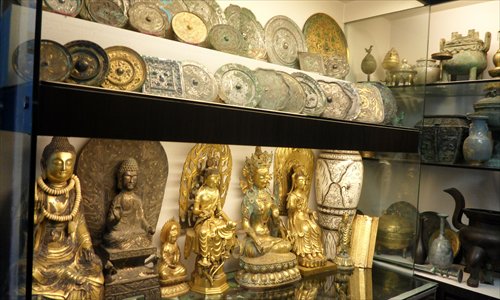
Items on sale at Cang Bao Lou. Photo: Sun Shuangjie/GT
Essence of tradition
The street's buildings boast many different architectural styles from the Ming Dynasty (1368-1644) and Qing Dynasty (1644-1911). Among the most notable architectural features are dark green tiles, white walls, raised cornices and red columns. Buildings constructed during the early period of the Republic of China (1912-1949) are characterized by lattice windows and removable wooden doors.
Built in the Ming Dynasty, the 600-year-old City God Temple on Fangbang Road Middle has recaptured its glory in recent years, after suffering grievously during the chaos of the Cultural Revolution (1966-76) when the statues of gods and goddesses were destroyed and all sacrificial ceremonies were stopped. The City God Temple has nine halls in honor of gods and heroes such as Huo Guang, a famous general of the Han Dynasty (206BC-220AD) who protected local people from Japanese pirates, and Guan Yunchang, a famous general of the Three Kingdoms Period (220-280) who is now honored as an important martial protector of businesses and financial affairs.
The 200-year-old pharmacy Tong Han Chun Tang stands at the eastern tip of Shanghai Old Street, on the corner of Renmin Road (1 Renmin Road). Inside are rows of ancient Chinese medicine cabinets and carved mahogany desks. Many years ago Tong Han Chun Tang mainly sold various kinds of medicinal liqueurs and herbal treatments, but today it trades in, not only TCM but also some Western medicines. Its "winter tonic" has long been a popular choice for staying healthy among local white-collar workers.
Less than 100 meters away from Tong Han Chun Tang to the west stands another famous TCM clinic, Ming Yi Tang (59 Fangbang Road Middle) which employs more than 40 eminent Chinese medicine doctors and is open every Monday to Saturday from 7:45 am to 3 pm.
The street's buildings boast many different architectural styles from the Ming Dynasty (1368-1644) and Qing Dynasty (1644-1911). Among the most notable architectural features are dark green tiles, white walls, raised cornices and red columns. Buildings constructed during the early period of the Republic of China (1912-1949) are characterized by lattice windows and removable wooden doors.
Built in the Ming Dynasty, the 600-year-old City God Temple on Fangbang Road Middle has recaptured its glory in recent years, after suffering grievously during the chaos of the Cultural Revolution (1966-76) when the statues of gods and goddesses were destroyed and all sacrificial ceremonies were stopped. The City God Temple has nine halls in honor of gods and heroes such as Huo Guang, a famous general of the Han Dynasty (206BC-220AD) who protected local people from Japanese pirates, and Guan Yunchang, a famous general of the Three Kingdoms Period (220-280) who is now honored as an important martial protector of businesses and financial affairs.
The 200-year-old pharmacy Tong Han Chun Tang stands at the eastern tip of Shanghai Old Street, on the corner of Renmin Road (1 Renmin Road). Inside are rows of ancient Chinese medicine cabinets and carved mahogany desks. Many years ago Tong Han Chun Tang mainly sold various kinds of medicinal liqueurs and herbal treatments, but today it trades in, not only TCM but also some Western medicines. Its "winter tonic" has long been a popular choice for staying healthy among local white-collar workers.
Less than 100 meters away from Tong Han Chun Tang to the west stands another famous TCM clinic, Ming Yi Tang (59 Fangbang Road Middle) which employs more than 40 eminent Chinese medicine doctors and is open every Monday to Saturday from 7:45 am to 3 pm.
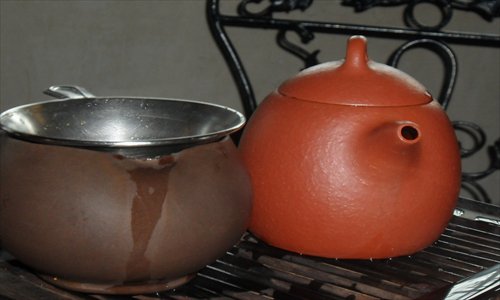
Tea wares in the Old Shanghai Teahouse. Photo: Sun Shuangjie/GT
Handicraft vendors
At the west end of Shanghai Old Street are dozens of small shops, dealing in various aspects of Chinese culture and history such as porcelain, picture books, antique door handles, small round mirrors with elegant decorations.
Cang Bao Lou (457 Fangbang Road Middle) is a seven-story building which is home to hundreds of small handicraft vendors. While stores on the three bottom floors do business daily, those on the fourth to sixth floor are only open from Thursday to Sunday, dealing in jade items for the first two days, and accessories in the latter two days.
"I like it here so much," said Vera Yang, a local college student, buying a 30-yuan pair of porcelain cups on the day the Global Times visited. "If you are a good bargainer, you can make brilliant deals."
Beside the compact and crowded antique stores, tea houses along Shanghai Old Street constitute another hotspot for tourists as well as locals.
The Old Shanghai Teahouse is a quaint destination, located on the second floor of 385 Fangbang Road Middle. The waitstaff here are mostly in their 60s, and are happy to answer questions (in fluent English) posed by tourists. Tourists can admire the teahouse owner's own collection of tea-related exhibits on display in the shop. The shop has a notebook in which visitors can leave their impressions of the place.
At the west end of Shanghai Old Street are dozens of small shops, dealing in various aspects of Chinese culture and history such as porcelain, picture books, antique door handles, small round mirrors with elegant decorations.
Cang Bao Lou (457 Fangbang Road Middle) is a seven-story building which is home to hundreds of small handicraft vendors. While stores on the three bottom floors do business daily, those on the fourth to sixth floor are only open from Thursday to Sunday, dealing in jade items for the first two days, and accessories in the latter two days.
"I like it here so much," said Vera Yang, a local college student, buying a 30-yuan pair of porcelain cups on the day the Global Times visited. "If you are a good bargainer, you can make brilliant deals."
Beside the compact and crowded antique stores, tea houses along Shanghai Old Street constitute another hotspot for tourists as well as locals.
The Old Shanghai Teahouse is a quaint destination, located on the second floor of 385 Fangbang Road Middle. The waitstaff here are mostly in their 60s, and are happy to answer questions (in fluent English) posed by tourists. Tourists can admire the teahouse owner's own collection of tea-related exhibits on display in the shop. The shop has a notebook in which visitors can leave their impressions of the place.
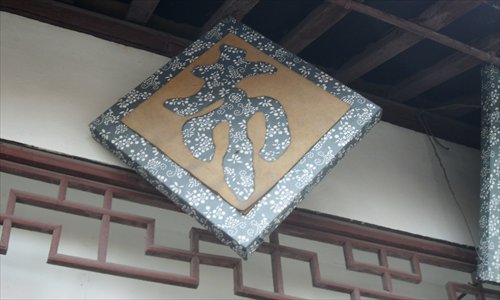
A typical Chinese sign outside a cloth store in Shanghai Old Street. Photo: Sun Shuangjie/GT
Longtang culture
Along the more-than-800-meter stretch of Shanghai Old Street, there are several crossroads that lead to another aspect of Shanghai history, that of typical longtang (lane) culture.
Turning onto Mayuan Road, tourists encounter a typical example: rows of compact buildings, usually two or three stories, on both sides of the narrow road and in which there are often several families sharing one yard. These are perfect places for neighbors to chat, gossip and while away the afternoon hours.
The abundance of washing, hanging from bamboo poles, is jokingly referred to by locals as "the national flags of hundreds of countries" due to their multiple colors and shapes.
Sipailou Road is another intersecting road with Shanghai Old Street, on which there are many booths selling dozens of snacks, such as toasted squid, small steamed buns, and sautéed rice noodles and sauced bran dough.
Along the more-than-800-meter stretch of Shanghai Old Street, there are several crossroads that lead to another aspect of Shanghai history, that of typical longtang (lane) culture.
Turning onto Mayuan Road, tourists encounter a typical example: rows of compact buildings, usually two or three stories, on both sides of the narrow road and in which there are often several families sharing one yard. These are perfect places for neighbors to chat, gossip and while away the afternoon hours.
The abundance of washing, hanging from bamboo poles, is jokingly referred to by locals as "the national flags of hundreds of countries" due to their multiple colors and shapes.
Sipailou Road is another intersecting road with Shanghai Old Street, on which there are many booths selling dozens of snacks, such as toasted squid, small steamed buns, and sautéed rice noodles and sauced bran dough.
Posted in: Adventures, Metro Shanghai