Antique production lines
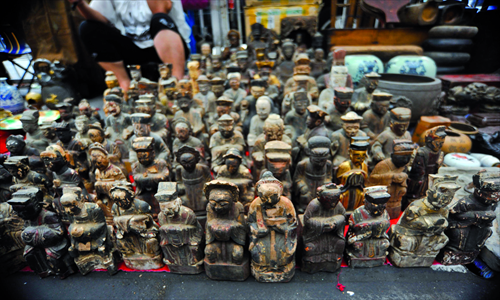
Fraud permeates relics industry in China
It's a familiar experience for many antique lovers. You find a piece you've long been searching for in some dusty warehouse or backstreet market, and your heart leaps. But after close examination, the priceless relic turns out to be just another forgery. Fake relics go back as far as the Song Dynasty (960-1279) when enterprising craftsmen would churn out "ancient" bronzes for an already-burgeoning antique market.
Today, according to a recent report from artron.com, one of China's leading professional art websites, the production of fake antiques has matured into a full-scale industry. Starting from ordinary workers turning out the fakes, to professional craftsmen who add touches of "authenticity" and crooked dealers who sell them on to auction houses or collectors, forgery has become a mature production line.
Regional specialties
Certain regions specialize in particular types of fakes, often the same locations where the authentic relics were once produced. For instance, the city of Jingdezhen, Jiangxi Province, which has a long history of making pottery and porcelain, has a thriving industry in faking the same relics.
There are over 4,000 pottery and porcelain enterprises in the area, employing more than 100,000 people, nearly a sixth of the local population. The factories not only produce some high-end fake antiques, but are also capable of mass production of ordinary counterfeits, said Ms Wang, one of the researchers of the artron.com report, who would only give her family name. "Many pieces of 'antique porcelain' we see in Beijing's various markets are made there," she told the Global Times.
Such scenes aren't strange to Beijing's collectors; at the Panjiayuan Antique Market, fake jade articles, as well as porcelain, are common. Peddlers claim their products come from the famous jade-making workshops, or are antiques.
"Most of those jade articles in Beijing's antique markets are from Zhenping county in Henan Province and Bengbu in Anhui Province," Wang said. Tens of thousands of local residents in Zhenping make a living by producing jade articles, while Bengbu has more than 100,000 people working in 3,000 jade factories, about 12.5 percent of the population. Each year the jade industry contributes about 16.7 percent of the local GDP. Wang noted that the cities of Tianjin and Nanjing, as well as Anhui Province, are popular places for producing counterfeit paintings while Yanjian village in Henan Province is widely famed for its bronzes. "Yanjian produces over 1,000 varieties of bronzes and some of those are very high-end, exported to southeast Asia, the US, France and other European countries," Wang said. Investment rush According to the Beijing-based China Association of Collectors, there are about 100 million collectors in China. In the view of Deng Haijian, a columnist on current affairs, due to Chinese people's huge savings, amounting to 35.2 trillion yuan ($5.59 trillion) in 2011, but limited investment channels, many people have turned to art collecting. "This is one of the reasons why the fake antique production has become an entire industry," Deng said, citing the huge consumer base. Most people in this chain are exploited, save for mid-level dealers, said Wu Shu, a cultural scholar and the author of the China Cultural Relics Black Book, a three-volume work about the protection of relics. "However, the biggest victims are still the final collectors," Wu said. Wu noted that the auction law in China stipulates that auction houses are exempt from legal responsibility, if they declare that they are not responsible for any problems concerning the antiques before the auction. At the beginning of 2011, a Han Dynasty (206 BC-220 AD) jade stool was auctioned for 220 million yuan in Beijing. But this February, the piece was revealed to be a high-end replica made by local craftsman in 2010. Zhao Jun, a jade workshop owner in Pizhou, Jiangsu Province, confirmed the piece was made by his workers and then sold to a buyer from Hebei Province at the price of 2.6 million yuan. "We spent a year on this stool, I don't know how it turned into a Han Dynasty antique at such a sky-high price!" Zhao told Chinanews.com. In some foreign countries with a more mature art market, if collectors buy a fake antique at an auction house, they will be refunded their full payment, said Li Yanjun, vice president of the Art Ware Appraisal Committee. Legal loopholes Despite the rampant fake antique business, Wu stated that not all those products are fraudulent. According to him, some local governments have drawn up polices to boost local cultural development, but these were misused by some people as cover for making antique counterfeits. For example, he said, the local government of Bengbu established some preferential polices for jade production, but this simply made life easier for crooked dealers. They bought jade articles from local producers on the cheap, but then sold them to less experienced art collectors for inflated prices, claiming they were genuine relics. Forged antiques are only covered by the consumer rights law, for small sums, and the criminal law. But neither of the laws specifically covers fake antiques, and fraud is so rampant that cases are rarely reported. "We don't have a sound legal system to regulate those dealers in fakes," Wu said. He stated that fraud was prevalent in almost every link of this industry, but that society could do little against it, since there was no legal foundation. "We now have the law on protection of cultural relics but it is meant to fight against damage or loss of authentic antiques, not to weed out fake ones," Wu said.