Martial operas fight for life
This classic Peking Opera, Wu Song Fights the Tiger, is based on the story of Wu Song, a fictional character from The Water Margin, one of the four great classic novels of traditional Chinese literature.
Fighting fit
In Peking Opera, this style of play has a specific name, wuxi or "martial arts" or "fighting play." This type of play mainly focuses on showing the physical skills of Peking Opera actors, including their gestures, movements and martial arts skills. Singing and dialogue are usually kept to a minimum. Also in Peking Opera are wenxi or "civilian plays," which mainly emphasize singing, speech and elegant costumes. The stories featured in examples of wenxi usually revolve around famous romances from Chinese history.
The actors in the martial arts plays are called wusheng. And the stories are usually based on China's historical wars and battles and related literary works such as The Water Margin and The Romance of the Three Kingdoms.
Last Saturday, a series of classic Peking Opera martial arts plays were staged at the Shanghai Oriental Art Center, performed by senior actors such as Pei Yanling, 65, and several of her "disciples," the young wusheng from the Hebei Peking Opera Troupe.
Wu Song Fights the Tiger was also part of the program, and is famous as a signature work of Pei. Other pieces for which she is known include Pick Pulley, (the story of how Yue Fei, a famous military general in the Southern Song Dynasty (1127-1279) fought against northern invaders), and At the White Beach (about a group of righteous heroes during the Ming Dynasty (1368-1644) who fought against the emperor's armies).

Pei told the Global Times that "the core of martial arts plays in Peking Opera is neither in the 'martial arts,' nor in the 'play,' but rather in a specific combination of both. Every gesture and every movement of the actors on the stage must be demonstrated through their acting abilities."
After Shanghai, the show will tour other Chinese cities, including Guangzhou, Shenzhen and Tianjin.
Pei said that the main reason she organized this presentation of martial arts plays of Peking Opera is because she realized that such plays, and the actors in these plays, have been largely ignored of late, both by people in the industry and typical Peking Opera audiences.
"And also many martial arts players of Peking Opera are not paying attention to the shape and creation of their characters, but are simply concentrating on the physical moves. But they should know that the audience has not simply come to see a martial arts demonstration or an acrobatics show."
Pei told the Global Times that another problem is the directors. "Today, many modern drama directors, even film directors who know little about Peking Opera, are trying their hand at directing Peking Opera, both civilian and martial arts plays. And yet they even don't know how to arrange the actors on a stage in the correct way."
Pei herself began to learn martial arts in Peking Opera when she was only 5 years old and she still insists on practicing her skills for about an hour a day. At the same time, she likes to read lots of original play scripts for traditional Peking Opera and to find her own way of interpreting them.
Her acting of Wu Song in Wu Song Fights the Tiger has been strongly praised by Peking Opera fans and her interpretation is generally referred to as an "intellect-styled Wu Song" because of her elegant and refined role playing. What is perhaps surprising is that Pei only first essayed the role of Wu Song when she was in her 50s.
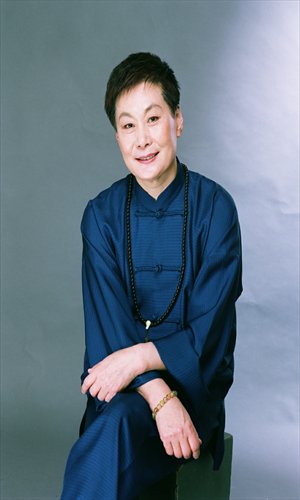
Pei Yanling. Photo: Courtesy of Shanghai Oriental Art Center
Two of Pei's protégés, Feng Fei and Xie Han, who also performed in Shanghai, are both in their 20s, and they first began to be coached by Pei when they were teenagers. "And even before that, they had been practicing the basic skills for six years. Unlike in the civilian plays, actors in the martial arts plays usually have to be trained professionally from childhood," Pei said.
Sun Chongliang, the director of the Shanghai Peking Opera Troupe said: "Today, fewer and fewer young Peking Opera actors are willing to work at learning martial arts performance skills in the first place, let alone realize that 'practice makes perfect.' Also, very few new Peking Opera plays are tailor-made for martial arts actors."
Zhou Long, the deputy director of the National Academy of Chinese Theater Arts agreed: "The martial arts plays are a very important part of Peking Opera, and their loss will make this traditional Chinese art incomplete," he said.