Shanghai's scruffy secret
Hovels and makeshift houses clutter Gaojiabang, which is home to 40,000 residents, mostly migrant workers. Photo: Cai Xianmin/GT
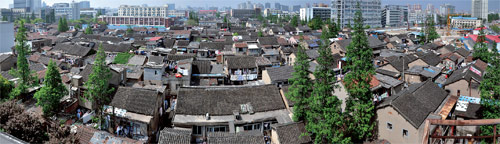
In the middle of Shanghai, one of the world's largest ultramodern cities, there's a secret. Most citizens have never heard of it and very few have visited it. But tucked away in the middle of the downtown area of Shanghai is a village of ramshackle buildings that is home to 40,000 migrant workers.
Zhang Qiang, one such worker, cycles from his job every night and gets off his bike in a dark alley off Caobao Road in Xuhui district. He pushes his bike along the alley and into Gaojiabang, his home. Gaojiabang is a 60,000-square-meter block of shanty homes, tumbledown buildings and makeshift apartments bounded by Caobao Road, Tianlin Road, Cangwu Road and Guilin Road. It is just a 15-minute drive to one of the city's most prosperous commercial centers, Xujiahui. This is one of the poorest parts of the city.
Just 2,000 of the 40,000 residents of Gaojiabang have a Shanghai hukou. Most of the people who live here are workers from provinces like Anhui, Henan, Fujian and Hubei. It is probably the last urban village of its type in Shanghai.
Zhang Qiang lives on the north side of Gaojiabang. He and his family and nine other adults share three rooms on the second floor of a two-story building. Zhang's house is considered one of the better apartments in the village. Sometimes on a fine day a tiny ray of sunshine will appear in the bedroom.
Zhang has lived in Gaojiabang for two years. He came to Shanghai from his hometown in Wuhu, Anhui Province, dreaming of making money. A friend arranged him temporary accommodation in a makeshift home in Gaojiabang. Six months later, after he found himself a job at an electronics factory in the nearby Caohejing New Technology Development Zone, his wife and son joined him. Then, one by one, other hometown workers arrived.
"This room is alright. Our first home was terrible. There were no windows, it was made of wood with thin walls and you could hear everything the neighbors did. When my neighbors cooked, the smoke from the fire would make us all cough," Zhang said.
For his new home, the one room with a window, Zhang pays 500 yuan ($79.29) a month, the best deal he could find in Gaojiabang. He is now also renting two neighboring rooms for the friends and relatives who have joined him in Shanghai.
"We come from villages in the rural areas of China. We are no longer villagers but nor are we citizens of Shanghai," Zhang said.
He enjoys a simple life with simple prices. He pays 5 yuan for a bowl of noodles, 0.30 yuan for a bottle of hot water, 3 yuan for a shower at a public bath house (9 yuan in winter).
Though he and his family have lived in Gaojiabang for two years, they have not visited any of the scenic spots of the city. Not even Guilin Park, just across from Caobao Road and famed for its traditional gardens and osmanthus blooms. They have not been to the cinema on Tianlin Road but occasionally they visit the Walmart supermarket a block away.
"Everything we need we can find in Gaojiabang. This is our world but a world only for people like us," Zhang said. "When night falls, you can hear the traffic on Guilin Road and there is enough light for me to read a newspaper. People say Shanghai has changed a lot. After living here my life hasn't changed," Zhang's wife, Chen, said.
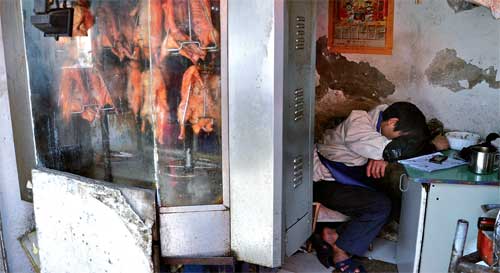
Village life
Gaojiabang is another world totally unlike its towering modern surroundings. It's a rubble of low-storied buildings, a smelly dirty place with garbage strewn about. It doesn't look like the picture postcard Shanghai that most recognize.
A long time ago Gaojiabang was a country village - actually two villages, Gaojiabang in the south and Qiaojiatang in the north.
"There were no shops or streets here 50 years ago. It was all farmland and few people lived here," said Ma Xiuyu, a resident who has lived here for more than 50 years. Ma now works with the Gaojiabang neighborhood committee.
In 1973 Shanghai authorities started to appropriate farmland in the area to build factories manufacturing scientific instruments, radios and chemicals.
Most of the young people in Gaojiabang went to work in the factories in the 1980s and that was the period when the first migrant workers arrived.
"I remember that the first group of people who came to Gaojiabang came from Anhui Province. That was 1985 when I opened this grocery store, the first one in Gaojiabang," said Shen Huifen, one of the few Shanghainese still living in Gaojiabang.
The farmers and the original residents of Gaojiabang were granted houses from the government as compensation for losing their properties and they began to rent spare room to the new people.
As the area developed rapidly most of the factories were demolished in the 1990s and replaced by banks, restaurants and offices. Nearby Tianlin area became a busy commercial center and more outsiders arrived to seek their fortune in various ways. Most of the locals moved out of Gaojiabang to the nearby newly built residential compounds and rented their old homes to the newcomers. Today 90 percent of the residents are migrant workers.
Gaojiabang, the village in the city, boasts restaurants, fruit shops, barbers, dress shops, Internet cafés, wet markets and medical clinics. "We offer people who have just arrived in Shanghai a place to stay at affordable prices. There is a constant supply and demand for rooms here in Gaojiabang and that's why more people come," Ma said.
But things are changing for this hidden village. In 2010 several residential compounds near Gaojiabang were demolished for the construction of metro Line 12 and redevelopment. "It is said Gaojiabang will be demolished later this year. It really is the last of the city's villages," Ma said.
Ma said that the Gaojiabang residents who had Shanghai hukou would be relocated in new residential compounds in the suburban Minhang and Songjiang districts. "That's not a difficult thing because few locals are still living here. The real problem is for the migrant workers who live here. Where will they go? "
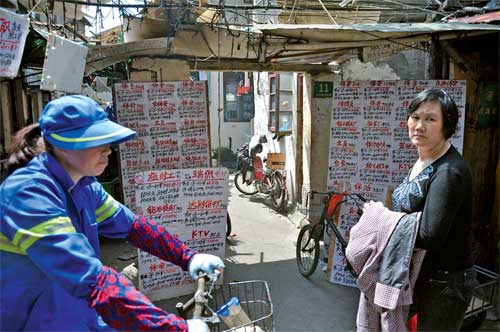
Beyond imagination
Chen Yanan is a member of a research team from the East China University of Political Science and Law who conducted a survey in Gaojiabang last summer as a social practice project. "We couldn't believe there was still a place like this in Shanghai today and we couldn't understand how people could still live here," he said.
The survey of 299 residents in Gaojiabang detailed the population structure, economic status, living conditions and attitudes to the possible redevelopment of the area.
The survey found that the average living space for a person in Gaojiabang was between 6 and 9 square meters and living facilities were appalling. Very few houses had toilets and running water. The average rent for a room was 450 yuan and 60 percent of the residents said they did not like living there, most blaming the lack of security and hygiene as the major reasons for dissatisfaction.
Half of the families surveyed earned less than 3,000 yuan a month. Few of the people living there are living on their own - most have families. After paying rent and daily living expenses there was little money left over for anyone.
The most popular form of entertainment for Gaojiabang residents was talking with their hometown friends. Few had set plans for the future. Most said they just wanted to make money.
When asked about the demolition plans, 73 percent of those surveyed said they were worried about how this would affect their lives and how they would find another affordable home or another job.
If everyone who comes to live in Gaojiabang comes for a different reason, they all have a common goal. They want to live a better life someday. The survey noted that even if Gaojiabang was hidden behind the glossy skyscrapers, the dreams and ambitions of the people who lived there should not be forgotten.
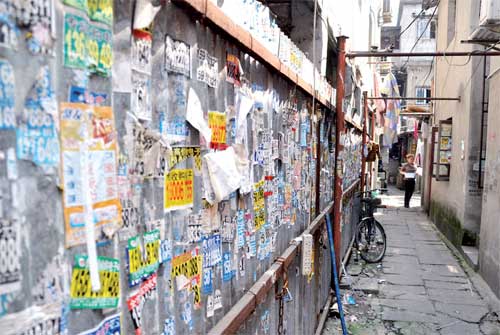
A natural process
According to the sixth national census, 8 million of the 23 million people living in Shanghai are outsiders. With the number of people coming to work here and the speed of the city's development, it was natural that areas like Gaojiabang sprang up.
"With society changing so much and in so many ways, it was to be expected that these urban villages would come about. The thing is how to manage, guide and eventually rebuild those places instead of simply demolishing them," said Su Zhiliang, the director of the School of Humanities at Shanghai Normal University.
An urban culture expert, Su said the concept of the urban village in Shanghai actually came from Shanghai's shanty towns which appeared along Suzhou Creek last century when many of the factory workers who worked there could not afford proper housing but constructed makeshift shelters.
After 1949 most of these shanty towns were demolished and redeveloped into modern residential compounds. The Shanghai Cosco 2 Bay project in Putuo district is a good example.
After that very few shanty towns remained in Shanghai and those that were surrounded by skyscrapers and modern buildings. Most of the inhabitants are low-income workers.
"These places were like ghettos in Shanghai. They might not be good places in many ways but it would be worse not to give these people somewhere to live," Su said.
"It's a tough issue that every city faces. The way we deal with these people will be a real test for Shanghai to show its quality," Su said.