Voices from the wilderness
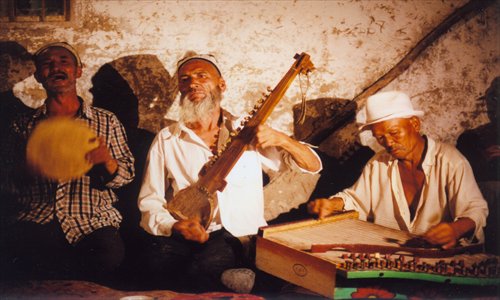
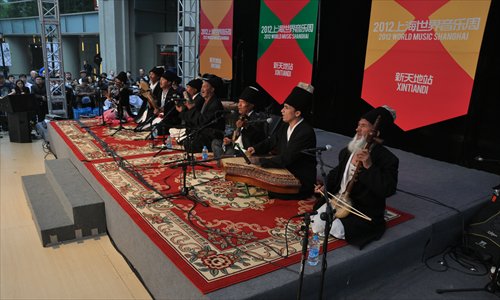
Capacious, exotic voices were bursting forth from Xintiandi on Tuesday afternoon. These were voices that had traveled more than 4,000 kilometers to be in Shanghai, and which sang of a culture that boasts more than 1,500 years of history and culture.
The men behind these voices are an ensemble of eight, mostly in their 60s, and all dressed in dark kaftans with high brown hats and black boots.
They appeared on a makeshift stage in Xintiandi, also playing instruments from their native Xinjiang Uygur Autonomous Region. From time to time, a young girl in a colorful outfit stood among them, performing a spinning dance like a whirling dervish.
The occasion was World Music Shanghai 2012 and these performers are all village musicians and dancers from Maigaiti county, in Xinjiang. They call themselves "Soul of Dolan" because they are all Dolan people, a semi-nomadic group of the Uyghur ethnic minority in Xinjiang.
Hunters and farmers
The ancestors of the present Dolan people lived as hunters and farmers on the edge of the Taklimakan Desert which is also close to the Yarkant River and Tarim River in the southern part of today's Xinjiang.
"It was believed that Dolan Muqam - the Dolan's performing culture - exists from that time," Osman Sedik told the Global Times. At the age of 66, Sedik is the oldest member of the group.
"Almost all of our people, from children to the elderly, are able to perform Dolan Muqam," said Sedik. "We perform it at any time in any place when we are not working the land, especially when we have a 'maxrap.'"
Maxrap, Sedik explained, is a party held on special occasions such as weddings, visits from outsiders and harvest celebrations. A typical maxrap will include music, dance and games. "Of course, the essential performance of a Dolan maxrap is just Dolan Muqam, whose lyrics are mainly about love, the harvest and nostalgia."
Sedik added that: "During a maxrap, people have the chance to mix with their peers and become acquainted with potential relationship partners which may lead to marriage."
Mu Qian is Soul of Dolan's agent and he was also responsible for first bringing the ensemble out of Maigaiti county to perform. Mu told the Global Times that he first visited Maigaiti seven years ago, where he enjoyed the Dolan Muqam experience during a two-week stay. This led him to persuade some local musicians to perform outside of their own community, and eventually outside of Xinjiang, so that more people could appreciate this unique musical heritage.
"I was very impressed at the time, although I couldn't understand the lyrics which are sang in the Uygur language," said Mu. "I remember the electricity went off that night, and they were just performing by candlelight. But I could still sense the strength and power emanating from their bodies while they were performing. It was very affecting. When a Dolan musician sings, he sings with so much energy, that it actually sounds like he is shouting or crying."
Traditional instruments used in Dolan Muqam include the Qalun dulcimer (a horizontal stringed instrument), the Dolan rawap (a plucked instrument) and the Dolan ghijak (a type of violin). A typical Dolan Muqam performance will also feature a chorus of singers and drummers who help create a trance-like atmosphere.
In Soul of Dolan, Iziz Kadir, who is in his 20s, plays the Qalun dulcimer. Kadir told the Global Times that he began to learn Dolan Muqam from his father when he was 14 years old.
Kadir is also responsible for making all the instruments in Soul of Dolan. "Making a Dolan ghijak, for example, takes me at least two weeks," he said.
Sedik said that in fact, muqam style of performances can also be found in other parts of Xinjiang, with about 12 traditions in total based in different parts of the area.
"And until now, no one knows how muqam started because there are no written records of its history. The music and techniques have been passed down orally from generation to generation in Xinjiang. It wasn't until the 1990s that someone began to collect and make written records," Sedik added.
Oral and intangible heritage
In 2005, muqam was listed as "Oral and Intangible Heritage of Humanity" by UNESCO, and Sedik himself was also recognized as an official "inheritor" of this tradition by the Chinese government.
According to a report on china.org.cn, since 2006, 10 Muqam educational centers have been set up in Xinjiang, with the aim of preserving and passing on this performing art.
Since 2006, Soul of Dolan has been performing around the country, mainly at music festivals in Beijing and Shanghai. Mu said that their first album will also be recorded in Shanghai after World Music Shanghai 2012 finishes.
The group members all expressed happiness at this unexpected change in their lives.
"We know people like our music and dancing, because they applauded very loudly even though they couldn't understand what we are singing," Sedik said.
The last performance of Soul of Dolan during World Music Shanghai 2012 will be on May 5 in Anting New Town in Jiading district. Visit worldmusicshanghai.com for details.