What a carve up!
Bamboo, orchids, plum flowers and chrysanthemums are recognized in Chinese culture as the "four men of honor" in the world of plants. And they have long been a source of inspiration to poets and writers from the distant past right up to the present day. The orchid embodies the character of seclusion from the hustle and bustle of earthly society, while plum flowers represent strength in the face of adversity. The chrysanthemum signifies indifference towards fame and wealth, while the bamboo is commonly regarded as a symbol of modesty and integrity.
Due to its wide use, bamboo has become an almost essential trope in Chinese literature. Before the invention of paper, Chinese people wrote on bamboo shavings. And in traditional Chinese studies, one can still find writing brushes made out of bamboo and animal hairs, and carved brush wash pots made from bamboo. During summer, bamboo lounge chairs are a big favorite, as well as colorful folding fans, which are also largely made of bamboo.
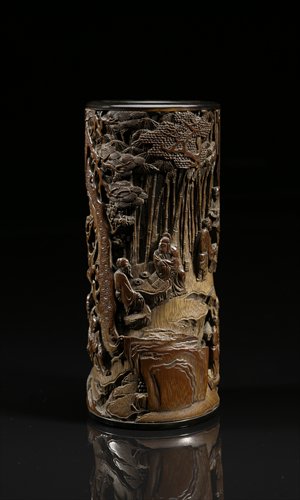
Dragon scales
Bamboo carving was first popularized during the Han Dynasty (206BC-220AD), and the first bamboo artworks were colored, lacquer bamboo spoons carved with images of dragon scales. These pieces illustrate the high level of bamboo carving at the time.
The Tang Dynasty (618-907) and Song Dynasty (960-1279) witnessed the maturing of the art of bamboo carving. And it was during the Ming Dynasty (1368-1644) that this particular art reached its zenith, with a variety of schools sprouting up in several fields. The best-known schools are the Jiading school based in Shanghai, the Jinling school in Nanjing, the Zhe school in Zhejiang and the Hui school in Anhui.
The Shanghai Museum has recently launched a special exhibition titled Literati Spirit, which features over 190 pieces of bamboo carving works from the Ming Dynasty to the present day. The exhibition is co-presented by the Shanghai Museum, and six other prestigious museums in China, including the Palace Museum in Beijing, the Tianjin Museum and the Nanjing Museum.
The exhibits range from bamboo brush pots and incense holders, to vivid animal, cabbage, and human images carved out of bamboo roots.
Carvings on brush pots include the calligraphy of well-known poems, popular maxims, and blessings for good wishes, as well as landscapes and popular characters. The most common images are pine trees, peaches and representations of Dongfang Shuo (a poet and politician of the Han Dynasty) who famously represents longevity in traditional Chinese culture. Other images include Liu Hai (an official during the Five Dynasties, 907-960) who embodies fortune and wealth, and some other "Taoist immortal" legends such as Fu Xing who is said to administer happiness, Lu Xing who is associated with fortune, and Shou Xing who bequeaths longevity. The images also include noted ancient Chinese men of letters.
"It's huge, and I'm impressed by the fine skills that have made these exhibits possible," said Amanda Ma, a holidaying visitor from Australia, who accompanied her mother to the bamboo works exhibition. "I've visited museums back in Australia, which also have carved bamboo works, but there are usually just five or 10 pieces; here there are hundreds of them."
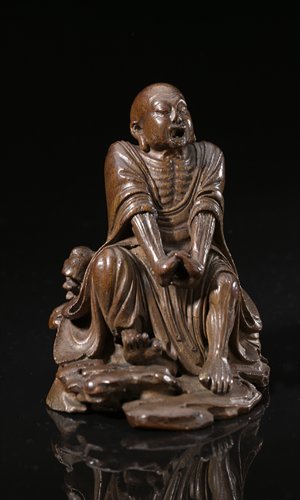
Major schools
The exhibition is composed of three separate parts, each dedicated to a singular tradition: the Jiading school of bamboo carving, the Jinling school of bamboo carving and liuqing (in which part of the bamboo skin is not removed), a typical bamboo carving technique.
The Jiading style boasts a history of more than 400 years. Its tradition features deep-carving and deep-reliefs. Buddha images are the most representative subjects in the works.
"Zhu He, the founder of the Jiading school was also a poet and a painter, like so many bamboo carving masters in history," said Li Jiaming, an experienced antique collector who visited the exhibition.
Li started collecting bamboo carving artworks almost eight years ago, and he now has some 20 pieces in his collection. "Bamboo carving is not only about carving; it's an overall review of the personalities of the creators as it integrates calligraphy and painting as well."
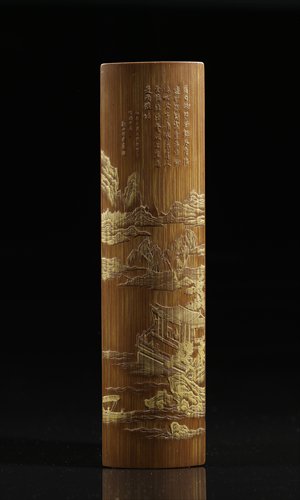
The Jinling school is characterized by artworks that use shallow carving techniques, which makes the works appear as almost like pictures drawn on the bamboo slips. Its representative works are fan frames carved with calligraphy and paint, carved wrist-rests, brush pots and seals.
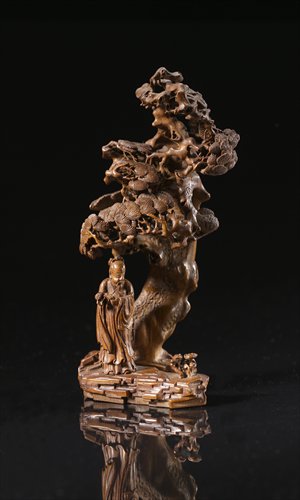
Fine skills
Bamboo artworks using the liuqing technique, constitutes the third themed part of the exhibition. The pieces created with this technique display differing degrees of shading. With liuqing, carvers are able to apply the typical colors of Chinese painting into bamboo carving.
The organizers have also set up a space for a video presentation of the techniques applied during the process of making refined bamboo carving artworks.
The process of completing a bamboo carving work constitutes several stages including the selection of raw materials, boiling and sun-drying the raw bamboo, drawing images, rough carving, fine carving and, finally polishing. "Bamboo carving is a demanding task with a single piece of work taking anything up to 20 days or more," Li told the Global Times.
Date: Until July 1, 9 am to 5 pm
Venue: No.2 Exhibition Hall, 2/F, Shanghai Museum
上海博物馆二楼第二展厅
Add: 201 People's Avenue
人民大道201号
Admission: Free
Call 6372-3500 for details