It takes two
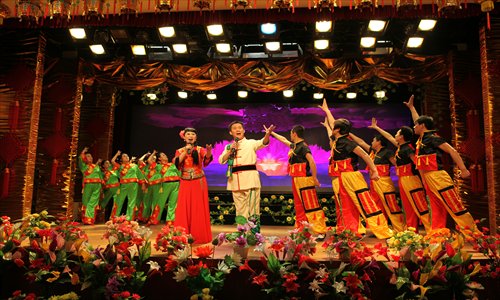
Two Fugu Er Ren Tai performers singing and dancing on stage Photo: Courtesy of Fugu Er Ren Tai Troupe
It was back in 1953 that Ding Xicai, a master of Fugu Er Ren Tai from Shaanxi Province, took part in the first nationwide folk music and dance performance in Beijing, which brought this particular style of Er Ren Tai to national attention.
In 2008, Fugu Er Ren Tai was officially recognized as an example of a national intangible cultural heritage. And the second tradition Donglu Er Ren Tai hails from Inner Mongolia.
Er ren means "two people" in Chinese, while tai means "stage," so Er Ren Tai literally refers to a Chinese opera, in which a male and a female perform on a stage. It is a popular folk art form from the shared border areas of Inner Mongolia, Shaanxi Province and Shanxi Province, and integrates various performing styles such as song, dance and instrumental performances.
Originating in the Qing Dynasty (1644-1911) in Fugu county attached to Yulin city in Shaanxi Province, Fugu Er Ren Tai was initially an informal performance style in which people sang their own stories, and improvised movements to accompany them.
Often a stage wasn't even needed, as performers would sing in the fields or wherever else they worked. But Fugu Er Ren Tai really came into its own during the early period of the Republic of China (1912-1949), rapidly absorbing the influences and essences of both Mongolian and Han cultures. This was facilitated by the fluid movements of both ethnic populations in the area during this particularly volatile period in Chinese history.
Folk culture
Fugu Er Ren Tai explores a large variety of subjects and themes, among which the most common are the hardships of rural life, young people's affections and marriage, and popular myths.
"Zou Xikou is a classic two-role Fugu Er Ren Tai opera which tells of a pair of lovers who are reluctant to part when the husband decides to seek his fortune elsewhere after a severe drought in their hometown," said Wen Yongkai, head of the cultural center of Fugu county and the director of the county's Fugu Er Ren Tai troupe.
In order to maintain the authenticity of the stories, the language used in Er Ren Tai is in Yulin local dialect, instead of Mandarin. And the arias vary in accordance with the subject matter of the songs and operas.
Fugu Er Ren Tai also highlights a unique array of musical instruments, such as a sihu (a four-stringed Chinese fiddle), a hammered dulcimer (a stringed instrument stretched over a trapezoidal sounding board), a sanxian (a three-stringed Chinese fiddle), a banhu (a loud two-stringed Chinese violin), and a set of small drums.
Shanghai bound
In 2004 and 2008, the troupe was invited to the International Music Festival in Shanghai, and received positive reviews, according to 36-year-old director Wen, who is also himself a respected Er Ren Tai artist.
Next week Wen's troupe will perform at an exclusive concert at the Shanghai Concert Hall as part of the 29th Shanghai Spring International Music Festival which will run till May 18.
"This will be a slightly altered version of traditional Fugu Er Ren Tai as they have adapted some of the scripts," Yu Zhen, executive secretary-general of the festival told the Global Times. "For example, the dancing will be minimized, while the arias will play a more prominent role. The musical accompaniment will be provided by artists from the Shanghai Chinese Traditional Orchestra affiliated to SMEG (Shanghai Media & Entertainment Group)."
Wen expressed confidence about the upcoming concert. "We're practicing hard every day in our local venue, and we hope to impress the audience with our profound northwestern culture."
On the program list for the concert entitled China Memory: Shaanbei Er Ren Tai Concert are vocal solos, dual choirs, four-stringed Chinese fiddle solos and Fugu folk songs.
Endangered heritage
Er Ren Tai is often thought as the counterpart to Er Ren Zhuan, (a similar folk song and dance performance from northeastern China which usually deals with modern-day subjects). However, the latter tradition has enjoyed a great flourishing in recent years with heavy media exposure due to the influence of Zhao Benshan and his proteges around the country. In contrast the future of Er Ren Tai, according to Wen, "faces a critical situation."
"The northeastern dialect in Er Ren Zhuan is much closer to Mandarin, but the northwestern dialect in Er Ren Tai is often confusing to non-local audiences," said Wen. "So it's much more difficult to popularize this art form."
And due to economic pressures in modern society, few young people are willing to attempt a career in such an "endangered" art. With Er Ren Tai masters ageing quickly, the imperative for Wen and his troupe is to stop this traditional art from dying out altogether.
To tackle the problems, classes have been set up in local vocational schools in Shaanxi to cultivate new Er Ren Tai performers. "We hold strict standards when selecting young apprentices," said Wen. "Firstly, the person should be talented in singing or playing instruments, and they should also be familiar with the north Shaanxi dialect and traditions, or at least be passionate to learn about them."
Date: May 14, 7:30 pm
Venue: Shanghai Concert Hall
上海音乐厅
Address: 523 Yan'an Road East
延安东路523号
Tickets: 50 to 280 yuan
Call 6386-2836 for details