Pushed to the limits
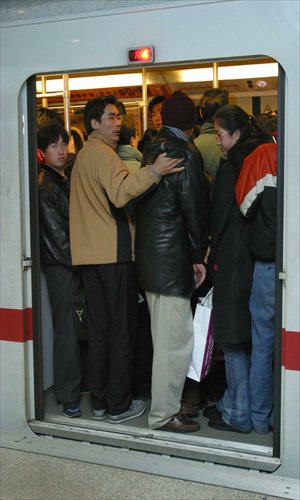
Melissa Lee rushes out of her apartment in Pudong New Area at 7:15 am on the dot. She has 15 minutes to beat the recently introduced crowd control system at the Yangsi Station on metro Line 8. If she doesn't make it to the station before 7:30 am, she will have to join a queue of 2,000 other hurried commuters pushed along a 200-meter zigzag route to catch her train to work.
"It's an absolute nightmare," said Lee. She works on Nanjing Road East in Huangpu district. "Since the subway introduced the crowd control system in April, I need to leave for work much earlier."
This day Lee did not make work on time. The crowd control system at Yangsi Station started on time at 7:30 am. From then on all commuters have to queue before entering the station. The system is intended to stop crowds rushing onto the platforms. It certainly stopped Lee rushing onto the platform. She spent 15 minutes in the queue before she reached the platform.
The 28-year-old advertising account executive from Hong Kong told the Global Times it was too much for the beginning of a stressful workday. She is now looking for an apartment closer to her downtown workplace.
"I don't want to spend two hours commuting to work every morning," she said. "It is time to dig deep in my pocket and pay more rent for a downtown apartment."
At least 22,000 residents who live close to the Yangsi Station share Lee's experiences and there are many more who rely on metro lines 6 and 8 as their way of getting to their downtown offices and schools. But the crowd control system is one the subway and transport authorities have described as indispensable.
Crowd controls
On the city's metro Line 8 more than 650,000 passengers travel every day. It has been described as "the nightmare line." The next most nightmarish line is Line 6 which carries up to 580,000 commuters daily. To ease overcrowding on the trains, Yangsi Station on Line 8 and Dongjing Road Station on Line 6 joined 28 other subway stations across the city on April 5 and introduced crowd control measures.
Metro lines 6 and 8 both run through the densely populated Sanlin town in Pudong New Area. Sanlin saw a population surge in 2006 when more than 18,000 residents were relocated there as their homes were demolished to make way for the World Expo 2010 in Shanghai. The city government built several residential complexes to house the relocated families and Sanlin Expo Garden is the largest. Sanli town is now home to more than 200,000 residents.
"I never travel on Line 6 during rush hours, even though the station is right outside my residential complex," said 69-year-old Guo Qing, a Pudong native who lives in Sanlin town. "The jostling crowds are way too much for a weak old man like me. Shanghai's subway is awful and unbearable."
The most recent statistics released by Shanghai Shentong Metro Group, the city's subway operator, show that Guo's impression of overcrowded trains might be well founded.
The city's subway network now carries 6.50 million passengers daily during the week, a 10 percent increase year-on-year and the number is rising with the daily passenger volume hitting a record high of 7.21 million on April 20. The subway network has seen passenger numbers passing the 7 million mark eight times so far this year.
"The passenger numbers will probably hit 7.50 million in October during the National Day holiday," said Lan Tian, the press officer for Shentong Metro Group. "From previous experience, we know that the influx of tourists will push passenger numbers to new highs."
The increase of passenger numbers in Shanghai is phenomenal, Lan said. He can recall the exact day when the metro system first carried 3.80 million people. "That was on April 30 in 2008," he said. "The record has been doubled in the past four years."
The subway network in Shanghai, the third built in the country after Beijing and Tianjin, was once the city's pride. It was a vivid demonstration of how the city became a metropolis so rapidly. Line 1 opened on April 10, 1995 and was then only 16 kilometers long.
Just 15 years after its grand opening, the city's underground network became the world's longest in 2010. It now boasts 425 kilometers of track and 282 stations across the city, eclipsing London's 408 kilometers and New York's 368 kilometers.
Shanghai's subway network will see an additional 200 kilometers by 2015, according to the city's 12th Five-Year Plan for public transportation and infrastructure. The new 39.50-kilometer Line 12 will run through the city's downtown areas and interchange with all existing 11 metro lines. It is scheduled to open by the end of this year.
Zhou Huai, the deputy director of the Shanghai Municipal Transport and Port Authority, which supervises the city's subway network, told a press conference that the city is planning an additional 300 kilometers of subway lines to be operating by 2020. If the ambitious plan is realized, in eight years Shanghai will have 800 kilometers of rapid transit track, more than all the rapid transit track in Japan.
"Shanghai's population will undergo a rapid growth in the coming decade," Zhou said. "It is important that the city's public transportation catches up with the demand and the city government will plan new lines to link suburban areas to the city's downtown areas. The new lines will help ease traffic congestion."
Speed not the solution
Over the past 17 years Shanghai has built over 400 kilometers of new subway lines, but this speedy construction has not helped maintain the "rapid" transit network. Transport authorities have become aware that just one solution will not fix the city's gridlock and they have introduced a series of secondary measures to ease pressures on the subway network.
The crowd control measures in Yangsi Station on Line 8 are among many the authorities have introduced to help manage swelling passenger flows on platforms. Thirty busy stations across the city now employ similar systems to stop passengers overcrowding stations and platforms.
"The crowd control measures slow passengers from getting onto platforms, allowing more space on the trains for passengers from other stations along the line," explained Lan, from Shanghai Shentong Metro Group. "It's a win-win situation for all passengers and it is safer for the passengers at Yangsi Station because overcrowding is dangerous and can trigger stampedes."
Nai Haihong, the station manager for the Yaohua Road Station on Line 8, which is two stops n0rth of Yangsi Station, told the Global Times that the crowd control measures have helped solve the overcrowding problem at his station.
"Trains were always jampacked arriving at Yaohua Road Station and passengers had to wait for two to three trains before being able to cram themselves onto a carriage," he said. "With the crowd control measures at Yangsi Station, the waiting time here has been cut by more than 50 percent."
To further ease the pressure on Line 8, the transport authority introduced three new trains at the end of April, reducing the interval time between trains by 30 seconds. Early this month Shanghai Shentong Metro Group announced that six more trains will be in operation by the end of 2012.
"The waiting times on the platform are slightly shorter now with the new trains," said Jonathan Ross, a Canadian expat who lives near Yaohua Road Station. "But three minutes between trains is still too long. The interval on Hong Kong's MTR is much shorter."
Line 6 will have 20 extra trains in operation by the end of 2013. The transport authority also added parallel bus lines to run along lines 6 and 8 in April. For 2 yuan ($0.32) per ride, dedicated shuttle buses run at five-minute intervals on weekdays from 7:20 am to 8:40 am, carrying Line 6 subway passengers to Century Avenue from Jufeng Road Station. Line 8 subway commuters can be dropped at People's Square from the Hongkou Football Stadium Station from 7:30 am to 8:30 am on weekdays.
The authorities had expected these buses would divert at least 2,000 commuters during the rush hours from the packed subway system because they were cheaper and there was no need to queue for 20 minutes. But commuters gave a very cold shoulder to the new alternative - an embarrassingly few 92 passengers daily chose to travel on the alternative bus lines for Line 8, according to Zhou Huai.
"The subway is extremely crowded during rush hours, but once you squeeze onto a train, it just takes 30 minutes for me to go to People's Square Station," said commuter Huang Shanni. "Taking the bus would at least double the traveling time because the roads are heavily congested."
The transport authority is not giving up on the plan. It announced last week it would crack down on cars using bus lanes during rush hours across the city. The city has 160 kilometers of bus lanes which are off limits to private vehicles and trucks on weekdays from 7 am to 9 am and from 4 pm to 7 pm.
The city will also add another 140 kilometers of bus lanes by the end of 2015 giving public transport the priority on the roads. The authority said this measure will help persuade more commuters to catch buses instead of the subway. Currently the city's 613 bus routes carry 2.26 million passengers every day, 18 percent of the commuters in Shanghai.
He Fang, the spokesman for the Shanghai Ba-Shi Transportation Group, which operates the city's buses, told the Global Times: "Shanghai's buses currently can carry up to 4 million people a day, We can definitely help take some of the pressure from the subway network if more people choose to travel this way."
He said that if the city had 300 kilometers of bus lanes by the end of 2015, they could shorten bus journeys on busy routes by up to 30 percent. "A 45-minute bus trip could be cut down to a half-hour trip," he said.
The car quandary
Shanghai commuters seem far from convinced that the measures introduced by the transport authority will relieve their rush hour travel troubles.
"I have heard on the news that there will be 30 million people in the city by 2020," said Qiu Zhisheng, a white-collar worker who is employed in Jing'an district. "Public transport can never catch up with the exploding population."
Qiu said her husband is planning to buy a car so that they won't need to struggle through the subway crowds every day.
But Yang Xiaoguang, the director of the Intelligent Transportation Systems Research Center at Tongji University, said this is exactly what commuters should not do.
"Only 35 percent of Shanghai's residents rely on public transport, far fewer than the 90 percent figures for Tokyo and Hong Kong," Yang said. "It is the problems and inconvenience of public transport that are persuading most people to drive to work every day."
Yang suggested authorities should introduce a more aggressive approach to give public transport priority on the roads to help ease pressure on the subway network. He told the Global Times that Shanghai should adopt an eight-hour window for bus lanes, adopting the Beijing experience.
"More than 30 percent of Beijing's residents catch buses, many more than the 18 percent in Shanghai," he said. "When buses are freed from traffic congestion more people are willing to catch them."
Ye Xiafei, the director of Urban Rail Transit and Railway Engineering Department at Tongji University, told the Global Times that technology could help the Shanghai subway network increase its capacity by 30 percent.
"If the subway system adopted an autopilot system, it could reduce the risk of human errors, and also shorten the intervals between trains," Ye said.
Shanghai's subway network uses a communications-based train control system that can limit the interval between trains to 90 seconds, Ye said. But the shortest interval in the city's network is two and a half minutes. "An effective autopilot system would allow Shanghai's subways to run on the tightest possible schedule," he said. "The current interval limits are set by human limitations - we cannot expect subway drivers to multitask like computer programs."
Shao Weizhong, the vice president of Shanghai Shentong Metro Group, said that metro Line 10, which opened in 2010, was designed to operate on an autopilot system. The operator is now conducting trials to ensure the autopilot system will be safe for its 560,000 daily passengers.