A blossoming trade
Our fascination with floristry, or flower arranging, goes back centuries, and is a perfect example of man's appreciation of the finer things that nature has to offer us. And more than just randomly placing flowers in a container, the rules of doing so take into account every part of the flowers including shape, color and form.
The Global Times presents three well-established traditions of flower arranging all of which can be found in the city.
China in your hand
"The rudiments of Chinese-style flower arrangements - which were originally tribute flowers for Buddha - can be traced back more than 1,500 years in China," Li Jun, a member of the Shanghai Flower Art and Arrangement Association, told the Global Times.
Flower arranging in China is said to have reached its peak - both technically and theoretically - in the Ming Dynasty (1368-1644), but its influence waned in the Qing Dynasty (1644-1911) and during the various conflicts that followed. A few decades ago, a renewed interest in the art started to blossom.
"Chinese-style flower arrangements highlight three aspects: the line of the stems, the natural way the plants grow and last but not least, the influence the tradition derives from Confucianism," said Li. "The philosophy behind each work has a spiritual connotation, which is a balanced, coexistent relationship between humanity and nature."
In Chinese flower arranging, this "classical" style highlights simplicity and elegance in color and brevity in shape. While the "new Oriental" style, as Li calls it, has absorbed more showy colors from typical Western flower arranging traditions.
Li gives lectures about Chinese-style flower arrangements in many workshops and institutes in Shanghai. In his words, he hopes to "promote and revive this traditional art form." Currently, he is holding a number of salons at Xinranhui Class (Room 2309, 220 Handan Road, 3532-1671), a female-targeted part-time class organized by School of Philosophy, Fudan University.
Courses are also offered at the Shanghai Flower Art and Arrangement Association, which is located at 130 Zhizaoju Road, Huangpu district (5158-6230).
For beginners, Chinese-style flower arranging is divided into six categories according to the different containers used - plate, vase, barrel, bowl, cylinder or basket.
Meanwhile, according to the longest branch line used, the flower arrangement can also be classified into basic shapes - upright standing, leaning, horizontal and hanging suspended.
"And compared to Western flower arranging, woody flowers and plants (such as plum blossoms and bamboo) are more commonly used than herbal flowers," added Li.
Big in Japan
Ikebana, the Japanese style of flower arranging, also evolved from the Buddhist ritual of flower offering that originated in China. With a history of more than 500 years, ikebana has developed systematically into three main schools - ikenobō, ohara and sogetsu. And ikenoboō, as the oldest tradition, remains the most popular.
Ohara style pays attention to the color and the seasonal nature of flowers, while sogetsu employs as wide a range of plant materials as possible to create a contemporary sense of beauty.
In ikebana, the floral materials are used in a minimalist way, following the basic principle of succinctness in composition.
Compared to the Western tradition, the flowers themselves are considered no more important than the stems, leaves and fruit of the plant.
With regards to its emphasis on line, there are also three categories in ikebana, known as ten, chi and jin, which respectively represent heaven, earth and humanity in Oriental philosophy.
West on show
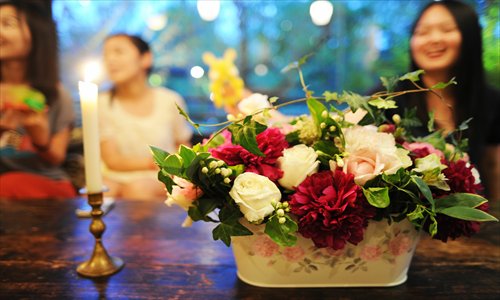
In the West, flower arranging traditions have long highlighted bright, varied colors and geometric shapes.
"Western-style flower arrangements are popular and practical in modern home décor, and make ideal gifts," Huang Yijun, owner of Vert et + studio (93 Wuyuan Road, 6403-8082), told the Global Times. Huang is a florist and teacher who trained at the Mami Flower Design School, a Tokyo-based part-time school offering instruction in contemporary Western-style floral design. Huang designs arrangements for buyers according to their individual needs.
For example, when making table arrangements she advises not to use flowers with falling pollen. She suggests dining tables should have brightly colored flowers that have an "appetizing" look. Red roses are suitable for Western cuisine, while bamboo strips complement Japanese cuisine well.
Huang also offers one-on-one floral design classes for 290 yuan ($45.53) per person for two hours. She said that beginners first need to master the seven basic flower shapes - vertical line, round style, radiating style, horizontal line, triangle style, topiary ball and topiary Byzantine cone. "The most important and ultimate goal in flower arranging is observing the flowers first before showcasing the most beautiful side of them," she said.
Shanghai has countless flower shops at which modern flower arrangements can be bought such as Boutique La Fleur, located at Unit 102, No.28 Sinan Mansions (531 Fuxing Road Middle).
Buying fresh flowers
Caojiadu Flower & Bird Market
Add: 33 Wanhangdu Road, Jing'an district 静安区万航渡路33号
Shuangji Flower & Garden Market
Add: 620 Pujian Road, Pudong New Area 浦东新区浦建路620号
Hongqiao Flower Market
Add: 718 Hongjing Road, Minhang district 闵行区虹井路718号
Yongjia Flower Market
Add: 406 Shaanxi Road South, Huangpu district 黄浦区陕西南路406号
Caoyang Flower Market
Add: 900 Caoyang Road, Putuo district 普陀区曹杨路900号