Desertification remains a challenge despite shrinking stony arid areas
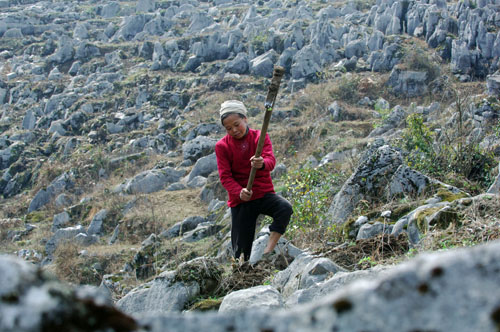
China's stony desert areas shrank to 12 million hectares (120,000 square kilometers) by the end of 2011, down 7.4 percent from 2005, according to the State Forestry Administration (SFA) Thursday.
"Stony deserts have been shrinking at an annual rate of 1.27 percent over the past few years," Zhang Yongli, deputy director of the SFA, said at a press conference.
"The spread of stony deserts has initially been brought under control, and the ecological environment in Karst regions has greatly improved," Zhang said.
However, Zhang noted that the current situation remains severe. Stony desertification, which is dubbed a "cancer of the Earth," is continuing to deteriorate in some areas.
The country still has 120,000 square kilometers of stony deserts, and destructive farming practices, excessive land reclamation and overgrazing still exist.
"Intensive agriculture has been promoted in those areas to improve farming yields. The application of modern agricultural technologies contributes a lot to the ecological restoration in those affected regions," said Liu Tuo, head of the desertification control center of the SFA.
According to the SFA, some 300 counties across the country have been in a program to control stony desertification since 2008, which encourages farmers to grow cash crops on stony lands to improve vegetation and increase earnings.
However, some experts have different views.
"Large-scale planting of an economic crop is not the best way to curb the degradation for its limited ecological function," Fan Xiao, an expert with the Geology and Mineral Bureau of Sichuan Province, told the Global Times Thursday.
"Recovery of the concentration of the natural flora is efficient in controlling the prevalence of stony deserts, especially on steep slopes," Fan added.
"Authorities should establish a long-term mechanism including a body designated to supervising the recovery of the vegetation, in a bid to stop the degradation backlash in handling the stony desert," another expert from the Peking University said.
Currently, more than 50 million people live in the rocky regions, where desertification is caused due to water shortages, soil erosions and persistent poverty.
"Stony desertification and poverty are intertwined, so we combined the work to control stony desertification with efforts to improve local people's livelihoods," said Liu.
The country will intensify efforts to prevent the spread of stony deserts and continue to increase investment in environmental improvement, Liu said.
Global Times