Entertaining no more?
PLA performance troupes face uncertain future
In China's army, there is a special ensemble that does not fight in the battlefield but partakes in perhaps an even more important way: They boost the morale of soldiers through singing and performances. They are the army's art and dance troupe.
The division originated during the foundation of the People's Liberation Army (PLA) and played an important role in carrying out publicity during the war years.
The late Liu Yalou, former commander-in-chief of China's PLA Air Force once said, "I have two armies: One is the combat troop of tens of thousands of soldiers, and the other is the art and dance troupe of five hundred."
But today, the function and role of the ensembles is not as prominent as before, and calls have been made for this division to either be disbanded or greatly reformed.
Present role
The number of art troupes in the army has been reduced several times during disarmament, but there are still estimated over 20 troupes across military headquarters, navy, army and the air force, and major military regions like in Guangzhou, Chengdu, Jinan and Nanjing.
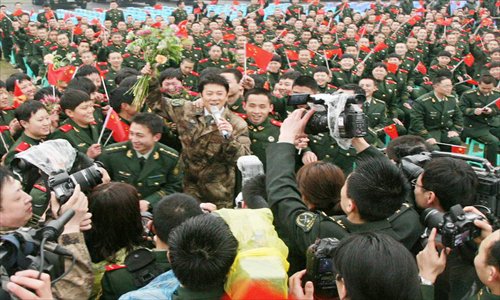
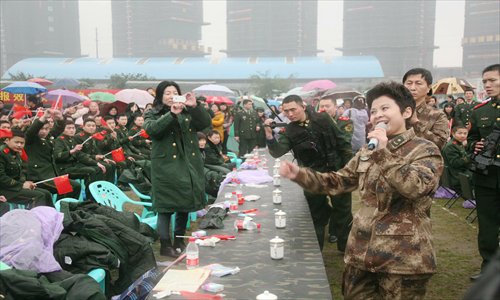
Today, they continue to play a special part in performing for disaster-struck areas, participating in various big events and performing abroad to enhance cultural exchange with other countries.
Like their predecessors, they often go to remote areas to perform for local troops. An employee of the Art Troupe of the Air Force Political Department surnamed Ren said that their troupe performs at the grass-root level many times a year.
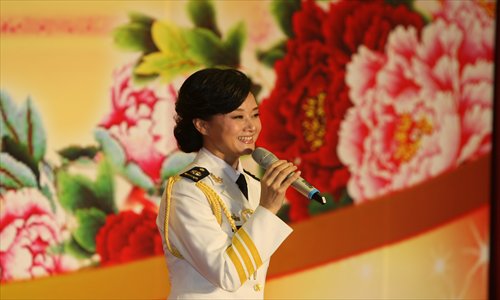
Many celebrities in the performing circle join these troupes. Every year, during the Spring Festival Gala broadcast on China Central Television, military artists occupy a large amount of stage time.
But many regard their role as unnecessary in contemporary China. Before, the military art and dance ensemble had to perform during basic level frontier defense. Now, they perform less for soldiers in combat zones and more in cozy theaters, some say.
Negative impressions
"Why are there still such troupes? Will they have any influence in combat?" There are many doubts from netizens online. Some say that these art and dance ensembles are promoted too rapidly, which is unfair for ordinary soldiers.
The subject of military rank is highly contested. An article that spread like wildfire on the Internet listed the ranks of many celebrities in the army, including Song Zuying and Yan Weiwen as vice corps level. However, some mistake the senior artists in the army as "civilian generals."
Xu Yan, a major-general and a military historian, explained the "civilian general" rank in the army.
"The civilian officials in the army, including the artists, are non-ranked and graded accordingly in terms of specialty and competence," he said.
The misunderstanding is mainly caused by the change in uniform implemented in 2001, when the military uniform of civilian officials above third rank changed to golden brown, similar to the uniform of major generals.
Besides, though not ranked, the civilian officials above third rank enjoy the same benefit in politics and life as officials of corps level.
There are also complaints that the performers occupy a heavy amount of military expense while China's weaponry falls behind developed countries. Proposals for the abolishment of this group have been raised, as they are replaceable in terms of performance and are costly.
A netizen nicknamed He Xie said that people might forget about the history of China's army, stressing the importance of these performing troupes for the Party and PLA in terms of political publicity and a boost of morale.
Chen Weiya, a director who once worked with the art troupe of the military region in Chengdu, told the Global Times that as a tradition of the Chinese army, these performing troupes have great value both as publicity and as a way to encourage soldiers.
"They exist for a reason. Even in peaceful times, we should remember their function," Chen said. "It is worthwhile to keep them, as long as they can produce quality work."
Reform
These performing troupes continue to play a key role, but economic and social conditions that artists rely on have changed fundamentally, resulting in the public strongly urging for either their disbandment or market-oriented reforms.
The army can provide them a basic salary and continue running these performing troupes, on the premise that they actually perform for soldiers, a netizen suggests.
In recent years, more pop singers have joined the troupes. Some are invited after they get popular, such as Phoenix Legend, Pang Long, and Han Hong.
For these troupes, celebrities bring in fresh blood and increases their popularity.
Take Phoenix Legend, a band that rose to fame from a talent show. They were invited to join the Art Troupe of the Political Department of the Second Artillery in 2009, as many thought their presence would benefit the troupe.
"We can only take other performances after strict [application] and examination," the band members said in an interview. "The precondition is that we must participate important assigned tasks."
By bringing in talent, this increases the proportion of non-military employees. In 2005, the State Council and the Military Commission of the Communist Party of China Central Committee issued a regulation that asks the army to employ inactive civil officials starting from 2006.
Many troupes have taken advantage of the policy and recruited a large number of talents, in addition to enrollment from military academies, art schools, and celebrities. For them, drawing in forces might be a good start.