Passion for porcelain
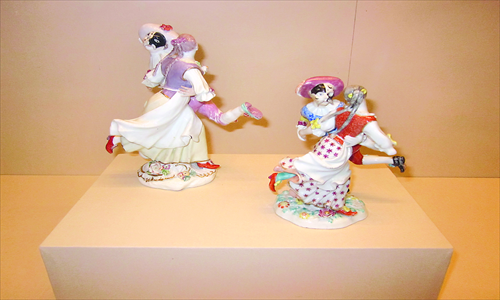
In the 17th and 18th century, with increasing trade between China and Europe, demand for China's porcelain rose sharply. Though Chinese porcelain was traded in smaller quantities than spices, tea and silk, its introduction impacted European culture, social life and economy. Passion for Porcelain, an exhibition at the National Museum of China (NMC) in Beijing, examines the significance of this Chinese art.
Running from June 22 to January 2013, the exhibition showcases 148 pieces of ceramics from the British Museum and the Victoria and Albert Museum (V&A) in London. With 10 sections, the exhibition presents luxurious porcelains collected by European collectors, exported porcelains during the early Ming Dynasty (1368-1644), special orders from Europe, and early imitation porcelains made in Europe during the mid 19th century.
"This exhibition is dedicated to the 100th anniversary of NMC as well as the 40th anniversary of the establishment of Sino-UK official relations," said Lü Zhangshen, president of NMC. "Through the exhibition, we not only review the cultural and trade exchange between the two countries, but we can also strengthen current ties, promoting the future," he said.
Import, export
The British Museum was established in 1753 and boasts the longest history among world's museums.
The V&A, established in 1851, and the second largest museum in the UK, holds one of the most important collections of Chinese art, dating from 3000 BC to the present.
"In history, the craze in the West about Chinese porcelain led to their export spree, and [also] had a big impact on European porcelain making," said Martin Roth, director of V&A. But this period of history is obscure in many textbooks.
China made ceramics nearly 10,000 years ago, but it was not until the East Han Dynasty (25-220) that genuine porcelain was produced.
The years between the Ming and Qing dynasties were the prime time for Chinese porcelain production, seeing a rise in both quality and quantity.
Jingdezhen in central China's Jiangxi Province, as China's "porcelain capital," was established during this time, producing pieces for both official use and foreign exports.
Exporting Chinese porcelains began during the late 8th century. From the late Tang Dynasty (618-907) to the early Ming Dynasty, exported Chinese porcelains were mainly of the traditional blue and white varieties, with trade concentrated in Asian countries.
European conversation
The 16th century ushered in a golden time for China's porcelain business, lasting until the 19th century. Between 1510 and 1600, Portuguese merchants operating from ports in Goa, Hormuz, Malacca and Macau dominated the export of Chinese porcelain to the Middle East and Europe. They traded Indian textiles, Indonesia spices, Chinese porcelain, and silver and copper from Japan.
In 1602, the Dutch East India Company broke the Portuguese monopoly in Asia. Based in Jakarta (Batavia) and becoming the largest company of its kind in the 17th century, the Dutch East India Company traded spices, tea, porcelain and silk. It ceased trading in 1798.
The English East India Company dominated international trade in Asia from 1699, concentrating on tea, silk and porcelain. Tea was regularly shipped to London from the 1670s, stimulating an English market for porcelain tea wares.
Tea represented 60 percent of the company's profits, and porcelain offered a waterproof vessel. "The porcelain story you see in this exhibition…The conversation that went on hundreds of years between China and the rest of the world," said Neil MacGregor, director of the British Museum. People can see how design, technology, and ideas flowed between China and Europe.
"Of course, porcelain was invented in China," Neil said. "But in this exhibition you see [how] porcelain from China [was influenced] by Iran, the Middle East, and Europe. You see those extraordinary complex conversation that keeps going on, ideas moving in most directions," he said.
"Without the story, the link, all those beautiful artifacts don't mean anything," said Linda, a representative at KT Linda Wong Davies, chairman at KT Wong Foundation and the organizer of the "In Conversation," a lecture before the exhibition to provide its context and discuss China's creative industry development.
The exhibition shows how porcelain from China influenced the rest of the world, traveling around Europe, slowly coming back to modern design in China today. It's a fascinating story, Linda said.
Exhibition highlights
The exhibition opens with exported Ming Dynasty items, such as a bowl with European armorial designs and Latin inscriptions from the early trade. The export upsurge is credited to the collection habits of European royal families including Poland, Britain and France in the 18th century. Blue and white porcelains were favorites.
A large section is devoted to "special orders," Chinese porcelain specially commissioned by European purchasers and made in tradition of European design. During the 18th century, to accommodate to European taste, the style of Chinese porcelains incorporated European themes like village scenery, stories from the Bible, and paintings from artists like William Hogarth.
The impact of Chinese porcelain on the development of European factories showed early European attempts at making porcelain, including a rear dish in "Medici Porcelain" and a display of European ceramics copying Chinese designs, such as a Worcester dish inspired by a traditional Chinese pattern.
For those early imitations, most copies were made from red or buff earthenware covered with a white glaze. They were only superficially similar to the Chinese originals. In 16th century Italy and late 17th century France, closer imitations were achieved.
Around 1710, a German alchemist discovered the nature of the raw materials and the firing process followed by Chinese potters, leading to the foundation of the Meissen factory.
Industrial spies took Meissen's secrets of real or "hard-paste" porcelain production to Venice and Vienna, from where they were across Germany. By 1800 this was common knowledge across Europe.