Preserving the epic of ‘Manas’
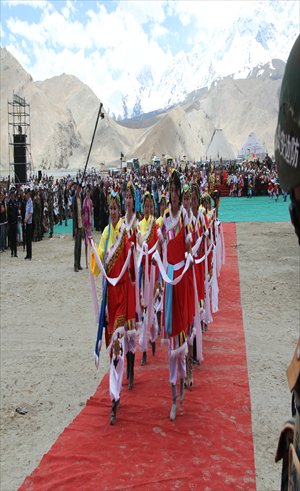

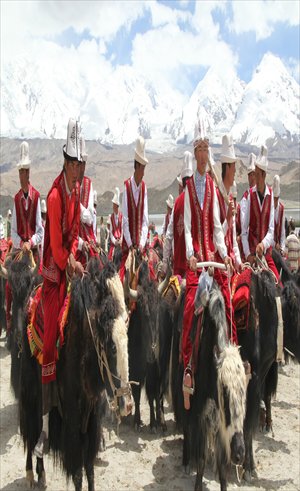
The three-day Manas International Cultural Tourism Festival (MICTF) came to an end on July 1 in Akto, a county in southwestern Xinjiang Uyghur Autonomous Region, once an important stop on the ancient Silk Road.
The history of Akto can be dated back to the Old Stone Age. Later, as the Silk Road formed, businessmen from the north and south who wanted to travel to the West all needed to pass through Akto.
MICTF is an annual festival in Xinjiang's Kizilsu Kirgiz Autonomous Prefecture. In previous years, it was held in Akqi county and Wlugqat county.
With former Kyrgyzstan president Roza Otunbayeva and over 30,000 participants from different ethnic backgrounds and various places attending, this year's festival was as diverse as it was grand.
The Kirgiz
The Kirgiz is one of the 56 ethnic groups in China, with most residing in Xinjiang. There are about 210, 000 Kirgiz people in China. Most live in Xinjiang's Kizilsu Kirgiz Autonomous Prefecture, with a small amount residing in Northeast China.
The Kirgiz population is estimated to be around 2 million in the world, according to Yang Wendian, vice chairman of the local people's congress.
Most Kirgiz people are Islam, and live by raising stock. Kirgiz have their own written and spoken languages.
The Kirgiz follow what is taught in Manas, an epic named after the Kirgiz hero Manas. It is as important to the Kirgiz as LunYu (or "Analects" of Confucius) is to the Han people.
Estimated to materialize between the 16th to 18th century, Manas is considered one of the world's longest epic poems and tells how Manas and his offsprings led the Kirgiz people to fight against invaders. The festival is named after him.
"By launching this festival, we hope people from other parts of China and the world will learn more about beautiful Akto and the people living here," Yang said.
MICTF rundown
The 2012 MICTF contained six parts: the opening ceremony, forums on protecting traditional songs of the Kirgiz, a photograph competition called Chinese Photographers Olympic Group PK, plans for the future production of the film Bingshanxia de Laike (Visitors to the Icy Mountain), the unveiling of the statue of Manas and the completion of Jiangxi village, a newly built cultural and tourist village for the Kirgiz.
The opening ceremony was held on the 3,600-meter high Pamir plateau near Karakul Lake.
The performances of three folk epics, Jangar (Mongolian), King Gesar (Tibetan) and Manas (Kirgiz) featured 1,500 performers, young and old, dressed in colorful traditional ethic costumes. They presented the folk stories of their heroes and traditional way of holding celebrations, such as weddings. The performance attracted a great deal of local residents, including Kirgiz from local pasturing areas.
"We never thought there would be so many people," said Yang. "We assumed there would be around 10,000, but there are around 30,000."
The photography competition invited over 100 photographers from 19 provinces and Xinjiang Uyghur Autonomous Region of China, who spent three days on the Pamir plateau, where they photographed natural scenes like the White Sand Mountain, Karakul Lake, and the lives of the Kirgiz.
The statue of Manas, a hero in Kirgiz history, was unveiled. Following was a ceremony for Jiangxi village. Supported by the Jiangxi provincial government, the new village began construction last year, costing around 54 million yuan ($8.50 million). It can house around 54 Kirgiz families.
Fifty years ago, Visitors on the Icy Mountain, a film about people residing in the border areas of Xinjiang fighting against spies, impressed audiences. Visitors to the Icy Mountain follows the next generation of heroes and heroines in the first film and is currently in production.
Epic poetry
Adil Jumaturdu, a Kirgiz scholar of Manas, said that Manas is the spiritual leader of the Kirgiz people.
According to the epic, the king of Khitan learned from a fortune teller that a man of great strength would soon be born. This man would lead the Kirgiz people to overthrow the rule of Khitans.
The king sent soldiers to kill pregnant woman as a preventative measure. But with the help of Kirgiz people, Manas was safely born. After growing up, Manas recruited 40 warriors and united tribes to fight the Khitans.
Protecting and carrying on the epic Manas has always been one of the most important aims of the MICTF.
Manas contains eight sections with over 230,000 lines, longer than Homer's Odyssey and Iliad. Together with Jangar and King Gesar, Manas is one of the three top epic poems of Chinese ethic groups. In 2004, the poem was included by the UNESCO as a world intangible cultural heritage.
"Because such a long epic poem was passed down orally, it is hard to protect it," Jumaturdu told the Global Times. He said that though there are written documentations of the poem, the singing is the most essential part.
Currently, 95-year-old Jusup Mamay sings the largest part of Manas. He learned to sing Manas at the age of eight.
"He can sing eight sections, and the current version is mostly based on his singing," said Jumaturdu, who translated Manas into Putonghua, and is helping the translation of Manas into more languages like English and Uyghur.
Jumasurdu said that over the years, increasing attention has been cast on protecting Manas. About five years ago, primary schools for Kirgiz children began to incorporate the epic poem into textbooks.
"Manas does not only belong to China but also to the world," Yang added. "He is a hero to all Kirgiz people living around the world. It is a good [start] to receive intentional attention."