Parkour life
Not many people in China had heard of parkour when Qiu Dongkun began to practice the sport - flipping off the side of walls, and leaping from roof to roof - some eight years ago.
"People scolded me when they saw me climbing onto their rooftops," Qiu recalled. But gradually more and more people began to appreciate his vocation. "At least, they now understand it's an actual sport," he told the Global Times.
Qiu started the city's first-ever parkour group, but even he knew little about the phenomenon until he watched the 2004 film, District 13.
Parkour was first developed by David Belle from France, who appears in the film.
"I first started learning parkour myself by watching videos and imitating the movements of the people in them," Qiu said.
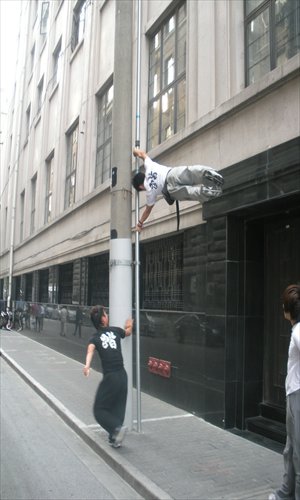
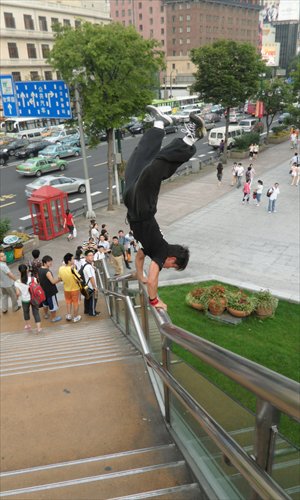
Comprising movements similar to those seen in Chinese martial arts, parkour focuses on moving through and around obstacles by means of running, vaulting, climbing, rolling and leaping.
Parkour practitioners often refer to themselves as "tracers." And a community of local tracers has been growing in the city in recent years.
And although Shanghai has only one commercially-run parkour training center, there are several non-profit clubs which provide training and skills for free.
Roll with it
Qiu started Jiyue She, the first amateur parkour group in Shanghai. The club has helped train more than 1,000 tracers over the last eight years.
"There are people coming and going all the time. Currently, we have about 30 core members including four expats, some of whom were tracers in their home countries," Qiu said.
Club members come from all walks of life including office workers, students, and migrant workers, and range from teenagers to people in their 40s.
"We interview new members and put them into different groups. We give advanced training to those in good physical shape, or with some experience of parkour, and we provide more basic training for absolute beginners," he said. The club has an indoor training site in a Hongkou district gym, where new members usually spend two months practicing the basics before moving outside.
The group practices every Saturday. Their usual outdoor practice spots include Century Park in Pudong New Area, and the Daning Lingshi Park in Zhabei district.
"New members start with what is called 'rolling training,'" said Qiu. "Rolling can prevent injuries when one jumps from a high place. Some members might find this boring. But it's essential to practice this movement for at least two months before moving onto more difficult moves," Qiu said.
Although parkour requires lots of repeated practice and discipline, Qiu believes that it is a sport of "freedom."
"The aim of the sport is to achieve freedom by crossing through the obstacles. I don't think there are any standards or even any real rules for the sport," he said.
E-mail qiudongkun5217@hotmail.com for details
Believe the hype
Started in 2009, Hyper Freedom, or Huta in Putonghua, is the only commercially-operated parkour training center in Shanghai.
"We used to practice in the city's parks. But the parks' security staff didn't exactly embrace this so we were always asked to leave," Yuan Guang, a coach and co-partner at Hyper Freedom, told the Global Times.
"But people have become more tolerant to the sport of late, because they are learning more about it. For example, crowds always gather when we practice near People's Square," he added.
Hyper Freedom now rents an indoor facility in Pudong New Area.
"There is more protection when you practice indoors. We've got mats, bars, railings, and walls to practice on. And it makes us feel that we have finally got a place that gives us some legitimacy," said Yuan.
Yuan said that many of the company's coaches were previously trainers of other sports. "We've got martial arts and taekwondo coaches. I was previously a taekwondo coach. If you have got some experience in these other areas, you will probably pick up parkour faster," he said.
Yuan describes parkour as a combination of martial arts, taekwondo, gymnastics, and even acrobatics. But there are still important differences. "Martial arts are used in a fight or as a defense, while there is no violent aspect to parkour. It is more of a one-man sport. The only thing you need to 'fight' is your own weakness and fear," he said.
Yuan said that it is better to practice in a group than on one's own. "You will be informed when you are ready for a difficult movement. And you will need encouragement and guidance from a coach before you can do that. You will have people watching your back."
Yuan said that it can be dangerous for someone to practice certain movements without any supervision. According to the city's education authorities, a senior high school student died this April after he fell off a school building while practicing parkour.
The center charges about 400 yuan a month for tuition fees, and runs classes every day.
Add: No.50-8, Lane 71 Hongqiao Street South 虹桥南街71弄50-8号
Tel: 5089-8393
Equality for all
AD Parkour is another amateur group based in Songjiang district. Formed in 2010, most of its 30 or so members are young Chinese men aged from 18 to 22 years old.
The group has no dedicated indoor site as yet, and the members usually go to parks in Songjiang district to practice. "But we have got a site near Chuanchang Road subway station in Pudong New Area. It is also a rock climbing site. Many tracers from other districts join us there," said a group member surnamed Miao.
Miao said that most parkour groups welcome female members. The training for women concentrates on flexibility as opposed to strength, he added. The group collects no fees for training, and usually meets on Sundays.
E-mail 912985113@qq.com for details