Reinventing traditional paintings
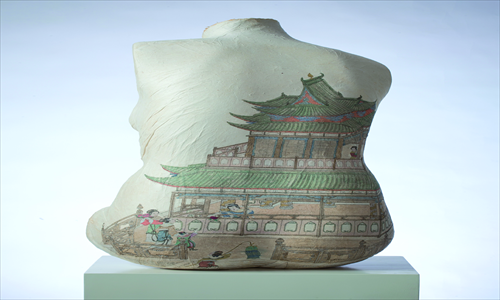
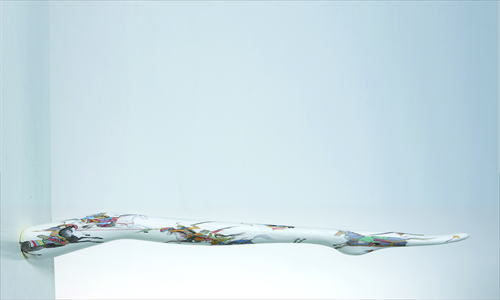
Gongbi, a realist technique in Chinese paintings, is characterized for its detailed, meticulous, brush-by-brush stroke execution, with artists using fine lines to sketch out details. This traditional ink and wash painting usually conjures images of mountains, rivers, flowers, birds, and scenery.
But Hang Chunxiao, an art researcher and curator, challenges traditional notions of this type of brush painting and showcases new gongbi styles in his latest exhibition.
Onward From Concepts - 2012 Xingongbi Document Exhibition, runs from July 11 through this Friday, at the National Art Museum of China in Beijing. The exhibition features 60 art pieces from 15 artists.
Hang has held similar exhibitions since 2005. With more people interested in this new art form, Hang has united artists from different generations, including Jiang Ji'an and Peng Wei.
Traditional paintings
Though gongbi paintings are regarded as one of the most representative traditional Chinese paintings, Hang believes most Chinese people lack an understanding of the genre.
"The current criteria for a good gongbi painting rely on three aspects: Whether the objects look real, whether it is delicately drawn, and whether it looks beautiful," Hang told the Global Times.
"But these were not the original concepts for gongbi or other Chinese paintings. Ancient Chinese paintings focused on ideas and often were distanced from reality."
According to Hang, the name "gongbi" first rose in the late 1800s but was regarded as a painting method rather than a genre.
As Western oil paintings were well-received in China during the first half of 20th century, realistic drawings were perceived to be quality art.
People in China were eager to prove that there were similar Chinese paintings as well. Therefore, gongbi paintings were picked out as examples of domestic, realistic productions.
New concepts
Hang advocates a "new style of gongbi paintings." This is not just a return to the origin.
"It is the ability to change from the old stereotype, to grow and activate itself. Then it can be called 'new,'" Hang said in a phone interview.
Hang prefers to call the new gongbi a "movement that spawned from globalization," rather than defining it as an art genre.
Though new gongbi paintings continue to use traditional painting tools and techniques like wash, water colors and dye, the paintings are based on the contemporary understanding of the world, including life experiences from the West.
These paintings cannot be directly labeled as ancient or modern art, the work of the East or West.
Referring to them as "documents" rather than paintings in the exhibition, Hang said he believes these paintings can be used as references for the study of old art as well as art of the future.
Ordinary objects like scenery, plants, animals and people are not always major themes; some paintings can be abstract and illusory.
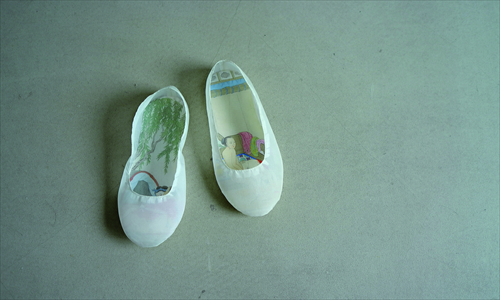
Also, paper and silken cloths are no longer the only canvases. The painting does not have to be on paper, it can be an installation.
In the same way, any object, such as shoes, can be used. Peng Wei's art for instance, touches on this.
Jiang Ji'an used one of his latest works to explain this idea.
"What I focus on is the relationship between an object and the painting. I modified and rebuilt the relationship between the two," he said.
"For example, I broke a cup, grounded the pieces into powder, and made the powder into ink through steaming, filtering and adding other materials, such as glue," he said. "With this ink, I drew a picture of the cup, and with the remains filtered out, I make a new cup. The pictures, along with the new model, were both made from the original cup."
Future market
"Gongbi paintings have been changing and have gone through many trials. But it was never a uniting force, said an anonymous insider in the gongbi industry, implying that the artists in this field work separately.
He said that contemporary Chinese paintings, including the new gongbi paintings, have been given more attention in auctions recently.
Before, there were few auctions held specifically for contemporary Chinese paintings, but in recent spring and autumn auctions, companies like Poly International Auction and China Guardian Auctions held special auctions on contemporary Chinese paintings.
"Some artists have already signed with auction companies, or have cooperation with institutions. In the past, people cared more about contemporary oil paintings. It was the same situation at art universities. More students choose to learn oil painting over Chinese painting," he said.
Wang Wei, the manager of painting and calligraphy department at Huachen Auctions, agrees.
Before, the industry for Chinese paintings was not mature. Many painters created art while looking for buyers, decreasing their time for creating, said Wang.
Now, galleries and auction companies cooperate with artists and help them promote and sell their products, he added.
Wang said that Chinese paintings, with their deep root in Chinese culture, are easier to appreciate than Western works. He predicts that there will be a large number of potential buyers in the future.
Global Times