HOME >> ARTS
Music show hits high and low notes
Source:Global Times Published: 2012-7-29 20:55:05
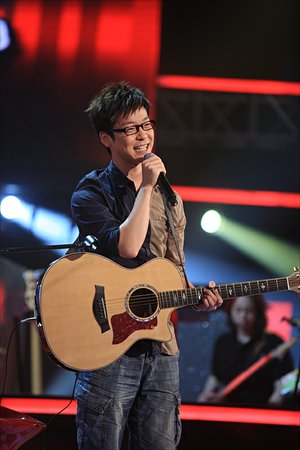
A singer performs on The Voice Photo: Courtesy of Zhu Hong
After NBC found immense success with The Voice in the US last year, the show managed to enter the Chinese mainland market despite the country's restraint on reality shows.
According to CSM Media Research's estimate, The Voice of China - the Chinese adaptation of the original Dutch music TV shows - topped nationwide ratings when its was shown on Zhejiang Satellite TV last Friday night, attracting 2.77 percent of the country's television audience.
Even re-runs of the show grabbed ratings higher than the premiere of any other music show this year, the company said.
Impressive debut
Debuting in China on July 13, the weekly The Voice of China is almost identical to the US version. Through a blind audition, four celebrity judges choose teams of singers who will compete for a recording contract.
The catch of the show is that the coaches compete with each other to convince strong singers to join their teams. Zhejiang TV invited Chinese celebrities Liu Huan, Na Ying, Yang Kun and Harem Yu as judges.
Singers like Huang He, a 20-year-old countryside girl, have shot to stardom. She amazed the four coaches with a powerful rendition of Adele's "Rolling in the Deep."
The impressive debut of The Voice of China was not expected by Chinese music critics, especially at a time when the market is flooded with similar foreign-format reality shows, including American Idol and China's Got Talent.
Revamping the genre
To compete for audience attention, some shows have gone to the brink of vulgarity, prompting a government-initiated restriction on "overly entertaining" reality shows from the state broadcasting watchdog late last year.
"I like the sense of honesty and respect for music shown by 'Voice' contestants. They are different from those in other reality shows," netizen "Elsa" wrote in a Sina Weibo.
After its debut, The Voice of China trended for a week on Sina Weibo.
Some fans voiced the hope that The Voice of China could spur a "renaissance" in China's show industry.
The producer of Zhejiang TV's The Voice of China Tian Ming admitted that the country's TV production sector lags so far behind its Western counterparts that it is too early for China to come up with a successful homegrown show format.
Tian said each adaptation of a popular Western TV show gives Chinese producers an opportunity to learn and improve.
"We can avoid taking the wrong paths. If by learning, we can catch up with the West in 10 to 20 years, I think it is worthwhile," said Lu Wei, publicity director of Zhejiang TV's The Voice of China.
Disappointed netizens
But the third episode, which aired last Friday, put a damper on some of the praise. Netizens began voicing concern about the growing number of advertisements on the show.
"There were many advertisements in the latest episode, which lowered my interest in watching it," a netizen surnamed Xu told the Global Times.
Alongside, leaked information portrayed contestants in a negative light. Many of the contestants had either fabricated their life stories or had exaggerated some of their hardships, in order to solicit sympathy.
Contestant Xu Haixing previously moved both audiences and coaches with her optimistic attitude after her grandfather's death, which she said was followed by her father's death.
Curious fans and netizens later discovered that Xu had participated in reality TV shows like Super Girl and Blossoming Flowers, using a similar story. Netizens who were once touched by Xu's story now feel betrayed, as several pieces of the story do not match up.
Contestants Zou Hongyu and Huang Yong were also questioned about their background. Zou claimed to be a farmer but was discovered to come from an affluent family.
Huang claimed he was an owner of a nail beauty shop, but netizens later discovered he was signed by an agent and had already released a record.
Lu Wei, publicity director of The Voice of China, told Guangzhou Daily that the show does not prevent professional singers from entering.
"We do not hide the experience of the participants. Before they sing, they have no chance to speak. They are judged only by their voices. Without a good voice, a rich personal story doesn't matter," he said.
In the US version of The Voice, it is widely acknowledged that many of the singers are not amateurs. Many contestants had previously been signed to record deals; the only deciding factor is the quality of their voice.
But some netizens feel deprived, as heartwarming stories add to their ability to identify with the contestants.
"If these were real stories, it would be OK to spread this energy to audiences. But if this was done purely for [hype] and speculation, it is immoral," a netizen surnamed Zhong wrote on his Sina Weibo.
Gao Xiaosong, a musician who has participated in a number of talent-based reality TV shows, said that it is common for a singer to attend more than one program, especially if there are not enough participants. Most reality TV shows face a limited number of contestants.
As Guangzhou Daily reported, Liu Wei, winner of China's Got Talent had previously participated in shows like The Top Talent and Super Boy.
Lu told sohu.com that the show currently has three directors, each with an individual style. This factor adds to the different directions the show seems to take.
Xinhua-Global Times
After NBC found immense success with The Voice in the US last year, the show managed to enter the Chinese mainland market despite the country's restraint on reality shows.
According to CSM Media Research's estimate, The Voice of China - the Chinese adaptation of the original Dutch music TV shows - topped nationwide ratings when its was shown on Zhejiang Satellite TV last Friday night, attracting 2.77 percent of the country's television audience.
Even re-runs of the show grabbed ratings higher than the premiere of any other music show this year, the company said.
Impressive debut
Debuting in China on July 13, the weekly The Voice of China is almost identical to the US version. Through a blind audition, four celebrity judges choose teams of singers who will compete for a recording contract.
The catch of the show is that the coaches compete with each other to convince strong singers to join their teams. Zhejiang TV invited Chinese celebrities Liu Huan, Na Ying, Yang Kun and Harem Yu as judges.
Singers like Huang He, a 20-year-old countryside girl, have shot to stardom. She amazed the four coaches with a powerful rendition of Adele's "Rolling in the Deep."
The impressive debut of The Voice of China was not expected by Chinese music critics, especially at a time when the market is flooded with similar foreign-format reality shows, including American Idol and China's Got Talent.
Revamping the genre
To compete for audience attention, some shows have gone to the brink of vulgarity, prompting a government-initiated restriction on "overly entertaining" reality shows from the state broadcasting watchdog late last year.
"I like the sense of honesty and respect for music shown by 'Voice' contestants. They are different from those in other reality shows," netizen "Elsa" wrote in a Sina Weibo.
After its debut, The Voice of China trended for a week on Sina Weibo.
Some fans voiced the hope that The Voice of China could spur a "renaissance" in China's show industry.
The producer of Zhejiang TV's The Voice of China Tian Ming admitted that the country's TV production sector lags so far behind its Western counterparts that it is too early for China to come up with a successful homegrown show format.
Tian said each adaptation of a popular Western TV show gives Chinese producers an opportunity to learn and improve.
"We can avoid taking the wrong paths. If by learning, we can catch up with the West in 10 to 20 years, I think it is worthwhile," said Lu Wei, publicity director of Zhejiang TV's The Voice of China.
Disappointed netizens
But the third episode, which aired last Friday, put a damper on some of the praise. Netizens began voicing concern about the growing number of advertisements on the show.
"There were many advertisements in the latest episode, which lowered my interest in watching it," a netizen surnamed Xu told the Global Times.
Alongside, leaked information portrayed contestants in a negative light. Many of the contestants had either fabricated their life stories or had exaggerated some of their hardships, in order to solicit sympathy.
Contestant Xu Haixing previously moved both audiences and coaches with her optimistic attitude after her grandfather's death, which she said was followed by her father's death.
Curious fans and netizens later discovered that Xu had participated in reality TV shows like Super Girl and Blossoming Flowers, using a similar story. Netizens who were once touched by Xu's story now feel betrayed, as several pieces of the story do not match up.
Contestants Zou Hongyu and Huang Yong were also questioned about their background. Zou claimed to be a farmer but was discovered to come from an affluent family.
Huang claimed he was an owner of a nail beauty shop, but netizens later discovered he was signed by an agent and had already released a record.
Lu Wei, publicity director of The Voice of China, told Guangzhou Daily that the show does not prevent professional singers from entering.
"We do not hide the experience of the participants. Before they sing, they have no chance to speak. They are judged only by their voices. Without a good voice, a rich personal story doesn't matter," he said.
In the US version of The Voice, it is widely acknowledged that many of the singers are not amateurs. Many contestants had previously been signed to record deals; the only deciding factor is the quality of their voice.
But some netizens feel deprived, as heartwarming stories add to their ability to identify with the contestants.
"If these were real stories, it would be OK to spread this energy to audiences. But if this was done purely for [hype] and speculation, it is immoral," a netizen surnamed Zhong wrote on his Sina Weibo.
Gao Xiaosong, a musician who has participated in a number of talent-based reality TV shows, said that it is common for a singer to attend more than one program, especially if there are not enough participants. Most reality TV shows face a limited number of contestants.
As Guangzhou Daily reported, Liu Wei, winner of China's Got Talent had previously participated in shows like The Top Talent and Super Boy.
Lu told sohu.com that the show currently has three directors, each with an individual style. This factor adds to the different directions the show seems to take.
Xinhua-Global Times
Posted in: Music