HOME >> LIFE
Is penmanship a dying art
By Xu Ming Source:Global Times Published: 2012-7-31 19:10:03
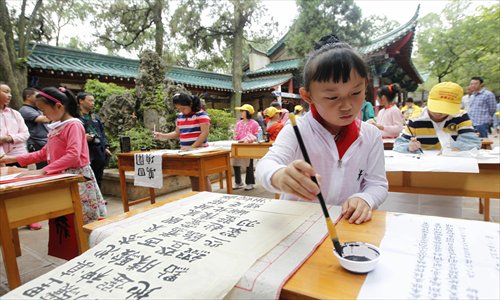
Twenty years ago, if you had beautiful penmanship, you would be the target of admiration and even envy. For a long time in China, handwriting was a way to judge a person. An old Chinese adage goes, "a person's handwriting is a reflection of character."
But with more people typing away on keyboards and cell phones, writing Chinese characters by hand is becoming extinct. Some worry that technology is causing a crisis for the 5,000-year-old art of penmanship in China. Worse, many scholars fear that the decline in handwriting will have negative effects on culture.
Ge Fei, a professor of Chinese language and literature at Tsinghua University, is wary of the direction handwriting is headed. "Chinese characters carry the culture of China and have intrinsic characteristics. Its decline will have unpredictable consequences," he said.
Chinese characters
Recently, Shandong Business Daily and t.qq.com, a Tencent microblog service, jointly carried out a survey online about penmanship. The results indicate that over 91 percent of netizens have experienced failing to remember how to write a character by hand.
Further, over 60 percent of the participants in the survey chose to use QQ, We Chat, e-mail and MSN to communicate; 33 percent used mobiles. Only around 5 percent actually handwrote letters.
"I haven't written for several months; I nearly forgot how to write," one netizen said.
This feeling resonates with many, especially due to the complicated nature of Chinese characters, difficult to remember compared to the English alphabet.
Many think that handwriting is a tedious craft, finding it tiresome to remember stroke order. Given the chance, most modern Chinese prefer utilizing technology as an aid.
"It is inevitable that the demand to handwrite decreases in modern society," Huang Yushang, a calligraphy artist in Hangzhou, Zhejiang Province, told the Global Times.
Withering writing
There have been two major changes in China attributing to the decline of penmanship.
The replacement of the brush with pens in the 1950s eliminated the need to learn intricate brush strokes, except in calligraphy.
In the 1990s, computers, cell phones and the Internet became the main modes of communication. As the predominant way of typing Chinese characters is based on the pinyin system using simplified characters, today's improved and efficient technologies have further decreased the need for handwriting.
After college, where students often take notes by hand, the generations born after the 1970s rarely use handwriting. Those born after the 1990s began using the computer to write at a young age.
"But the influence of new technology is not the sole cause," said Li Boqian, professor of archeology at Peking University.
"The deeper reason is the lack of respect for Chinese characters and traditional culture. It is an act of shifting responsibility to blame technology for the [decline]," he added.
Zhang Yun, a member of an art and culture association in Beijing, agrees.
There is no direct conflict between handwriting and technology, she said. They can be mutually beneficial. For example, computers and cell phones use touch screen technology to write characters.
"It is a problem of the times," she said, "The country is developing too fast and the importance of culture is played down during economic development."
Behind the decay of handwriting is the decreasing skill of the Chinese language at large. Incorrect characters are increasingly found in textbooks and dictionaries.
"The root reason is that we
are not serious about the Chinese language," Zhang told the Global Times, "People neglect the cultural significance of writing by hand. "
Educational reforms
Earlier this month, a newspaper in Shenyang, Liaoning Province displayed a front page of handwritten news to emphasize the importance of the handwritten word.
"Handwriting is irreplaceable," the newspaper stated.
Many netizens acknowledge the importance of handwriting.
"Most of my friends realize the need and want to improve their penmanship," said Huang Yushang, a student at Zhejiang University.
The current outline for curriculum reform in basic education regulates that the teaching of handwriting should be strengthened during compulsory education.
Last year, the Ministry of Education asked primary and middle schools across the country to add calligraphy into the curriculum. Many schools have implemented the regulation.
A man surnamed Chen, whose daughter will attend middle school this September, said he was relieved to learn the first homework assignment was to practice handwriting.
"We hope she can develop good handwriting. Though there are less opportunities to use it, the art demonstrates one's cultivation and is awarded in occasions such as the gaokao," he said. The quality of handwriting on such tests has the ability to influence grades.
Zhai Benkuan, a professor at Zhengzhou University, said that regulations are not enough to restore penmanship. He said that it is necessary to view penmanship as a pragmatic pursuit. It must be made into an aesthetic necessity.
"Advocating it is important, but handwriting depends on one's interest," said Zhang. She calls for the media to play a bigger role.
Technology does not stop many people from learning calligraphy, for example. There are still a large number of people interested in calligraphy and penmanship, and the hobby has resulted in various classes and centers.
"I don't think the culture will be abandoned. People might be unfamiliar with it but could pick it up if they are persistent enough," said Zhang.
Posted in: Diversions