HOME >> LIFE
'The Execution of the Judge of Hell'
By Lu Qianwen Source:Global Times Published: 2012-8-6 20:25:03
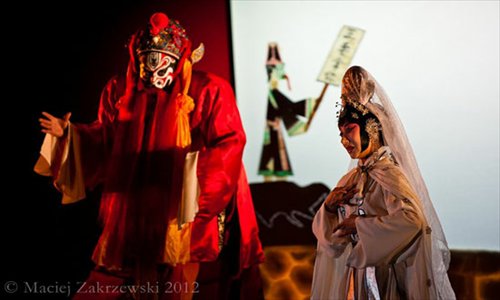
Scene from the play, staged in Poland. Photo: Courtesy of Han Chi
Experimental Peking opera, an innovative attempt to revive a traditional Chinese art, is pervasive nowadays. Despite failed predecessors, new shows emerge one after another in a quest to balance tradition and modernity while finding an audience.
The Execution of the Judge of Hell, based on the traditional Peking opera, Zha Panguan, incorporates shadow play and Peking opera with experimental twists.
The Execution of the Judge of Hell will run from August 8 to 19 at the Xiaoke Theater, in Beijing's 798 Art Zone.
This is the second time the play will be staged for domestic audiences, said Han Chi, producer of the play.
"After this round, we will go to France and Italy for the rest of the year," she said. "Since it was produced in 2009, we have been trying to introduce it to audiences at home and abroad," said Han. "We have been targeting foreign audiences, because we hope foreigners will understand and love traditional Chinese culture."
French director
Directed by French director Sarah Oppenheim, the play premiered in June 2009 at the 4th China-France Cultural Season in Beijing. It then toured several European countries including France and Poland, where Han said it was positively received.
"The combination of Peking opera and shadow play is new to them, as well as the Chinese storyline," Han told Global Times.
Peking opera and shadow play are time-honored traditions in China, but the two art forms are rarely staged together.
Though Peking opera is granted State protection, shadow play, or shadow puppetry, has gradually retreated from public eye, despite its entry into the UNESCO World Intangible Heritage Lists in 2011.
The play, with its dual setting on earth and hell, offers an optimal chance to incorporate the two.
The Execution of the Judge of Hell is tells the story of Bao Gong, or Bao Zheng, an incorruptible official in Chinese history.
The Judge of Hell unfairly judges a case that involves the death of a young woman, Liu Jinchan, killed by the son of the Judge of Hell. Liu's beloved cousin is framed as the killer and sentenced to death.
Bao's investigates the case and is assisted by Youliugui, a lamplighter and witness to everything that has happened.
Western elements
The play brings in Western stage elements under the foreign director. Differing from the original script where Bao Gong is the leading character, Youliugui plays the main character in the updated version.
"Bao Gong has the power to judge the living and the dead, and he was the hero of the play. But I wanted Youliugui, the minor character, to become the main character," said Oppenheim.
Despite Youliugui's secondary role in the original plot, he is an indispensable character who provides narration and resolution.
"He's the link, the one who tells Bao Gong what happened. Since Bao Gong is like a god and a hero to Chinese people, there's a huge distance between ordinary people and him." Oppenheim said.
But a small lamplighter belongs to people. As the common, everyday hero, there will be less distance between the audiences and the characters, she said.
The mode of storytelling also draws from Western stage plays. Usually in a Peking opera the story unfolds in a gradual and slow way, but Oppenheim makes it more accessible to foreign audiences, according to Han.
"What happens in hell is performed by Peking opera actors, and what happens on earth is portrayed by shadow puppets," Han said.
Oppenheim said she wanted to deliver the message that people living in the real world cannot always live as they want.
At times, they are controlled, just like puppets and the female character Liu Jinchan. Liu's life is controlled by her father, and she is unable to live with the one she loves.
"The tour marks the completion of the play," said Wang Xuehua, leading actor of the play Youliugui. "We are seeking the best way to express tradition culture to modern people."
New experimental elements are included in this month's performance, like modern music that incorporates the guitar and piano, and pingshu, a traditional storytelling performance.
Trial and error
Early this year, two bold innovative Peking opera plays aroused interest but received mixed responses.
Farewell My Concubine, a new Peking opera staged February in Beijing by Chinese-American director Chen Shizheng, combined modern multi-media technology with stunning costumes and set.
It used a real Ferghana horse priced at 8 million yuan ($1.26 million) on stage. But the dazzling visual effect distracted from the Peking opera itself. The Ferghana horse left a long lasting impression, not the performance.
In February this year, Peking opera Three Kingdoms, which incorporated pingshu, premiered.
Though it received less criticism than Farewell My Concubine, it was regarded as a dry and mechanical combination of two traditional arts.
"These are attempts to revamp traditional culture," said Han. "But only those that stick to the basics can stand the test, especially for the overseas market."
"For a while we thought that due to the cultural barrier, foreign audiences can't understand traditional Chinese art," she said. "But not only do they understand it, they prefer an accurate execution."
Han said that promotion or stunning visual effects will not draw in foreign audiences. The key to success rests on the play and art itself.
The Execution of the Judge of Hell, based on the traditional Peking opera, Zha Panguan, incorporates shadow play and Peking opera with experimental twists.
The Execution of the Judge of Hell will run from August 8 to 19 at the Xiaoke Theater, in Beijing's 798 Art Zone.
This is the second time the play will be staged for domestic audiences, said Han Chi, producer of the play.
"After this round, we will go to France and Italy for the rest of the year," she said. "Since it was produced in 2009, we have been trying to introduce it to audiences at home and abroad," said Han. "We have been targeting foreign audiences, because we hope foreigners will understand and love traditional Chinese culture."
French director
Directed by French director Sarah Oppenheim, the play premiered in June 2009 at the 4th China-France Cultural Season in Beijing. It then toured several European countries including France and Poland, where Han said it was positively received.
"The combination of Peking opera and shadow play is new to them, as well as the Chinese storyline," Han told Global Times.
Peking opera and shadow play are time-honored traditions in China, but the two art forms are rarely staged together.
Though Peking opera is granted State protection, shadow play, or shadow puppetry, has gradually retreated from public eye, despite its entry into the UNESCO World Intangible Heritage Lists in 2011.
The play, with its dual setting on earth and hell, offers an optimal chance to incorporate the two.
The Execution of the Judge of Hell is tells the story of Bao Gong, or Bao Zheng, an incorruptible official in Chinese history.
The Judge of Hell unfairly judges a case that involves the death of a young woman, Liu Jinchan, killed by the son of the Judge of Hell. Liu's beloved cousin is framed as the killer and sentenced to death.
Bao's investigates the case and is assisted by Youliugui, a lamplighter and witness to everything that has happened.
Western elements
The play brings in Western stage elements under the foreign director. Differing from the original script where Bao Gong is the leading character, Youliugui plays the main character in the updated version.
"Bao Gong has the power to judge the living and the dead, and he was the hero of the play. But I wanted Youliugui, the minor character, to become the main character," said Oppenheim.
Despite Youliugui's secondary role in the original plot, he is an indispensable character who provides narration and resolution.
"He's the link, the one who tells Bao Gong what happened. Since Bao Gong is like a god and a hero to Chinese people, there's a huge distance between ordinary people and him." Oppenheim said.
But a small lamplighter belongs to people. As the common, everyday hero, there will be less distance between the audiences and the characters, she said.
The mode of storytelling also draws from Western stage plays. Usually in a Peking opera the story unfolds in a gradual and slow way, but Oppenheim makes it more accessible to foreign audiences, according to Han.
"What happens in hell is performed by Peking opera actors, and what happens on earth is portrayed by shadow puppets," Han said.
Oppenheim said she wanted to deliver the message that people living in the real world cannot always live as they want.
At times, they are controlled, just like puppets and the female character Liu Jinchan. Liu's life is controlled by her father, and she is unable to live with the one she loves.
"The tour marks the completion of the play," said Wang Xuehua, leading actor of the play Youliugui. "We are seeking the best way to express tradition culture to modern people."
New experimental elements are included in this month's performance, like modern music that incorporates the guitar and piano, and pingshu, a traditional storytelling performance.
Trial and error
Early this year, two bold innovative Peking opera plays aroused interest but received mixed responses.
Farewell My Concubine, a new Peking opera staged February in Beijing by Chinese-American director Chen Shizheng, combined modern multi-media technology with stunning costumes and set.
It used a real Ferghana horse priced at 8 million yuan ($1.26 million) on stage. But the dazzling visual effect distracted from the Peking opera itself. The Ferghana horse left a long lasting impression, not the performance.
In February this year, Peking opera Three Kingdoms, which incorporated pingshu, premiered.
Though it received less criticism than Farewell My Concubine, it was regarded as a dry and mechanical combination of two traditional arts.
"These are attempts to revamp traditional culture," said Han. "But only those that stick to the basics can stand the test, especially for the overseas market."
"For a while we thought that due to the cultural barrier, foreign audiences can't understand traditional Chinese art," she said. "But not only do they understand it, they prefer an accurate execution."
Han said that promotion or stunning visual effects will not draw in foreign audiences. The key to success rests on the play and art itself.
Posted in: Miscellany