HOME >> ARTS
Express yourself: Domestic designers aim to create unique looks for China
By Liao Danlin Source:Global Times Published: 2012-8-12 20:05:04
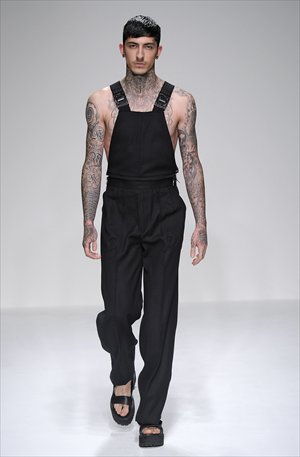
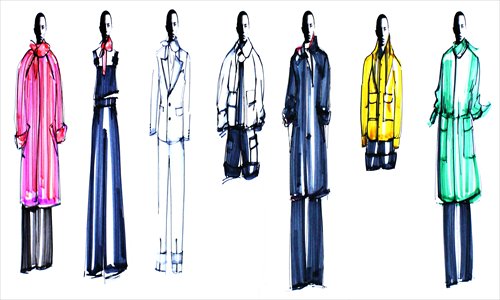
Zhou's manuscript
Xander Zhou Collection. Photos:Courtesy of Xander Zhou
Chinese designer Zhou Xiangyu showcased pieces of his brand Xander Zhou during London Men's Fashion Week in June, and designer Yin Yiqing debuted at 2012 Paris Haute Couture Fashion Week in July.
Chinese designers are reshaping themselves into innovative and unique figures in the fashion industry. Abandoning stereotypical Chinese elements, the younger generation is weaving their interpretations in designs.
Studying abroad
Liu Qingyang, an independent Chinese designer, saw her designs appear on the cover of Vogue China this January.
She said that like herself, many of the younger generation of designers studied abroad.
Before, going abroad was a rare honor, but young people today have more opportunities to experience a different culture and learn from the best in fashion.
Other examples include Wan Yifang from Xiamen, Fujian Province and Ma Masha from Beijing. Both trained at Central Saint Martins College of Art and Design in London.
Wan gained fame this year after her design was worn by Lady Gaga, during the singer's trip to South Korea. Ma is a common face in fashion shows around the world.
"Design is a language," said Hu Nan, the editor-in-chief of Fashion China.
She finds that young Chinese designers growing up in the globalized era receive similar educations as their international peers. With a nuanced understanding of fashion, beauty and design, this group can speak the same language as designers in the rest of the world.
Also trained in Saint Martins as a textile designer, Liu Qingyang developed a systematic understanding of the creative process, from research to ready-to-wears in London.
After graduation, Liu founded her line Chictopia in 2009, in Beijing. It soon became popular and was selected by Hong Huang in her Brand New China (BNC) retail venture. Chinese fashion icon Fan Bingbing along with other actresses have worn Liu's designs to various events.
"I was clear about my goal during my last year at university. I wanted to create my own brand. It was at the right time, and the market in China was [receptive]. The production costs in China are also relatively low," said Liu.
"The media is paying attention to independent designers in China. And China needs original brands," she added.
Zhou studied fashion in the Netherlands and came back to Beijing to pursue his dreams. For him, being an international student cultivated individuality. Zhou said he learned how to develop himself during his time abroad.
Instead of working under big names in the fashion world in Europe, Zhou returned home to base his studio in Beijing's Jianwai SOHO in 2007, focusing on high-end men's wear.
"The system in Western countries is fully developed and regulated, leaving little space for big changes," said Zhou.
Niche markets
"Everyone is working hard in their own way," said Zhou, who sees domestic designers today as pioneers in the fashion industry.
As the development of this field started in China in recent decades, existing business models cannot cover the entire market. Young designers are discovering endless possibilities in the fashion industry.
"Starting is hard, positioning a brand, contacting suppliers, and marketing - each step was difficult," said Liu who feels most independent designers are targeting niche markets in China.
She said that for many young designers, initial start-up money comes from family support.
Zhou faces a different group of consumers. "Men are more loyal to the fashion brand they like," said Zhou.
His intention is to explore new possibilities and experiment with men's trends. He said that the idea of a "niche market" is not small, especially for designers who create original work instead of repeating trends, like some mainstream fashion companies do.
A similarity these designers share is their focus on individuality and the absence of obvious Chinese elements.
"Nationality is not a proper way to classify designers," said Liu. "Fashion is an attitude, a lifestyle." Liu told Global Times that she wants to craft her own image of a confident, modern Chinese woman, with elegance and humor.
For Zhou, design is a form of self-expression. He said that in an age of globalization and mixed culture, creations from young domestic designers reflect China without needing to use cliché Chinese elements. Emphasizing ethnicity suggests a lack of innovation.
Opportunities, challenges
Domestic designers are currently facing different obstacles and fickle markets. Liu said lacking experience, many independent brands fail to expand.
These brands want to enter malls and big shopping centers but struggle to find a place in the mainstream.
For Zhou, the challenge comes from creating a new line every season. Results may not generate in a short time, requiring confidence to continue.
Hu said that unlike older designers who have years of experience working for a brand, many young designers gain fame through media recognition and attending events in the international community. A lack of business experience is a common weakness.
On the other hand, the potential for future development is also obvious.
"This is a great time for Chinese designers. They have the attention of the world and support from domestic consumers, organizations and financers," said Hu.
"One should understand his position, set a high standard and speak through the work itself," Zhou said.
When staged alongside top designers from around the world, high quality designs speak for themselves.
Posted in: ARTS