You can be sure of shells
"The moment I get up in the morning, I realize that I will spend a whole new day with my beautiful shells, and that makes me happy and excited," said He Jing, holding aloft several colorful conches from the Philippines, a small fraction of his 7,000-strong collection of shells.
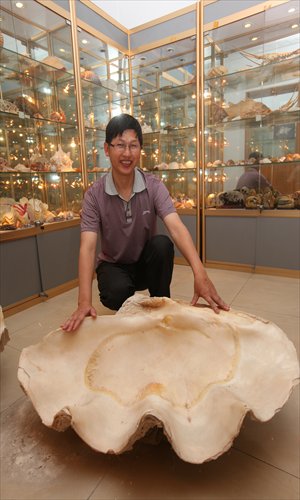
He first came up with the idea of a shell collection when he graduated from Tsinghua University. And now his 100-square-meter museum named Gondwana which he set up in Songjiang district in 2008, displays shells that He has collected from China, Canada and Australia among many other countries. "I've got shells from probably every sea and ocean in the world," He told the Global Times.
Passion for collecting
He is a professional conchologist, (who studies and collects shells) and he claims to be the only full-time shell dealer in China. He started his business in 2005, before which he worked in the food industry in Shanghai. But this steady and reliable job couldn't compete with his passion for collecting and studying shells, so he decided to turn this hobby into a career. Today, He is in contact with some 1,000 shell enthusiasts all over the world. And every week he is able to put between 200 and 300 shells online for sale which means he is able to cover the museum's daily running costs.
"There are only a few public nature museums in China, roughly equivalent to the number that a single American state can boast. That's unbelievable," said He.
Entry to He's museum is free, and he said that teenagers make up the majority of visitors.
"I hope that through studying and touching these beautiful shells, children will gain some knowledge of biology and this will inspire a wider interest in nature," he said.
According to statistics from the Chinese Academy of Sciences, China is home to 1,500 indigenous species of shell, far less than the 4,500 species He has painstakingly collected over the years. "I take three or four 'shelling' trips every year, collecting and taking photos of new shells, especially those that are not already very widely recorded."
High-altitude areas
In August 2007, He went to Tibet looking for shells in high-altitude areas. He walked for 10 hours along the shore of Namco, a lake located in the Qinghai-Tibet Plateau with an altitude of more than 4,700 meters. At the end of 2008, he embarked on a 20-day trip into the East China Sea with local fishermen. He said that such trips are both educational and pleasurable.
He is constantly replenishing his collection, and enriching the displays at his museum. In 2004 he set up a website to classify and store pictures of all the shells in the museum. He still updates the site every Tuesday.
"And if I ever forget to update the site, some shell fans will send me an e-mail or ring me to ask why!" He told the Global Times. The website provides basic information about shells, as well as tips on collecting and how to spot a fake shell.
In the shell-collecting community, He is known by the nicknames "Biluo" and "Mitra" and he is happy to give advice to other shell enthusiasts, including how to identify certain shell species. In 2011, he donated 170 shells to the National Zoological Museum of China. "I'm fond of sharing the happiness of collecting shells with others," he said.
In 2006, He began to build a "shell library" on the internet. The English-language site (www.shellspecimen.net) contains 16,300 shell specimens, and all of them can be searched using key information such as species name and provenance. In the early 1990s, He also began compiling a natural science dictionary in Latin, English and Chinese. Although the trilingual dictionary has not been published, it can be accessed on the Internet free at www.ganvana.com/dic.asp.
Overseas enthusiasts
He's guidebook entitled Shells: A Guide to Their Collection, Identification, Preservation has been published by ConchBooks, a German publisher that specializes in books about fossil shells. All of the pictures in the book were taken by He. "I have probably taken more than 300,000 photos of shells over the years."
He added that the museum is becoming increasingly popular with overseas enthusiasts. "I usually welcome between 30 and 50 foreigners to the museum every year, some of whom have made a special trip to come here," He said. A 75-year-old American collector made his second visit to the museum this May, studying He's collection for two full days before flying back to the US. "As for Shanghai, the number of foreign shell fans in this city is no smaller than that of locals," he added.
When asked about his plans for the future, He said that he will continue to enjoy the business side of the job, as well as the research and trips. "I am lucky enough to be able to make a living from what I really love doing," he told the Global Times. "And I intend to keep it that way."
Gondwana Musuem
Add: Room 101, 158 Dingxin Apartment, Guyang Road North
谷阳北路鼎信公寓158号101室
Tel: 6773-7531 (appointment required)