Shaanxi, a mecca for writers
Rustic realism surfaces in local literature
For tourists and locals alike, the city of Xi'an in China's northwest Shaanxi Province is as well-known as the country's capital city of Beijing. Known for signature cultural relics like the Terracotta Warriors and the Greater Wild Goose Pagoda, this ancient capital city is usually on the list of must-see sites.
Shaanxi is not just famous for its concentration of cultural heritage from China's 5,000 years of history; it is also attracting attention for its modern literature. Local writers like Jia Pingwa, Chen Zhongshi and Lu Yao (1949-92) have long become household names.
"Since the opening up (in 1978), three writers received the Mao Dun Literature Prize, the most prestigious literature award in China, six received the Lu Xun Literature Prize and others were recipients of literary prizes like the Bing Xin Award and Jun Ma Award," said Lei Tao, executive vice president of Shaanxi Writers Association.
"Shaanxi novelists represent the pinnacle of literature in the country," Lei told the Global Times.
Consistent development
In the 1950s and 60s, novels like History of Starting up an Undertaking by Liu Qing (1916-78), In the Peaceful Days by Du Pengcheng (1921-91), and On the Beach by Wang Wenshi (1921-99) were representatives of Shaanxi's literature, reflecting a change of pace in rural lives and mentalities during the socialist reforms of that period. Their influence in the literary circle was already obvious.
"Works then featured a revolutionary realism," said cultural critic Xiao Yunru, in an interview with Xi'an Daily in September.
In recent years, Shaanxi literature gained wide recognition following masterpieces like Jia Pingwa's Turbulence (1987), Deserted City (1993) and Qin Qiang (2008) and White Deer Plain (1993) by Chen Zhongshi.
Shaanxi literature of 60 years shares one common characteristic: a realism that reflects local life in different eras, according to Xiao.
"Realism is a tradition among Shaanxi writers," said Lei. "Most writings centered on life in the countryside, reflecting local life and psychological changes."
For example, White Deer Plain, which earned author Chen Zhongshi the 4th Mao Dun Literature Prize in 1997, describes three generation of interactions between the Bai and Lu families in their village. The novel chronicles 50 years from the end of the Qing Dynasty (1644-1911) to the beginning of the founding of the country (1949).
Jia Pingwa's Qin Qiang took home the 8th Mao Dun Literature Prize in 2008. The author depicts the profound upheavals in a village, values and interpersonal relationships brought by the period of opening-up in the late 1970s. The story is based on Jia's hometown, Danfeng county, southeast of Shaanxi.
"This is similar to the works of other local writers like Ye Guangqin, Gao Jianqun and Feng Jiqi," said Lei. "They are familiar with this subject. This is an advantage."
Rich resources
Standing as the capital city for 1,000 years from the Han Dynasty (206BC-220AD) to the Tang Dynasty (618-907), Xi'an has long been the cultural center of China, along with neighboring areas of Shaanxi Province.
"Shaanxi has a strong significance in history, a place of diverse cultures," said Lei.
According to him, the northern parts of the province integrated nomadic culture, while the central area inherited culture from the Zhou Dynasty (1046-256BC) to the Tang Dynasty. The southern area was influenced by Bashu Culture, a branch of Chinese culture dating back to the late Neolithic Age, mainly taking shape in southwest Sichuan Province.
"This area is immersed in traditional Chinese culture," said Qiu Huadong, deputy chief editor of People's Literature, China's flagship literature magazine. "Local lives represent a good deal of Chinese history. Writing about local life is writing about the Chinese [identity]," Qiu told the Global Times.
"They depicted the life of these locals, reminding us of being Chinese and our roots," he added.
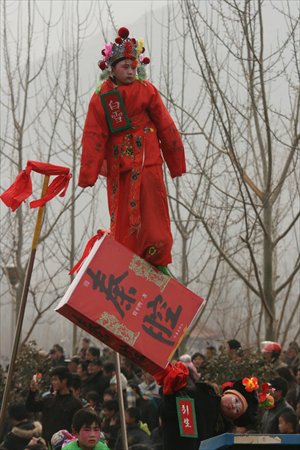
The historic Yan'an Talks on Literature and Art in 1942, a speech given by Mao Zedong on the role of literature and art in the society was held in Shaanxi. This later influenced the development on literature, encouraging authors to write about the realities of workers and farmers.
"Being held in Yan'an also gave Shaanxi writers an advantage, influencing their writing direction," said Lei.
A voice in the community
Though focusing on rural subjects earned Shaanxi writers a strong domestic following, they are often under scrutiny for being limited in their subject.
"These writings revolve around traditional life in the countryside, featuring Shaanxi dialect, Confucius beliefs and feudal patriarchal systems in ancient China," said Qiu. "Writing in the native language and dialect poses difficulties for their works to be translated."
"It's valid that they write about country life, as we have 900 million farmers in a country with a population of 1.3 billion," said Lei.
Besides, Shaanxi is the birthplace for Chinese civilization. Writing in the local dialect remains true to the heritage set from the Zhou to the Tang Dynasty, Lei said.
Emerging Shaanxi writers are widening their areas of expertise. Wang Hai, an author in the region, is being increasingly known for approaching urban subjects in Paradise, Lao Fen and City Gate.
Meanwhile, writers like Kou Hui, a representative of Magic Realism which is a mainstream literary style today, and Wang Yan, a writer of children books like Large-Headed Turtle and Red-Faced Rabbit are all trying their hands at different genres.
"In the future, more writers may write about contemporary issues, as the country is in the process of urbanization and industrialization. But the countryside will remain a rich source for Shaanxi writers," Lei said.
Urbanization brings many problems to rural areas, such as land requisition and compensation, employment, and psychological adjustment to city life for farmers.
"Meanwhile Shaanxi is an inland region less exposed to outer influence and maintains much of the Chinese tradition," he explained.