HOME >> BUSINESS
Closed for business
By Zhang Ye Source:Global Times Published: 2012-11-8 20:10:06
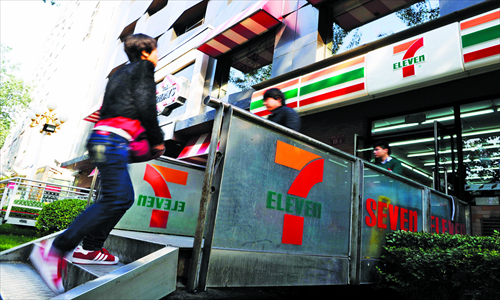
A 7-11 store in downtown Beijing. Photo: Li Hao/GT
At almost 2 am on the Tianshuiyuan East street near Beijing's CBD, a 25-year-old man was looking around anxiously, hoping to find somewhere to buy some food.
Off duty from his night shift, Qin, a Shanghai resident who was transferred by his company to Beijing in May, was looking for a convenience store to buy a snack, but he couldn't find one.
In Shanghai, there are convenience stores everywhere, Qin said.
Beijing should in theory offer a promising market for convenience stores as the local purchasing power is strong. However, companies in the sector have encountered a series of obstacles hindering their growth.
At almost 2 am on the Tianshuiyuan East street near Beijing's CBD, a 25-year-old man was looking around anxiously, hoping to find somewhere to buy some food.
Off duty from his night shift, Qin, a Shanghai resident who was transferred by his company to Beijing in May, was looking for a convenience store to buy a snack, but he couldn't find one.
In Shanghai, there are convenience stores everywhere, Qin said.
Beijing should in theory offer a promising market for convenience stores as the local purchasing power is strong. However, companies in the sector have encountered a series of obstacles hindering their growth.
Rigid regulations
According to UK-based retail consultancy Kantar Retail Analysis, the development of convenience stores in a city is proportional to the city's GDP, and the market can become strong when average per capita GDP surpasses $10,000.
In 2011, Beijing's average per capita GDP reached $12,447. However, while Shanghai had 7,600 stores by 2011, Beijing had only 2,200 according to Kantar Retail Analysis.
Many ambitious convenience stores operators in China and abroad are deterred by the unfavorable regulations in Beijing.
It is hard for them in the capital to offer cooked food legally, as they have to get a catering service license. The license is used to regulate businesses in the catering industry like restaurants, according to an insider who has been in this sector for 10 years and wished to remain anonymous.
"In order to obtain the catering service license, our stores have to be equipped with unnecessary facilities, like the special drainage systems that restaurants have. We are even required to hire cooks," he noted. "Shanghai has issued specific and flexible regulations for convenience stores, facilitating their expansion."
Japanese-owned 7-11 is the only foreign convenience store in Beijing so far. It gained permission to offer cooked food, according to the insider, but it still faces the risk of fines from the Beijing Administration for Industry and Commerce (BAIC).
"Last month, we paid a fine equal to nearly a month's profit for not keeping packed box lunches in the thermal insulation cabinet," said a member of staff surnamed Li at a 7-11 near the CBD. Li said that BAIC officials frequently make site inspections and can always find reasons to impose fines.
Many small convenience stores continue to sell boxed lunches and boiled fish balls to local residents without permission, said Zhong Xiaobing, the vice president of Wumart Group, a Beijing-based retail chain operator.
Cold weather, wide roads
The tricky regulations in Beijing are not the only problem. The capital's long winter, dispersed city planning and local residents' consumption habits are also obstacles for the local convenience stores market.
In 2010, the lowest temperature recorded in Beijing during winter was -16.7 C, while it was -5.9 C in Shanghai, according to data released by the National Bureau of Statistics.
"We would like to operate around the clock as there are still consumers who want to buy things at night. However, how many people will be on the streets when the temperature is -10 C? After 8pm in winter, community consumption is almost zero," said Zhong.
Chen Yuefeng, a retail chain store expert and associate editor of China Chain Store magazine, noted that Beijing's cold weather is another reason why overseas retail firms are not so enthusiastic about the market in the capital, as more than 50 percent of stores' revenue normally comes from nighttime operations.
All 7-11 stores are required to work around the clock, not because there are many people shopping after midnight but because the company will supply goods during the night, according to Li from 7-11.
7-11 has started to turn all its stores in Beijing into franchise stores and does not intend to open new stores here in the near future, Li said, as profits in the capital have been less than expected so far.
According to Kantar Retail Analysis, Family Mart, a leading Japanese convenience store operator had opened 600 stores in Shanghai by last year, but it has not yet opened any in Beijing.
The company considers Shanghai to be a more suitable market, as its city planning is more like Tokyo's, with alleys and streets for people to walk around, while people in Beijing prefer to drive, according to Mitsuyoshi Harada, the company's vice president.
Wang Hongtao, head of the press department with Beijing-based China Chain Stores & Franchise Association, said that unlike Shanghai, Beijing mainly consists of wide roads and sight-blocking overpasses, making it hard for consumers to spot the convenience stores across roads.
Not interested
Having stayed in Beijing for less than five months, Qin is going to convenience stores far less frequently than in Shanghai. The difficulty in finding them is only one reason for this. Another is that the services and goods in Beijing's convenience stores are less appealing.
Those in Shanghai offer cooked food around the clock, while the ones in Beijing sometimes turn off their outside lights at night, even though they're still open.
"Before working in Shanghai, I saw convenience stores as small shops around the corner where I could get daily necessities like shampoo, instant noodles and toilet paper. But I rarely shopped there," said Liu, a Beijing resident who recently moved to Shanghai.
Partly due to the local residents' cool attitude toward convenience stores, firms in this sector have less incentive to improve their services in Beijing, and other firms are not so eager to enter the sector and boost competition.
However, Zhong from Wumart still expressed confidence in the future of Beijing's market, given that although Beijing's winter is cold and most residents tend to head home at night, there are still many people who work late into the night or who watch overseas sports live in the early hours of the morning, and who need to buy food and drinks.
Beijing may not witness fast growth in this sector, but the demand remains fairly strong. As long as they operate in the CBD or near higher-end residential districts, stores can still make a profit, noted Chen from China Chain Store.
Posted in: Insight