Where small is beautiful
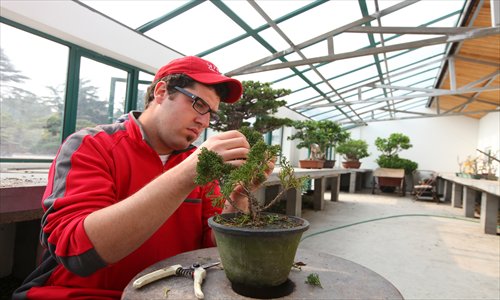
Small things have brought a 30-year-old Canadian to Shanghai to work long hours and labor intensively. But Matthiew Quinn wouldn't have it any other way.
Quinn is in the city to study the art of penjing, the 2,000-year-old Chinese art of creating a miniature landscape with trees, a forerunner of the Japanese bonsai treescapes. He spends most of his time tucked away in the south of Shanghai's downtown area, in the four-hectare Penjing Garden in the Shanghai Botanical Garden. This is considered the best penjing garden in the world and showcases more than 2,000 examples of the delicate and intricate art form.
Quinn has been sent by the Montréal Botanical Garden to learn the Chinese art of styling and maintaining these miniature trees and landscapes.
"I was really impressed at the sheer amount of penjing that the garden has here in Shanghai and the quality. You have very nice trees here," Quinn told the Global Times.
"Most of the trees here are not good enough to be put on display here. They are kept as a backup. But if you took these trees to Canada, they would be some of the best in the country. Even the nursery here is amazing for me."
Fascinated with age
"What I find fascinating in China, at the moment, is you keep penjing trees for a long time. The trees are probably 70 to 80 years old and have been kept in penjing style and artistically managed for a very long time," Quinn said.
In Canada, he explained, there were no trees that old. He was captivated about the long and rich history of penjing art here. In Canada, penjing has only existed for about 35 years. "That is something we do not have, and I have only half a year to absorb everything."
Feeling the pressure of his limited time in Shanghai, Quinn has proved a very diligent student since arriving here a month ago, according to his teacher, Zhao Wei, a senior penjing stylist and artist at the Shanghai Botanical Garden.
Quinn will stay in Shanghai till the end of December, and then he will move to Guangdong Province for further study.
"He comes here every day to practice, even at the weekends when I have told him to take a break. I am really touched to find a foreign student so dedicated and with passion for our traditional art. Most of the young men that come to work here leave within six months because of the low wages and hard work involved," Zhao told the Global Times.
Zhao said Quinn had quickly picked up the basic styling skills. And he is gradually grasping the essence of Chinese penjing by comparing it to Japanese forms - bonsai is related to penjing but is very different in practice.
"Chinese people like to have more space between the branches. So when you look at the silhouette of a tree, it's not big in form, but it's got details like slanting or curved trunks, layers of foliage and exposed roots. The Japanese prefer a fuller shape," Quinn said
The style of penjing art reflects other Chinese art forms like Chinese landscape ink drawings which traditionally feature contrasts between emptiness and substance, denseness and sparseness.
"The scene becomes more vivid when the trees reflect these contrasts in their setting. We believe a young seedling is better appreciated when it is contrasted with an old stump. These aesthetics reflect the Chinese concept of the universe as one that is governed by two contradicting forces," Zhao said.
Rhythm and charm
In Quinn's eyes, this technique brings rhythm and charms to penjing. "Bonsai in Japan are calmer and express serenity rather than movement."
Zhao explained that this was a generalization and that there were some Japanese bonsai artists who preferred to set more space in their leaf clusters while some Chinese penjing stylists formed more solidity in their works.
Quinn said that back in the Montréal Botanical Garden, there were collections of penjing and bonsai. "For me, the penjing collections contain more emotion than the Japanese examples which are more peaceful, more reserved - like someone who is very shy."
"Penjing is much more expressive. When I look at penjing and bonsai, I feel that when the Chinese people create penjing, they don't care what other people think. They express themselves and they have fun. Whereas when I look at bonsai, I have the impression that the Japanese artists always do the same thing, like other artists there, catering to other people's likes and dislikes."
He has discovered that Chinese penjing artists cut more growth than the Japanese, which partly due to the climate - having longer seasons means the trees have more growth. "If you cut more, it doesn't matter, because the following year, more branches will grow. But in Canada or Japan, if you cut too much, you have to wait for a really long time for the penjing to form a nice silhouette again," Quinn said.
Another uniqueness he found in the art form was the use of accessories like miniature figurines, pavilions and rocks. Quinn said in North America and elsewhere in the world, artists did not use accessories the way Chinese did.
The accessories help make penjing live up to its name (beautiful scenery preserved in miniature). And if there is a small figure, it can help observers relate to the landscape, giving a contrast of the grandeur of nature compared to the minor part a person can play in it.
Different schools
Some visits to Suzhou in the neighboring Jiangsu Province have given Quinn some insights into the different schools of penjing in China.
"In Suzhou the pine trees have rounded tops but the Shanghai school artists leave the pines with flat tops.
"The first Shanghai penjing masters decided that they were going to style the trees according to the pine trees growing on a mountain. They probably saw them as having flat tops. They were trying to show the trees the way they saw them," he suggested.
He said the Lingnan style dominated the art form in the southern part of China. "They create branches and structures. In the south, they master deciduous trees. They often grow and cut to form dynamic lines. They are not smooth, so it surprises you when you look at them," he said.
Quinn is now exploring the different styles because they have some trees from Shanghai back in Montréal and he wants to recreate the views. To do this he has to understand the different styles of penjing.
The trees of the Shanghai school of penjing are free curving and have extended branch lines. Unlike the symmetrical shapes widely found in Japanese bonsai, or the aged appearance of the Suzhou school, the Shanghai school artists feel that spontaneous-seeming trees are the most beautiful, Zhao said.
Although the landscapes in penjing are highly designed and trees are wired for support, the overall impression that the Shanghai school of penjing delivers to onlookers is that man cannot impose himself on nature, and that nature is not something that can be tamed or rigidly controlled.
Quinn sees it like this: "The one thing that I keep in mind is that one has to go with the pace that nature wants to go at. You cannot push. You have to do it at the right moment, watering, cutting and wiring. The plant should be healthy. If it is not, you cannot wire it. Otherwise, you are not helping it."
Teacher Zhao said that in reality it took many efforts and many skills to make things look as natural as they did in good examples of penjing.
Creativity and nature
After years of experience, Zhao believes that a good penjing is the result of the partnership between man's creativity and nature's forces. It is the years spent on nurturing the plant and responding to its natural tendencies that make penjing a high art.
"It condenses every element into a small container - time, space, and human activity. One can create something really beautiful with the magic touch of nature, and this is really life-enhancing," he said.
Quinn's visit has attracted the attention of senior management at the Shanghai Botanical Garden.
"It shows the huge influence of penjing art - here is a young man from abroad who has come a long way to study here. We do hope there are more young Chinese who will develop an interest in this ancient art form, and that more of them will be willing to devote themselves to it," Feng Shucheng, the curator of Shanghai Botanical Garden, told the Global Times.
Feng said that penjing gives people a temporary escape from life. "It doesn't matter whether the penjing was designed for ancient scholars and aristocrats or for modern city dwellers, everyone needs a way of getting away from the daily hustle and bustle. Penjing art is a pastime that creates a green retreat for the mind, insulating it from the noisy world."