Eroticism for the Ages
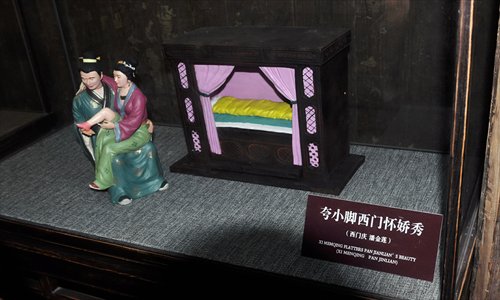

Controversial and rich in sexual details, Jin Ping Mei, or The Plum in the Golden Vase, has been a taboo book in China for centuries.
Composed during the Ming Dynasty (1368-1644) by an author using the pseudonym "Lanling Xiaoxiao Sheng," the book still holds the adoration of scholars. A new take on the old text, Liu Xinwu's Critiques on 'Jin Ping Mei,' was published just last month. With Liu's keen aesthetic vision and sharp, sophisticated language, the book is a must-read for fans.
Previously acclaimed for his literary criticism of another Chinese classic, The Dream of the Red Chamber, Liu states in the preface, "It's wrong to think of the sexual descriptions completely as a 'stunt' to attract readers." Instead, he considers the sexual explicitness of the book an essential part of the realistic and naturalistic masterpiece, revealing the extensive and complicated social life of that time, as well as the experiences that make up the human condition.
"The narrative style of it is calm, without anxiety or heaviness, without agony or romance - it's the most realistic one of its time," Liu writes.
Jin Ping Mei is often seen as a Chinese counterpart of the notoriously tawdry novels in English literature, such as Fanny Hill, Tropic of Cancer, and especially Lady Chatterley's Lover, by D. H. Lawrence.
Jin Ping Mei and Lady Chatterley's Lover, published in 1928, have bold, intuitive and licentious descriptions of sex. The sexual interactions play impactful roles on the plots and plights of characters in both novels.
The two novels' differences lie in writing styles, themes, characters, and cultural backgrounds.
Employing thousands of words, the author of Jin Ping Mei describes each sexual experience thoroughly, sometimes even redundantly. It emphasizes the abnormal and adulterous, and even sadomasochism. The main male character, Ximen Qing, has intimate relationships with more than 20 women. He is a promiscuous villain, an embodiment of all the evils, including adultery, prostitution, incest and pedophilia. This was a story and a style that Chinese literature had not yet seen.
Sexual descriptions in Lady Chatterley's Lover, on the other hand, seem to have deeper cultural connotations, and more complex implications. Lady Chatterley and Oliver Mellors made love in a cabin, in nature, and in a storm, with all the vitality of life, suggesting the contrasts and unions of body and mind.
When it comes to the sexed-up female characters, Jin Ping Mei's Pan Jinlian is portrayed as both a despicable, malicious slut and a pitiful victim of the time period. In the hands of D. H. Lawrence, however, Lady Chatterley fights for her sensual and mental happiness with integrity and dignity. She is noble, not notorious.
Both books comment on their respective mileus, each providing a unique critique of society. Jin Ping Mei asserts that humanity is sinking into depravity. The book warns that ugly behaviors can lead to tragic destinies.
Sexual restraint is condemned, however, in Lady Chatterley's Lover, and the book tries to build a new relationship between the two genders, united against the industrial civilization.
Erotic literature like Jin Ping Mei helped break through old, conservative China. New critiques may also brave insight into humanity. As Liu asserts, "Jin Ping Mei is a great masterpiece not only for the Chinese, but also for the mankind."