HOME >> ARTS
A story told and retold
By Wei Xi Source:Global Times Published: 2012-12-3 20:55:04
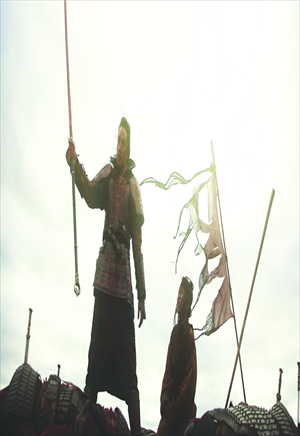
A Scene from The Last Supper Photo:CFP
A good story, whether real or fictional, will always attract attention. And despite how many times the story is repeated, there will be people who are ready to listen.
Dream of the Red Mansion is such an example. Written by Qing Dynasty (1644-1911) writer Cao Xueqin (1715-63), this novel has been adapted over the centuries into Peking Opera, Yue Opera, TV dramas and movies.
A recent film The Last Supper, directed by Lu Chuan, is about another well-known story in China - the story between General Xiang Yu (232BC-202BC) and Liu Bang (256BC-195BC), the first emperor of Han Dynasty (206BC-220AD).
Both Xiang and Liu rose up for the same purpose - to overthrow the outrageous rein of Qin Dynasty (221BC-206BC). But as the two became strong through combat, their union broke and they began to fight against each other to rule the whole nation. Xiang, a former noble who in the beginning had a much stronger army, finally lost to Liu and committed suicide.
With limited analysis in historical records, many people of later generations wonder what led the two characters to their fate and to what degree people around them influenced the result.
A good story, whether real or fictional, will always attract attention. And despite how many times the story is repeated, there will be people who are ready to listen.
Dream of the Red Mansion is such an example. Written by Qing Dynasty (1644-1911) writer Cao Xueqin (1715-63), this novel has been adapted over the centuries into Peking Opera, Yue Opera, TV dramas and movies.
A recent film The Last Supper, directed by Lu Chuan, is about another well-known story in China - the story between General Xiang Yu (232BC-202BC) and Liu Bang (256BC-195BC), the first emperor of Han Dynasty (206BC-220AD).
Both Xiang and Liu rose up for the same purpose - to overthrow the outrageous rein of Qin Dynasty (221BC-206BC). But as the two became strong through combat, their union broke and they began to fight against each other to rule the whole nation. Xiang, a former noble who in the beginning had a much stronger army, finally lost to Liu and committed suicide.
With limited analysis in historical records, many people of later generations wonder what led the two characters to their fate and to what degree people around them influenced the result.
Three versions
In The Last Supper, Lu put the major focus on the fears Liu had after Xiang was defeated. So Liu schemed and plotted to kill those who once helped him, worried that they might betray him just as they betrayed Xiang. Just as Lü Zhi, wife of Liu, says in the film, that's a lesson they learned from Xiang.
Han Xin is another figure given much attention in The Last Supper, as it is believed he was a key person to help Liu succeed. Lu depicts Han's betrayal of Xiang as a result of Han feeling neglected in Xiang's army and having some admiration for Liu.
In a different version of the story, Hong Kong director Daniel Lee expresses the idea that both Liu and Xiang were heroes worth admiring, but the tragedy is that both leaders cannot exist at the same time.
Instead of Han Xin, Lee's version, White Vengeance (2011), pays more attention to Fan Zeng, portraying him as an extremely smart man who was able to foretell the future. As he learns Xiang is going to lose, Fan uses tricks to drive a wedge between Liu and his followers.
A 1994 film of the same story provides another interpretation. In The Great Conqueror's Concubine, Xiang is described as a man with abundant power but little political skill: He takes Yu Ji, a concubine, to be more important than anything else. His defeat, as depicted in the film, to a great extent is due to his love for Yu.
Lü Zhi is taken as a key figure that influenced history. She is portrayed as a smart woman and full of scheming. Having lost her husband's love, she uses her political skill to take the crown for herself.
It's how the story is told
Besides providing different portraits of some important historical figures, the three films use different ways to tell their stories.
The 1994 work is shot in a more traditional way. It follows a natural timeline, starting from the historical background about how the Qin rule the country savagely, which causes others to rise against it.
Both White Vengeance and The Last Supper are told through flashbacks. But while the former maintains a fluid plot for the most part, The Last Supper keeps shifting between past and present.
Also, in White Vengeance, the narrator is an old man, who went through most of the issues with Liu. Though pale and weak, he has a clear mind, which enables him to tell the story completely and accurately.
In The Last Supper, however, the story is recalled by Liu on his deathbed. Though Liu wears the crown, he lives in fear in his later years, which makes him neurotic and causes the whole story to appear in segments and in a black mood.
Have your own understanding
Like most men, director Lu Chuan is very interested in films about fighting. Yet when he read the story about Xiang and Liu, what impressed him most was the story after that - how after attaining success, Liu remained troubled in his heart.
In an interview with Sanlian Lifeweek Magazine, Lu said Satelight International once came to him with the script of White Vengeance years ago, but he felt following the traditional way to talk about the story was not satisfying. He believed there were hidden stories in between the lines of historical records.
Movie critic Teng Jingshu thinks The Last Supper "is not a simple work for entertainment, but one that asks for patience and wisdom from the audience."
"It is able to surpass other films of the same theme… What Lu wants to express is all in it. [This film provides] various interpretations among different audiences, which is one of the joys of film," Teng said.
However, not everyone understands Lu's new approach to the history. A number of audiences found it difficult to understand or follow the narrator's jumping mind.
"[The story in the film is] somehow broken. It was more like a neurotic man telling his own memories, which may contain a lot of unjust personal emotions, rather than a picture of the whole historical event," a businessman in Shandong Province surnamed Zhang wrote on his Sina Weibo after watching the film.
Yet, it's hard to tell, which one among the three is the best, regardless of the fact that a work shot more than 10 years ago performs worse technically, as there are one thousand versions of Hamlet in one thousand readers' eyes.
For The Great Conqueror's Concubine, it is a work most easily understood by those with little knowledge of the history.
For White Vengeance, it fits the flavor of most audiences today, as it contains not only exciting battle scenes but also pretty faces. For The Last Supper, it's a work that sparks discussions.
"With The Last Supper, Lu answers his own doubts on history, but his work is definitely going to face doubts from the public," movie critic Yang Tiandong wrote on China Art News.
"How The Last Supper will be interpreted by audiences might become a more interesting thing than the film itself," he said.
Posted in: Film