Opera-tunity knocked
One day in the autumn of 1905 Liu Zhonglun pointed a hand-cranked movie camera at a white curtain in the Fengtai Photography Studio in Beijing. In front of the curtain stood the famous Peking Opera star Tan Xinpei performing extracts from the classic opera, Ding Junshan.
The occasion was to mark Tan's 50th birthday and was arranged by the studio owner Ren Qingtai who was a big fan of the actor.
Five minutes later, the very first piece of film ever shot on the Chinese mainland was in the can.
Favorite star
"Watching it today you realize it's nothing more than an admirer's tribute to his favorite star," Shi Chuan, deputy director of the Shanghai Film Association told the Global Times. "However it was to be the beginning of a long association between traditional Chinese opera and film, an association that lasts to this day."
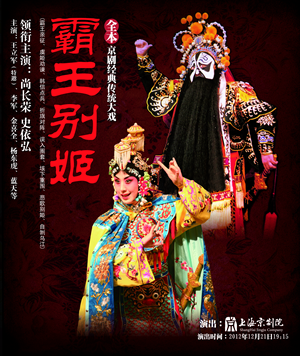
Two films featuring Yueju Opera (the opera tradition from the Yangtze River Delta region) stories, Shenyuan Qing (Love in Shen Garden) and Panfu Suofu (Protecting my Husband) were released in Shanghai earlier this month. And in 2013, a classic of the Peking Opera repertoire, Farewell My Concubine, will also be made into a film starring veteran opera performers Shang Changrong and Shi Yihong .
Sun Chongliang, director of the Shanghai Peking Opera Troupe told the Global Times that the film is a part of a nationwide project called "Filming Big Operas." And over the next few years, 10 classic Peking Operas will be given the celluloid treatment. The project is being supported by the government.
However, despite this good news, Shi said that he still feels "disappointed and helpless" about the current situation of Chinese opera films. Not only is the number of films declining every year, but the quality of those being shot also gives grave cause for concern.
"Few people care about this genre today, and it is very little known about among members of the public," he said. Shi said that the last traditional Chinese opera film he saw was so bad, that he left the cinema without waiting for the end.
"The films being made today can't compare to those produced from the 1950s to 1980s."
Shi believes these three decades were a golden age for traditional Chinese opera films.
And he has calculated that from 1905 to 2009, more than 390 such films were made in China, with 317 of them produced during these 30 years.
"These works reveal how early Chinese film directors operated in this new medium and learnt to master the language of cinema," he added.
Cinematic language
The first genuine Peking Opera film was probably 1948's Sheng Si Hen (Wedding in the Dream-Remorse at Death) starring opera legend Mei Lanfang.
"This was the first traditional Chinese opera film to be made using authentic cinematic language, and it was also the first traditional Chinese opera to be filmed in color," said Shi.
An article discussing this film, and published in a journal of the Beijing Film Academy in 2009, said that the "camera lens follows every movement of Han Yuniang (played by Mei) in a very precise way."
And the film used a combination of long distance and close-up shots. In addition, scenes also cut between the stage backdrop of a garden, for example, to scenes that were filmed in a real garden to give an extra authenticity to the story that isn't possible in a theater. Mei Lanfang also provides a voice over to the action at certain points in the film.
Shi added that after the founding of the People's Republic of China in 1949, the popularity of traditional Chinese operas provided the new government with a perfect propaganda tool.
Diplomacy film
The 1952 Yueju Opera film Liang Shanbo yu Zhu Yingtai (Butterfly Lovers) starring Yuan Xuefeng and Fan Ruijuan, is often referred to as a "diplomacy film." This is because it was screened in Geneva, Switzerland during an international conference in 1954 to discuss the Korean War and which was attended by then premier Zhou Enlai. Also in attendance that day was the Hollywood movie star Charlie Chaplin.
"The China diplomatic team screened the film for their overseas counterparts and before the showing Zhou described it as 'the Chinese version of Romeo and Juliet but with a more romantic ending," said Shi. He also recalled that the audience was "moved" by the film, and that some were even reduced to tears."
And Shi believes that this film contributed to China's improving status in the world after it was widely praised by international audiences.
With respect to the survival of Chinese Opera films, Shi and Sun both expressed a hope that the government would offer more protection and financial support in future.
"Today's movie industry is so highly commercialized that it is unrealistic to simply put our films onto the open market and see how they fare. They need subsidizing because they document a part of our history and culture that is worth preserving. And when many of these great performers have passed away, we will still be able to appreciate their unique artistry."