A night at the opera
"Art that audiences can't relate to cannot thrive in the 21st century," said Li Wei, art director of Shanghai's first comic opera festival, Opera Comic Shanghai. From December 24 to January 1, the festival will showcase adaptations of six classical European comic operas at the Lyceum Theatre, with five of them making their debut in the city.
Among his various titles such as director of the Shanghai Opera House and guest director of Opera Hong Kong, Shanghai-born Li is well-known to Chinese audiences as the country's first director to localize Western operas, and as a pioneer in the successful commercialization of such operas.
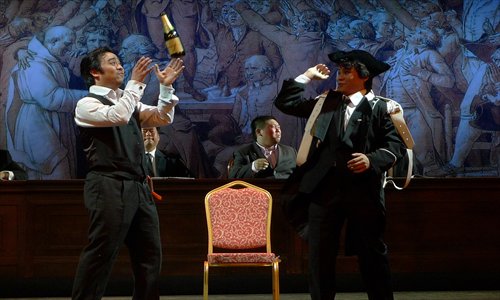
Privately funded
A modern-day version of The Marriage of Figaro produced by Li in 2008 marked his first venture into privately-funded localized operas on the Chinese mainland, and the production was critically acclaimed by audiences in Shanghai and Xiamen. At the end of 2010, Li successfully launched the annual Beijing Comic Opera Festival which has since become one of the capital's most important cultural happenings.
Opera Comic Shanghai will be a collaborative effort between Li Wei and other distinguished directors from the French opera comany Opéra de Poche.
The operas on the list for the festival are Gaetano Donizetti's Don Pasquale, Giovanni Battista Pergolesi's The Servant Mistress, Gian Carlo Menotti's The Telephone, Bizet's Carmen, Mozart's Don Giovanni and Gioachino Rossini's The Barber of Seville. Of them, Don Giovanni and Carmen features both French and Chinese performers, while The Telephone has an all-French cast.
While the music and libretto of each remain unchanged and will be performed in the original Italian or French, the spoken dialogue has been adapted to expound a new, localized plot.
"For many years, the role of opera has been misunderstood by the public in China. There is a perception that it was exclusively a noble artform for the former elites in China, and was something that ordinary people could not feel close to," said Li who has adapted and directed four of the operas for the festival. "What I'm doing is adapting the plots of these operas - while leaving intact their classical themes - in order to popularize the artform among ordinary people."
According to Li, The Servant Mistress will tell the story of a present day Shanghainese employer and his ayi who is from Anhui Province, while Don Giovanni in Li's words will tell "a more complex version of Don Juan who has many different sides to him."
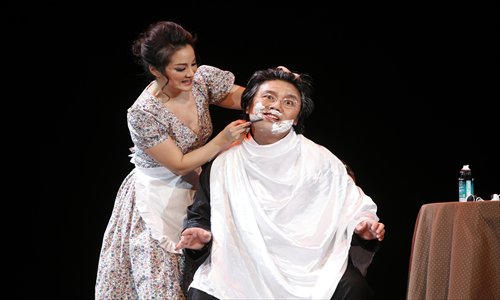
Best outcome
"I think the process of cultural communication should be like a chemical experiment in which cultural differences should be carefully considered in order to produce the best outcome. To simply copy Western productions and impose them on local audiences is not going to work anymore," Li told the Global Times.
Li explained the ideas behind the stage designs for the festival. "The sets may not be as grand as audiences are used to seeing for operas such as Turandot or Madame Butterfly, but we have concentrated most of our efforts in bringing the best voices to the festival so that audiences can fully appreciate the charms of these operas," said Li.
The version of Carmen being staged at the festival is that by the English theatrical legend Peter Brook and which has become a modern classic since it debuted in 1981. Chloé Latour is directing a distinguished cast in the opera that will include baritone Vincent Billier, and sopranos Isabelle Fallot and Lucie Mouscadet.
Among the Chinese singers are Sun Li, a well-known baritone who regularly performs at the National Centre for the Performing Arts in Beijing, Shi Heng, an award-winning baritone who has held solo concerts in Japan, Germany and France, and Qian Hong, regarded as one of the country's finest vocalists.
Xiao Ma, popularly known as the "first Chinese tenor," and Mauro Bonfanti, who trained with opera maestro Luciano Pavarotti, will be guest performers in The Barber of Seville.
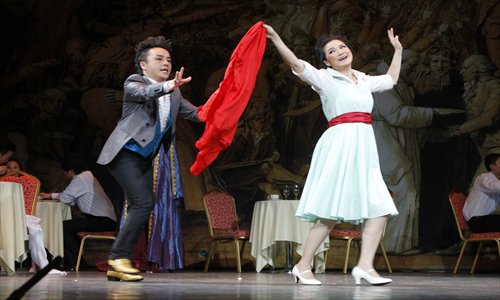
Special gift
And among the six operas, Li singles out The Barber of Seville as a "special gift" to the city he grew up in. Actors from the Shanghai Farce Troupe will participate, and the dialogue will be performed in both Putonghua and Shanghai dialect.
"Audiences will see me performing a tongue twister in Shanghai dialect," Qian Cheng, the deputy manager of the Shanghai Farce Troupe told the Global Times. Typical characteristics of Shanghai farce will be included in the performance, such as abrupt changing of contexts, and wordplay.
"I think Li's operas are groundbreaking," said Qian. "He has bravely changed the plots and backdrops of the stories, and attempts to talk to audiences in an everyday way by involving elements that are familiar to them."
Date: December 24 to January 1, 2013, 7:30 pm
Venue: Lyceum Theatre 兰心大戏院
Address: 57 Maoming Road South
茂名南路57号
Tickets: 80 yuan to 880 yuan
Call 6217-8530 for details