The surreal deal
At a press conference to mark the start of an exhibition of surrealist art in the city, one question from journalists, or variations thereof, was posited time and time again: "How are visitors supposed to understand these artworks of surrealism?"
Real life
The works at Electric Fields: Surrealism and Beyond, have all been loaned by the Pompidou Centre in Paris, and the institution's director, Alain Seban attempted to give an answer to this question. "Most people in France have always found surrealism hard to understand as well, but the truth is that these works are actually very closely related to real life. For the surrealists, any daily object can become an artwork."
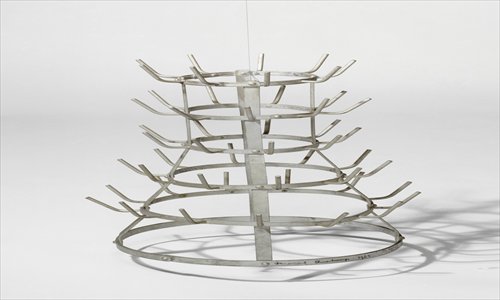
Echoing what Seban said, one of the exhibits on show is Marcel Duchamp's Porte-bouteilles (Bottle Carrier) from 1914. It appears to be nothing more than an ordinary bottle rack which Duchamp purchased at a bazaar near the city hall in Paris.
But later, he labeled the piece a "readymade," a term Duchamp used to describe any ordinary, manufactured object that is not commonly associated with art. With these readymades, Duchamp removed such objects from their context as functional items and re-contextualized them as works of art.
Important keywords
Gong Yan, one of the main organizers of the exhibition, said: "'Object' is one of the most important keywords in surrealism," she told the Global Times. "Surrealism lives on most vividly today in these objects and in their metamorphoses at the hands of contemporary artists. All, or nearly all, contemporary objects _or what we rather too hastily refer to as sculpture _ are found in the surrealists' inventory of objects."
The exhibition features more than 100 works, dating from the beginning of surrealism in the 1920s up until the present day and covering the genres of painting, sculpture, installation, video, photography, architectural models and text. Among the stellar names whose works are displayed are Pablo Picasso, Joan Miró, Max Ernst, René Magritte, Jean Dubuffet, Georg Baselitz, Sigmar Polke and John Baldessari,
This exhibition also showcases surrealistic works by Chinese artists such as Cai Guoqiang, Wang Du, Huang Yongping, Zhang Huan and Yan Peiming. One notable highlight is Chen Zhen's Round Table (1995) in which 26 upright chairs are perfectly slotted into the sides of table so that their legs are lifted off the ground.
The exhibition is composed of six separate sections: "Objects," "Collage," "Night," "Automatism," "Eros," and "Words & Images."
And these section names, according to Gong, represent the keywords of surrealism.
Largest artwork
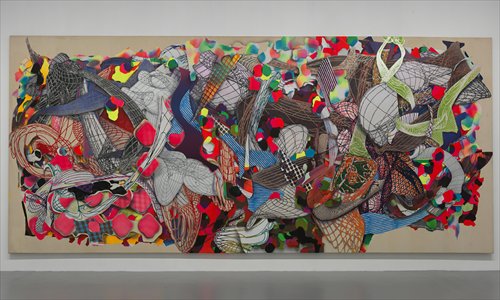
One of the works inside "Automatism", and which is the largest piece in the exhibition, is an acrylic on canvas piece from 1994 called Polombe by the Italian American painter Frank Stella.
He used computer information techniques to reproduce patterns from his previous works on canvas to a length of 9.6 meters.
"Whether in expressionism, calligraphy or writing, as a sort of prompt trace, automatism has always been decisively significant to surrealists," Gong said.
And love and lust have also always been important subjects in surrealism. In the "Eros" section, audiences see a series called La Poupée (Doll) by Hans Bellmer. In the 1930s, and inspired by sixteenth-century wooden dolls, this German artist created this famous set of ball-jointed dolls.
Date: Until March 15, 2013, 9 am to 5 pm (closed on Mondays)
Venue: Power Station of Art
上海当代艺术博物馆
Address: 200 Huayuangang Road
花园港路200号
Ticket: 20 yuan. Visitors should book their admission ticket on artshow.eastday.com (for individual visitors) and ticketing.exposhanghaigroup.com (for group visitors) two days in advance.
Call 400-9219-021 for details