Drawn closer to Peking Opera
Cartoonist serves the grand traditional art on a new stage
When describing Peking Opera, a traditional Chinese opera style with a history of 200 years, you might choose adjectives like elegant and magnificent rather than cute and lovely. But actually, many classical characters in Peking Opera plays have already been turned into cute cartoon characters.
Shi Junling, the woman who overthrows people's impression of the classical art, is a freelance cartoonist from Hebei Province and a fan of Peking Opera. "I simply sketch out what Peking Opera looks like to me," she told the Global Times. "It is cute, lovely and close to ordinary people."
'A Bite of Peking Opera'
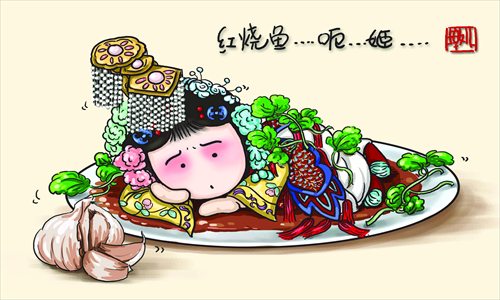
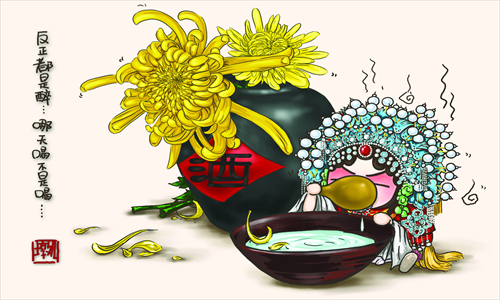
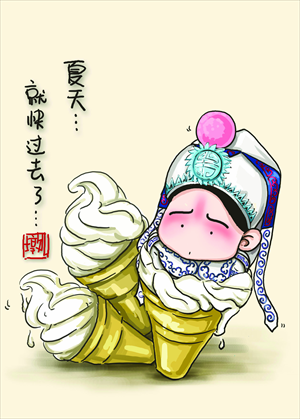
Most people got to know Shi (nicknamed Pangbuduner, which roughly translates to "chubby") and her A Bite of Peking Opera through a series of cartoons she posted on Sina Weibo recently. There are 19 pictures so far, each depicting a classical figure in Peking Opera drawn as a yummy dish based on the looks and colors of that character, explained Shi.
In the paintings, Bao Zheng, a black-faced judge during the Song Dynasty (960-1279), becomes a black sesame dumpling. Yu Ji, the favorite concubine of King Xiang Yu in Farewell My Concubine, transforms into a dish of fish in brown sauce crouching in a white plate, decorated with several leaves of parsley. Zhou Yu, an important military counselor in The Romance of the Three Kingdoms, is drawn as vanilla ice-cream to mimic the character's creamy white skin as a youth.
And Wang Zhaojun, one of the four legendary beauties in China, becomes a plate of tomatoes mixed with white sugar. Shi said that she watched the opera Zhaojun Chu Sai when the first snow of the season hit China's north, so in the dish she combined Zhaojun's red coat with the white snow.
Shi said this group of pictures began last June with Meng Liang and Jiao Zan, two characters in Mu Ke Zhai, a well-known Peking Opera. She painted what the two look like after being burnt in a fire (as happens in the story): they are depicted as brochettes.
"It was right after the documentary A Bite of China was broadcast and a friend said what I painted was 'a bite of Peking Opera.' I thought it was a good idea and painted more," she said.
These lovely cartoons do not come easily. Shi must spend from four to 10 hours on one picture, depending on the complexity of the figure. "Each [figure] has a fixed image on stage. I need to be faithful," Shi said.
All the figures are drawn strictly based on their images, with details in costumes and headdresses. "The most difficult part is I cannot make a mistake in the details," said Shi, "I cannot change their costumes as I like. They are really complicated."
Shi prefers characters that appear frequently on the stage and are known by the majority of opera fans. "I plan to draw 54 in total, to make it enough for a poker card game," she joked.
Innovative storytelling
A Bite of Peking Opera is not Shi Junling's first attempt to represent Peking Opera with cartoons. People can easily find online a series of cartoon stories titled May I Tell You a Peking Opera Story? that she began drawing in December 2011.
"I came up with the idea naturally," Shi said. Born in 1980s, Shi was attracted by the stories in Peking Opera since childhood.
The first story she told in the series is Da Tan Er, a famous play in Peking Opera. In Shi's cartoon, the usurping story from the Ming Dynasty (1368-1644) was told through cute and lifelike cartoons. Many netizens praised her work, not only for the little cartoon figures but also for the humorous dialogues. Time and again fashionable slang phrases pop up, adding modern color to the ancient story.
Following the same cute style, she posted another story called Youlong Xifeng (Meilong Town), a love story between an emperor of the Ming Dynasty and an ordinary waitress.
Both stories circulated widely online. "I didn't expect Peking Opera could be so interesting," one netizen exclaimed. Others said they would go to see the original Peking Opera after learning from the cartoons.
The official Weibo for CCTV's Studio Theater, a TV program that broadcasts live or recorded Chinese drama, posted Shi's cartoon of another classical Peking Opera story, The Marriage of Dragon and Phoenix, to promote its live broadcast on New Year's Eve. "Those who are not familiar with the plot can take a look at the cartoon first," the program suggested.
Shi said she was glad to read the comments. "I didn't expect my pictures would have such an effect since I drew them out of [personal] interest," she said, "It would be great if it helps make more people like Peking Opera."
Another stage
When Shi started the cartoons, she was not sure whether they would be accepted. Questions arise as her work gets increasing exposure. Some wonder if it is appropriate for the elegant art form to appear in a lovable format to cater to a larger audience. Others suggest Shi may even be ruining it.
But to many, Shi has shown respect for the tradition by faithfully representing the stories, in spite of making the characters cute. "The classic is there without being changed," said Ling Ke, a Peking Opera actor with Tianjin Peking Opera Theater.
Ling said he was impressed by Shi's cartoons because she not only conveyed the spirit of the opera but also painted the costumes based on careful examination. "It is no exaggeration to say that she is performing Peking Opera on another stage," Ling said.
According to Shi, she researched every detail to create her cartoons. She watched videos and stills, read books and sometimes consulted Peking Opera professionals and theatergoers to avoid mistakes. Besides external decorations, a character's disposition also needs to be demonstrated, she said.
Shi's cartoons have removed many young people's misunderstanding about Peking Opera, Ling said. "They show that Peking Opera is not as sophisticated and serious as they thought and that it can be funny. It is impossible for most young people to spend much time learning to appreciate the art. Cartoons are a good start."
Shi will publish May I Tell You a Peking Opera Story?,the first cartoon book of its kind, early this year as many of her fans have suggested. The book will boast seven plays including Da Tan Er and Youlong Xifeng, Shi told the Global Times.
"It's a pity that many traditional arts have been pushed into a lofty position today. People's interest in the cartoons shows they are still interested in traditional culture," said Shi.