Travels with my art
"Living in the modern world, it's inevitable that Chinese artists will be somehow influenced by Western artistic concepts. But I'm also pleased to see that there are some extraordinary Chinese contemporary artists offering very original and unique artworks," said the art critic and curator Victoria Lu at a forum held at the Museum of Contemporary Art (MoCA) Shanghai last Friday.
Currently, MoCA is hosting a joint exhibition of two Chinese artists, respectively, Tian Wei and Qiu Jie, both of whom have established unique artistic languages during the course of their careers.
Both of the artists lived through the Cultural Revolution (1966-76), and they also share the common experience of having studied and worked abroad for decades. While Tian Wei has established his reputation in contemporary calligraphy, Qiu Jie excels in pencil drawing.
"It's really a rare opportunity for people to see these two distinctive types of artworks under the same roof," said Lu.
Large repository
Born in the ancient Chinese capital city of Xi'an, Tian Wei showed an early and promising interest in Chinese calligraphy. In 1972 Tian became the youngest artist at the first Chinese painting and calligraphy exhibition held by the Xi'an Beilin Museum, which is famous for its large repository of inscribed headstones in graveyards.
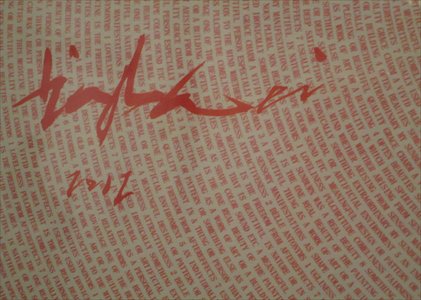
The ongoing exhibition at MoCA Shanghai displays Tian's calligraphy works, in the forms of oil paintings, ink prints, and installations. And almost all of them feature English words and sentences.
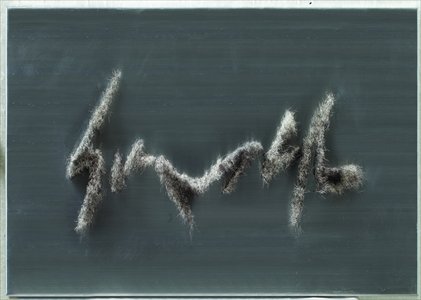
Paintings, such as Gray, Green, and Fame Money Sex, feature English words. The words are written in a style that is similar to caoshu, a typical Chinese cursive writing style.
And this cursive writing style of English words can also be found in Tian's installation works. For example, in the Human series wolf hairs are used to fill in the shape of the word "human," while in I Myself Me series Tian uses his own hair to present these three words.
Meanwhile, in installation series such as Square, Triangle, Beauty, Ugly, and Splash, beside the cursive descriptions of such words, visitors can also see closely-printed tiny words in the background that are arrayed in the curves of tai chi movements.
"What I want to achieve in my works is Chinese abstract expressionism, which is different to that in the West," said Tian Wei at the forum when asked why he came up with his particular art language. In recent years, Tian has focused a lot of his thought on abstract and infinite concepts such as life, death, being, and the beauty and power of nature.
"Although the West also has its own calligraphy in art, it's very different from the calligraphy art of China, which reveals the calligraphers' mind through their different styles of writing," Lu commented on Tian's works.
Pencil drawings
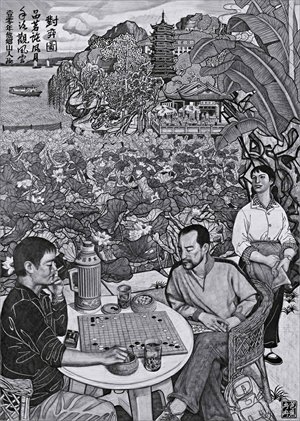
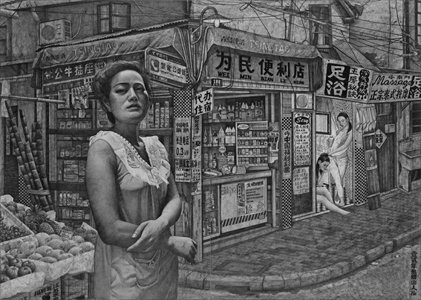
On the second floor of MoCA Shanghai is displayed a dozen or so of Qiu Jie's pencil drawings, some of which are as large as one meter high and one meter wide. In order to accomplish such large works, Qiu usually sketches on smaller pieces of paper in the first place. According to Qiu, each of his works usually takes six months to complete.
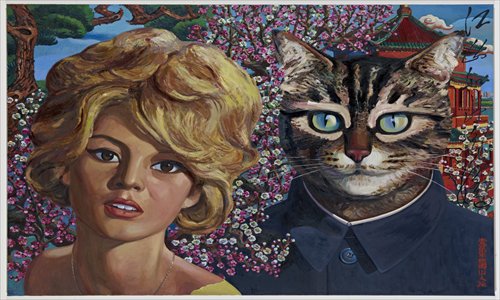
As a Shanghai native, Qiu's works depict the sceneries and people of this city, which cover scenes from decades ago, such as grocery stores, people's communes, and advertising posters, and more contemporary images such as the Oriental Pearl Tower and the Shanghai Expo in 2010. Common images in his works includes both Western and Chinese women, sometimes in the nude, and a cat dressed in a Chinese tunic suit.
Qiu's works may seem to be fragmented by the many different images that appear in them, but he is currently directing a film that draws all of these disparate strands together.
"I think that people in different ages and with different life experiences may have different interpretation of my works," said Qiu.
"My works are based on my own perceptions of the city over the past few decades," said Qiu. "I really enjoy the process. For example, when I am drawing a bottle of rice wine in my work, I feel that I am actually drinking rice wine at that moment."
Foreign experiences
"Although Tian and Qiu's works are very different, it's undeniable that their overseas experience has influenced them a lot," said Lu.
Tian agreed with Lu on this point. "I think that if I hadn't spent decades in Los Angeles, I would never have come up with this kind of art," said Tian, who returned to China and founded his own studio in Beijing seven years ago.
"Some Chinese artists may zealously worship Western art and culture before they go abroad. But it has been proved by many Chinese artists that, even after spending many years abroad, they still root their work in traditional Chinese art," said Lu.
Date: Until February 16, 10 am to 6 pm (opens on public holidays)
Venue: MoCA Shanghai
上海当代艺术馆
Address: 231 Nanjing Road West
南京西路231号
Admission: 30 yuan
Call 6327-9900 for details