Nature of neglect
Winning World Heritage status is not the end of the race
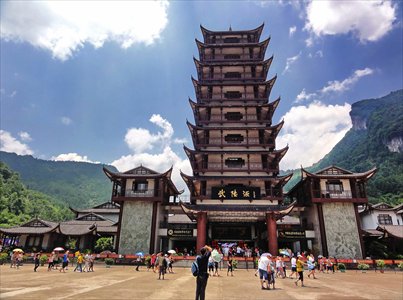
For lovers of natural scenery, Zhangjiajie Geopark is an ideal choice. The park, located in northwestern Hunan Province, became particularly famous after it claimed association with the film Avatar, saying the majestic scenes in the film were inspired by its unique landscape. Around major mountains in the park are introductions boasting of their presence in the film, attracting numerous visitors to have a look.
The advertisement is successful, but the explanation of the geopark is apparently not satisfactory to UNESCO. Recently, the UN organization issued warnings to three Chinese geoparks, including Zhangjiajie Geopark, Mount Lushan Geopark and Wudalianchi Geopark, saying that they fall short of expectations in promoting scientific knowledge to the public. They are reported to be in danger of getting expelled from the list of Global Geoparks if no improvement is made before 2014.
Chastisement
The warnings came to public sight early this month after UNESCO conducted evaluations at the three scenic spots that appear on the list of the Global Geoparks Network (GGN). Initiated by UNESCO in 2000, the GGN aims to select over 500 sites of special geological features around the world to enhance protection.
But the laurel does not automatically include lifetime tenure. Every four years, UNESCO evaluates the GGN members and examines how they are doing in preserving geological relics and spreading scientific knowledge.
The three geoparks were the first among Chinese parks to enter the list in 2004. They are major tourist attractions in China known for their unique geological features. For example, Mount Lushan Geopark boasts geological relics of the quaternary glacier and other special topographic features that are valuable in scientific research. Becoming global geoparks has made the three parks globally known.
But as Xinhua News Agency reported, after assessing the Wudalianchi Geopark last year, the experts invited by UNESCO concluded that in order to meet standards the park has much more to do when it comes to spreading scientific knowledge and communicating externally. Zhangjiajie Geopark and Mount Lushan Geopark reportedly have similar problems.
"A geopark must provide and organize support, tools and activities to communicate geoscientific knowledge and environmental and cultural concepts to the public," according to the guidelines and criteria for GGN status.
"Scientific education should be the basic function of a geopark. But most Chinese geoparks are not doing well in providing sufficient knowledge about the geological phenomena, which demands huge manpower and time and does not directly impact profits," Fang Shiming, a professor with China University of Geosciences, told the Global Times.
He said that Hong Kong Geopark is doing much better in this regard. "They spent much more time and energy in writing the explanation, and even took it to middle and primary schools to make sure it is readable."
Rectification
The evaluation team of GGN will examine the three Chinese geoparks again before 2014. Those that do not meet requirements may be expelled.
Now the three geoparks in question are reportedly taking active measures. It is said that Zhangjiajie has already taken preliminary steps in response to the 10 problem areas pointed out by the experts, including compiling textbooks of scientific knowledge and training tour guides. Lushan is planning to build a professional team for the geopark work and use easy language to mark trails and explain geological relics. Wudalianchi responded similarly stating that it will enhance communication with global and domestic geoparks and spread geological knowledge through a variety of channels.
Zheng Xiaofan, a staff member with UNESCO, told media that the experts usually provide suggestions on how to improve programs of protection, research and education. "World Heritage Committee is not happy to see the elimination of a world heritage or intangible heritage," he said, "but it could stimulate better management and protection."
As of 2012, GGN had 90 members from 27 countries and regions, and 27 were from China. As Zhang revealed, it is getting increasingly competitive for geoparks to become members of GGN. And while GGN's original intention aims at protection of these global resources, many Chinese geoparks' first consideration is to raise their fame. Once obtaining GGN status, most slack off, ignoring their role in public education.
To Fang, the warnings for the three geoparks will serve as a wake-up call to other GGN members, though there emerged doubts over the evaluation standards of UNESCO.
"It shows that getting on the list is not the end. They need to shoulder applicable responsibilities," said Fang.
Profiteering
As a country with a huge tourism industry, China boasts hundreds of scenic spots that are crowned as either "Global Geopark" or "World Heritage." Since 1986 when China started to apply for World Heritage inclusion, the country now boasts 300 such sites.
Particularly in recent years, the competition to gain world heritage status is getting heated. Last year, the application plan of 10 important cultural pagodas as a package for world heritage aroused much controversy. Many regarded the plan as just one excuse to pursue profiteering.
It is no wonder. Many natural and cultural scenic spots scramble for international recognition because it is regarded as a "golden advertisement" and an excuse for higher ticket prices. The duty of education and protection is often immediately neglected.
Compared to the huge investment in the application effort, the lack of protection is particularly worrying. Over exploitation and lack of protection has pushed some World Heritage sites onto the list of endangered sites while some are on the verge of being expelled. More than 40 sites worldwide have been warned in past years.
Oman's antelope conservation district was the first to be expelled from UNESCO's World Heritage list in 2007 for drastically decreasing the protection zone, and in 2009, Germany's heritage site in Dresden was deleted from the list for building bridges that damaged the sight.
Some sites in China have faced similar challenges. The Wulingyuan scenic spot attracted millions of tourists every year since it became a World Natural Heritage in 1992. But by 1998, the scenic spot was rampant with rough buildings, covering 190,000 square meters. The World Heritage Committee thus sent warnings and asked it to demolish the unsightly structures before a certain time.
An expert in cultural heritage who refused to reveal her name told the Global Times that she does not advocate cultural sites applying for World Heritage under the present circumstances. "For most scenic spots, the laurel is just a tool to pursue economic profit and stimulate the local economy," she said, "In the end, what originally makes it qualified as a World Heritage will be lost. The tourism activities should not overrun the protection purpose and damage the site itself."