On the button
Most expats in China are aware of the classic qipao. But few people are aware that the qipao makers use a special type of button, not seen in other garments. Made from cloth, these buttons are known as pankou. Craftsmen usually sew strips of cloth into thin lengths and then twist them into different shapes before affixing them to the collarband of the qipao. A traditional pankou combines an embossment and a corresponding circular piece of material, which are then looped together in the manner of a buckle to "tie" the button.
Decorative adornment
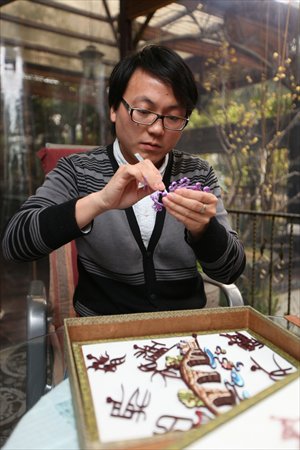
The Chinese character pan in the term pankou describes the delicate process of curling small, thin cloth pieces. "It must be elegant as well as practical, as it functions not only as a button but also as a decoration on the dress," said Song Tao, a pankou master craftsman.
Born and raised in Shanghai, the 31-year-old has been working in the industry for 14 years. He studied dress designing in a vocational school, becoming fascinated by the exquisite beauty of hand-made cloth buttons on qipao dresses.
"I've never dreamed about being a successful fashion designer in Milan, Paris or wherever. All I've wanted is to create pankou," Song told the Global Times.
While his former classmates headed into apparel companies after graduating, Song paid a visit to an 80-something dressmaker and signed up as the man's apprentice to learn the skills of pankou making. This master tailor, Rong Huagen, was among the few remaining people in the city who still knew how to hand stich a qipao from scratch. And he was as equally renowned as a craftsman of pankou.
It was not an easy apprenticeship, according to Song. He spent more than six months practicing cutting suitable lengths of cloth, sewing the lengths together, and then binding the edges of two cloth lengths together. "These handmade lengths have to be as accurately straight as if they had been manufactured by a machine. There can be no tears or uneven cuts," he said.

Basic skills
When Song had passed Rong's tests for basic skills, he was allowed to start the next phase of training, where he found more difficulties awaiting him.
After designing the button to match the color and style of a qipao, there are still more than 10 steps to master including shaping, pressing, padding and starching.
Rong assessed his pupil's progress, according to the suitability and authenticity of the pattern chosen, as well as the quality of the manual work. On occasions, pankou that Song had worked on for more than three months were ultimately rejected by his master, often only because of minor faults.
"If I had not had such an intense passion for it, there were times when I would have given up after experiencing such disappointments," said Song.
Through sheer determination, Song got through his apprenticeship. And following the Shanghai municipal government's decision to declare pankou as an aspect of "intangible cultural heritage" in 2009, the local authority also named Song an official "heir" of the pankou arts and encouraged him to further develop his skillls.
Traditional pankou patterns often feature flowers or animals in simple patterns and colors and which are considered "lucky" in Chinese culture. However, Song's team is eager to push the idea that pankou can become popular consumer goods in themselves, and that it can have a wider application in daily life.
Song currently works under a senior craftswoman in a team of 10 at a studio in Xuhui district (No.21, Lane 980 Shilong Road, 5408-0053).
And Song's ambitions have progressed from simply mastering pankou skills, to promoting the art to the world.
Up to 2008, Song's team had developed 157 different pankou design series, including patterns of Beijing Opera masks, a flying Apsaras (a female dancer seen in the painted frescoes of the Dunhuang Caves), and popular cartoon characters.
"We have made breakthroughs in patterns and colors to make pankou appear more vivid and three dimensional," added Song.
Sold as artworks
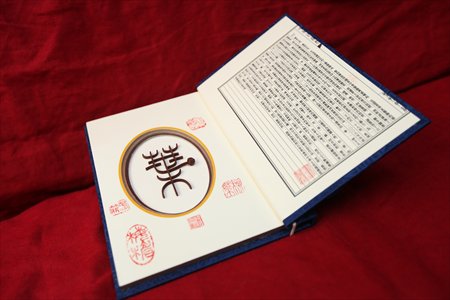
Many of these innovative pankou are too intricate for practical use, but are sold as artworks. Presented in glass frames, they sell at the studio for an average price of 2,000 yuan ($322) each.
Song has also mastered the skill of making cloth buttons that resemble characters in Chinese calligraphy and also English cursive script. "This particular service is popular among customers," said Song. "People provide us with their English or Chinese name and we can produce them within a month."
The studio also spent a year making a huge pankou reproduction of the Great Wall, and which was exhibited at the World Expo 2010 in Shanghai.
To earn a regular income, Song and the team now spend 10 percent of their time producing traditional pankou for a high-end qipao customized service, and another 30 percent creating more artistic examples of pankou. They devote the rest of their time to preparing for exhibitions. Song also teaches pankou skills to students in local high schools.
"A lot of youngsters are interested in what we do," added Song. "I don't expect them to master the skills, but I hope they can appreciate the beauty of what we do."
Song recounted the time he saw a girl using a pankou as an adornment on her mobile phone. "That's my dream, to have pankou used in more everyday settings, and for more people to know about this art," he said.