Serving up China's champs
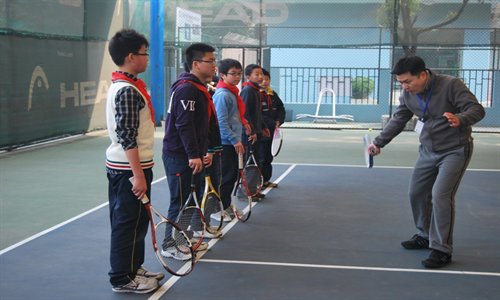
Some might call her lucky. Fourteen-year-old Zhang Yin doesn't need to worry about math tests or English vocabulary exams. She will have nothing to do with the gaokao (the college entrance exams), the source of pressure for many of her peers. And for lunch and supper every day she enjoys a free buffet of more than 10 courses including shrimp, steak, fish, cheese and yogurt. For this upbeat teenager everything is taken care of. The only thing she has to worry about is playing tennis.
Last April Zhang started training as a junior player at the Shanghai Pudong Tennis Team, Shanghai's provincial tennis team. Coming from a small village in Changxing county in northern Zhejiang Province, she's a tall girl and has an athletic build that makes her appear more mature than her age. But once she starts talking about Li Na and Maria Sharapova, her favorite tennis players, she becomes just another young teenage girl with sporting idols.
Like many athletes in China, Zhang was admitted to the provincial team in a traditional way. Her talent was spotted by coaches from Changxing's sports center when she was in primary school. "She couldn't play tennis then, but loved sport. The coaches probably saw something in her that was promising," said her father Zhang Guofang.
She pulled out of formal schooling and began training. When she was 11 she was chosen by the Huzhou Tennis Center and trained in the city of Huzhou for two years, before the Shanghai team selected her.
Zhang Guofang is proud of his daughter and pleased - not just because of her sporting prowess but also because he doesn't need to worry about her expenses. "The costs of accommodation, training and food are all covered by the government. In fact, we only pay for her clothing - that's all."
Obvious benefits
The benefits of being one of the chosen athletes in China's sports system are obvious. The system gives talented children from rural areas or from less well-off families a chance to succeed in sport and the training, though stringent and costly, works well if you count Olympic medals.
Over the past few years, however, the rights and wrongs of the State-sponsored tennis system have been debated in China, as leading women players, led by Li Na in 2009, left the government sports system to play successfully on their own.
Professional tennis is a highly lucrative business not only for the players - the world's top players earn millions of dollars in prize money and endorsements - but also for the media, sponsors and coaches.
It's also highly competitive. Each win and loss can determine whether a player's air tickets and accommodation fees for the next tournament can be covered, and, for the top players, whether sponsors will renew their contracts.
This is where China's paternalistic system may seem outdated. A Shanghai team executive who wanted to remain anonymous, explained: "Our players in the system, because everything is prepared for them, tend to be less aggressive on court and have a lower drive for the prize money, because they get a salary from the government anyway."
Pablo Eguiguren is a tennis coach from Argentina who has spent most of his professional life in Australia. He has been working with the Shanghai team for 20 months and also helps with the team's junior development program. He recognizes the benefits of China's system but warns: "Players in China lack responsibility as it can be too easy within the system. I believe that team leaders and coaches should create the environment for the players to understand this through incentive-driven sponsorship programs."
For Eguiguren, tennis is a highly individual sport. "The player starts and finishes each match alone and therefore he or she must know how to react in all kinds of situations," he said.
"The Chinese culture is to push and drive players to be their best. This is necessary when they are young to teach them the habit of working hard. However, as they grow up, there isn't enough letting-go to allow the players to develop themselves and their personalities through their own experiences. So when the player needs to become independent, there is a big problem."
Independent attitudes
Yu Wanzheng is another coach with the team. A former athlete, Yu lived in Europe for a long time and once worked as the training partner for the international champion Rafael Nadal. Yu said foreign tennis players were very independent. They determined what tournaments were most suitable for them to play, they knew how to maintain their bodies at the peak condition and how to find training partners at an international tournament when their coaches weren't there.
"During tours, foreign players mix with each other and often practice together, a great way to make friends and improve at the same time. Chinese players, lacking social and communication skills, tend to isolate themselves and stay in their safety zones, practicing only with Chinese players."
But some Chinese players are now taking a different approach. Wang Qiang, a Tianjin native, also plays with the Shanghai team, but her relationship with the team is much looser. Wang only plays for the team in certain matches and she pays for her own coach.
After deciding to pursue a career in tennis while in primary school, Wang didn't join a government-sponsored team or sports school. Instead she joined a private tennis club in Beijing. Five years ago, she hired a full-time coach from Japan and a Japanese agency to negotiate sponsorship deals.
Wang's father Wang Tielian, who works as a driver in Tianjin, said that not everyone was suited to being in the system. "You have to obey what the coaches say. The coaches might favor other players, and in that case you'll be ignored. But of course, if you come from a poor family and want to become a professional player, then the system might be your only choice."
The expense is enormous, and as Wang Qiang improves and is eligible for higher levels of competition, Wang Tielian has to spend a lot more on his daughter every year. "This year will be the first year Wang starts to play in the international tour of the Women's Tennis Association. We're not sure how much it's going to cost yet but it's definitely going to be more than 1 million yuan ($160,324)," he said.
When asked how Wang, a driver, can raise so much money for his daughter, the reticent man sighed and said: "Money is a constant problem. We only take one step at a time, and then think about the next."
Yu, the Chinese coach, said that nowadays more and more parents are sending their children to private coaches and clubs. "About 20 percent of the players today are going this way. But exactly how they'll turn out is hard to say. Most of them are still juniors, and it might take another five to 10 years to see the results," he said.
Wang is a trail-blazer among these players, currently ranking 186 in the world. However, her father said that as an individual player, his daughter doesn't get as many opportunities to attend international tournaments. "Many wild cards and opportunities for big games are in the hands of the city- and national-level tennis administration centers. Naturally, they'll give priority to players from within the system, and we are often ignored."
Financial burdens
The cost of professional tennis not only concerns the individual players, but also the government-funded teams, although that burden is more on the managerial side. There are now 17 coaches and more than 10 players in the Shanghai Pudong Tennis Team, which is funded mainly by the Pudong New Area government and the Shanghai Sports Bureau. Three of the team are also members of the national team.
Up until 2009 the team's major sponsor was the Shanghai Ba-shi Public Transportation Company, after which the team was then named. This State-owned enterprise hoped that their investment could bring it returns, but was disappointed. In 2009, after a change of executive personnel, the company cancelled its sponsorship.
"Tennis is a long-term investment," the Pudong team executive said. A junior player like Zhang would cost more than 200,000 yuan every year, and there were almost no returns, as junior tournaments offered little prize money.
"The cost of sponsoring an adult player each year is about 1 million yuan. That includes the coach's fee, air tickets to the international tournaments, accommodation, equipment and massages and therapy."
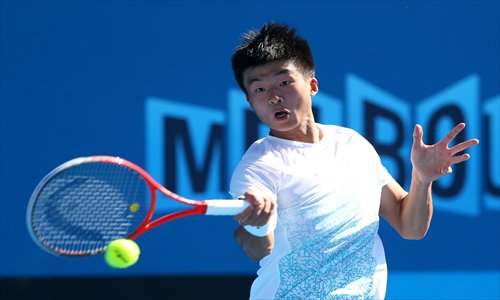
There are returns, but they are small. The executive did a quick calculation and cited Wu Di as an example. The 22-year-old Wu is a key member of the team, and played in the Australian Open in Melbourne in January, making him the first Chinese mainland player to take part in a singles match in a Grand Slam event. Although he lost to Croatia's Ivan Dodig in the first round, his participation was considered a breakthrough for men's tennis in China.
Hailing from Hubei Province, Wu currently ranks 187th in the ATP (Association of Tennis Professionals) world rankings and is the second highest ranking male player in the Chinese mainland. At present there is not a single Chinese mainland player in the men's world's top 100.
"Wu wins about 300,000 yuan in prize money each year but this is a long way from being enough to cover his training and touring expenses. Although tennis is his occupation, Wu isn't capable of earning a living from it," said the anonymous Shanghai team executive. "Wu depends on his monthly salary."
Another problem is that a player like Wu isn't considered as marketable as Li Na, and can have problems attracting sponsorship. One solution would be to introduce professional sports agents to China. When Wu Di played in the Australian Open this year, Western media were astonished that the promising player didn't have an agent. "Agents are vital in the highly commercialized world of professional tennis. Their main function is to maximize a player's income through sponsorship deals, media appearances and other income opportunities," Yu said.
On a tennis court in Dianfeng Tennis Club, Minhang district, 7-year-old Zhang Chingching swings her racquet enthusiastically at a ball served to her by her coach. The first grader, who barely knows who Li Na is, plays tennis for fun and fitness.
"She loves sport. The PE courses at school can't do enough for children nowadays. We have to find extracurricular activities for her," said Ji, her mother.
Zhang takes tennis lessons three times a week during holidays, and twice a week the rest of the year. But Ji doesn't want her child to become a professional.
"First of all I don't think she's talented enough to become a professional player. Also, becoming a professional is a very tough job. We don't want her to go that direction unless she's really into the sport."
Zhang's coach is Liu Yu, who founded the club in 2010 and is a former player for the Jiangsu provincial team. He has been promoting tennis in Minhang district's primary and middle schools by working with local schools and the education department.
When asked what tips he might have for parents who wanted their children to become professional tennis players, he said: "Why? I would never suggest parents do that. The cost of being a professional is too high today, financially and mentally. Why not just play tennis for fun?"
Liu has his own thoughts about the future of tennis in China. "In a healthy environment, the demography of tennis players, just like anything else, is shaped like an olive. The 'belly,' or amateur players, should greatly outnumber the professionals, or the tip, to form a healthy sports environment. In China we often ignore the middle part. There should be clubs and competitions designed for amateur players. Then, when the sport is widely popular, the rest of the market can follow healthily."
Liu also thinks the Chinese training methods sacrifice education for the junior players. Liu's club now sends coaches to schools to train 400 students. Last year, he organized the first amateur competition for teenagers in the district, and more than 200 students participated.
Liu plans to dig out the talented players from among the amateurs and send them to foreign tennis academies for professional training. "But I won't do it until the market is mature. Li Na wasn't trained in one day and we can't expect another Li Na to emerge from nowhere."