Downfall by design
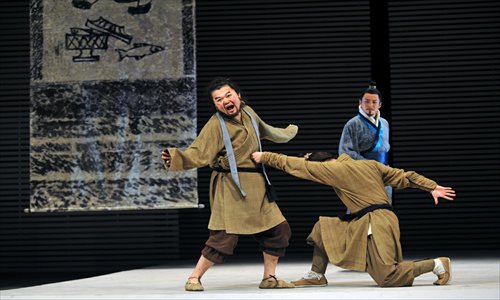
'Our Jing Ke' by Mo Yan depicts the self-sacrificing hero in everyone
Because it is part of nearly every student's assigned reading, the historic story Assassin Jing Ke is familiar to most Chinese from an early age.
Recorded in the Intrigues of the Warring States, a famous book on ancient history edited by Liu Xiang during the Western Han Dynasty (206BC-25AD), assassin Jing Ke became a household name in modern days for the character's chivalry and altruism.
As a historic classic, the story is also a favorite source for stage and screen works, most of which mainly follow the original book. However, the stage play Our Jing Ke, produced by Beijing People's Art Theatre (BPAT) and playing at the National Centre for the Performing Arts (NCPA) in Beijing beginning on February 19, tries to present a different hero that is more relevant to modern people.
Mo Yan's stage version
One of few works for the stage by Nobel laureate Mo Yan, Our Jing Ke was first completed in 2003. After some revisions, the play premiered in August 2011 by BPAT. Last year, it won Best Play Award and the Outstanding Script Award of the Golden Lion, the highest award for Chinese dramas.
In its 3rd round of performances (after a 2nd round that was carried out last December), the play is still produced by the same team with veteran director Ren Ming at the helm, leading actor Wang Ban in the title role and actress Song Yi playing Yan Ji, the only female character in the play.
"Maintaining the modern style of stage setting and background music, we didn't have many changes for this round of performances except some actors. Also with increasing experience in practicing and performing the play, we have deeper understandings about the lines and characters in it," said Ren.
"From a pioneering perspective, Mo Yan has depicted a Jing Ke with multiple interpretations as well as his chivalry. This is much different from traditional dramas since most of them are simple and flat with one line delivering just one meaning," said Ren.
"But this one is different: while challenging our understanding each time we rehearse, it also leaves much room for audiences to interpret it," Ren told the Global Times.
The Jing Ke within
In the historic book, Jing Ke is depicted as a brave assassin who, in order to preserve his small country Yan, is sent to kill the ruler of the Qin kingdom, Ying Zheng, who goes on to become China's first emperor of the Qin Dynasty (221-206BC), which united the Middle Kingdom for the first time in history by conquering the smaller states. In the end, Jing Ke fails and is killed by Ying Zheng.
Focusing on the motive of Jing Ke's mission, Mo Yan chose to retell the story from a completely different perspective.
"The basic storyline is the same as we know from the historic book, but Jing Ke's motive … his process and his personality are given different interpretations," he said upon the play's premiere in 2011.
Under Mo's pen, Jing Ke is no longer the fearless warrior who doesn't hesitate to risk his life to kill the king of the Qin. Instead, he is thoughtful and even wishes to refuse the task when asked by the prince of Yan.
Moreover, in his preparation for the assassination, he is thrown into a hopeless spiritual predicament, becoming so worried about being unable to find a justifiable excuse for the assassination that he suffers severe insomnia.
Ultimately, it is Yan Ji - a beautiful woman that the prince of Yan gives Jing Ke as a reward for accepting the task - who finally inspires him to intentionally fail in the attempt since, as Yan Ji says in the play, "a successful assassination will be as cliché as two lovers who finally get together, but a failed assassination will turn common people into heroes."
As the interpretation about Jing Ke is totally new, so is his chivalry in the play. Mo has made it more accessible to modern people.
"We used to have a stereotyped impression about the group of knights-errant, like faithfulness, bravery, commitment and so on," said Mo, "but from the historic materials about them, they are not actually so principled."
"More often than not they promised to kill someone because they received benefits from others," he continued, "but they didn't know whether the men they killed were truly bad people, and furthermore, whether their motive to kill others was really to avenge their benefactors."
In Mo's words, knights-errant seem to be a special group, but they are closely related to modern people, in whatever circles.
"As I'm in the literary circle, I don't know about others. There is a 'Jing Ke' living deep in my soul. I have also experienced the self-recognition process that Jing Ke on stage has experienced."
"Everyone has a Jing Ke in his heart," said Ren, "That's why (the play) is called Our Jing Ke," he explained. "The hesitation, anxiety and even insomnia of modern people brought on by advanced civilization are very similar to the predicament Jing Ke on stage encounters."
Modernized classic
To relate to modern people, not only are the lines in the script mostly contemporary words, the stage setting also looks like present-day.
The backdrop features a hollowed-out letterpress plate with characters in Li calligraphy to overlay a historic grandeur.
The lighting theme, which changes with each of the five acts in the play, reflects the character's various moods at different times and in different spaces. For example, the initial light grey that implies the character's failing logic moves into colors of gold and silver to represent luxury as he accepts the mission.
Additionally, a rotating floor delivers the concept of choice, implying the difficult choices made by the characters in the play.
Some lines in the play have become known for their catchy and modern wording, like when the swordsmen and knights-errant warmly discuss, "Who doesn't want to stand out when the chaotic world offers a big stage?"
Also well-known among audiences is Jing Ke's line, "If I kill the king of Qin, he will be the hero and I will only be a costar, but if I can kill him, yet choose not to, I will be the hero and he will be a minor player."
Our Jing Ke plays at the NCPA from February 19 to 24, 2013.