Home of the Sun King
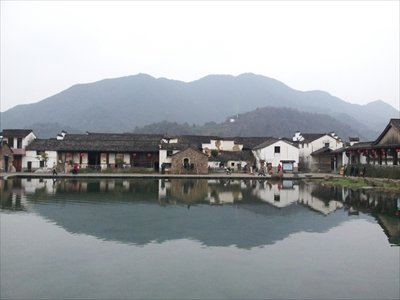
Agurgling brook flows under a low, stone bridge, framed by a landscape of stuccoed white walls in sharp relief against their black roof tiles. This is the typical picture of a Chinese water town and one that perfectly fits that of Longmen Old Town, a 2-square-kilometer ancient settlement located outside Fuyang city about 50 kilometers from downtown Hangzhou.
The town is a well-preserved site that faces the Shanxi River on one side and the Longmen Mountain on the other. The Longmen River runs down from this mountain, crossing through the town and merging into the Shanxi River.
Enter by the dragon
Longmen literally means "dragon gate," and the town's main claim to fame derives from it being the ancestral home of Sun Quan (182-252), the founder emperor of the State of Wu during the Three Kingdoms (220-280) and who still has approximately 7,000 descendants in the town. Some 90 percent of the local population are surnamed Sun. An introduction for tourists describes Longmen as: "a living, ancient town of more than 2,000 years; it is like a book in which people can read and understand China."
The Yuelong Bridge on the Shanxi River, decorated with red lanterns, brings visitors into the town. And before ascending the bridge, tourists are encouraged to write blessings on a red scroll which they then tie to the bridge.
Most of the town's structures were built during the Ming Dynasty (1368-1644) and Qing Dynasty (1644-1911) including the ubiquitous cobblestone-paved roads. Because of this, it's best to avoid wearing high heels when you visit.
The entry ticket to the town includes admission to 10 indoor scenic spots along the route. Besides the private homes, the public architecture includes stone-carved archways, ancestral temples, pagodas, corridors and pavilions.
History lessons
A leisurely and winding walk will eventually bring visitors to an open space where the Yan Pond (yan meaning "ink-slab") is located, surrounded by houses, corridors and trees. This scenic spot has the name Yan Chi Ye Yue, meaning "ink-slab water and moon night." In traditional Chinese culture, the ink-slab symbolizes education, schooling and examination passing, indicating the value placed on education. By the pond is a sculpture of a boy writing the Chinese character long (meaning "dragon") on the ground using a mop-sized brush. This has become a hot spot for taking photos.
Probably the biggest highlight of the old town is Sun's Ancestral Hall. Among the community descended from the Emperor Sun has been a number of important figures down the years. A collection of memorial tablets recounts for visitors the glorious history of the Sun family.
Notable among his progeny was Sun Kun (1373-1428) who helped contribute to the building of ships for Zheng He's expeditions to South-east Asia. An exhibition about Sun Kun's achievements can be found at Cheng'en Hall in the town.
Just neighboring Sun's Ancestral Hall is the Lao Dongxi Museum which prosaically translates as the "old stuff museum." Here you can find precious wooden architectural adornments native to the town.
All the world's a stage
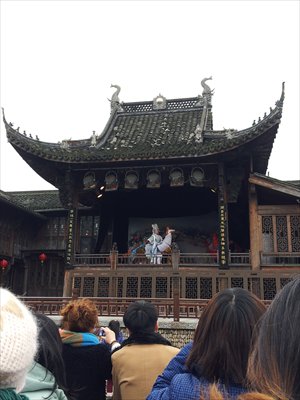
Directly outside the museum lies the Mingqian Garden containing a square and a stage within a pavilion. And everyday at 10:30 am and 2 pm, especially on traditional Chinese festivals, performances and folk customs are enacted such as traditional operas, bamboo horse dances and puppet shows. A number of events are being planned here for the upcoming Lantern Festival (February 24).
It may take three to four hours to see all the lanes and halls in the labyrinth-like Longmen Old Town, and you will need to pay close attention to the signposts to avoid getting lost. And there are plenty of street snacks to indulge in such as fried flour gluten balls, a local specialty.