Cure for the common copy
To check if a painting is real or fake, first have a look online
A week ago, Jenny Pat, the granddaughter of famous Chinese painter Fu Baoshi as well as an experienced painting appraiser, wrote on her Sina Weibo that the recent exhibition at Plaza Hollywood in Hong Kong of Fu's 15 works were all "copycats." She uploaded a few photos taken at the scene to support her argument. Soon, the controversy attracted wide media attention and generated discussion among netizens.
According to Pat, the exhibition of Fu's paintings was the first part of a series of traditional Chinese painting exhibitions. Later exhibitions would include works by Qi Baishi and Wu Changshuo. The 15 pieces by Fu, which would have a total estimated value of at least 10 million yuan ($1.6 million) if they are indeed real, were promoted as being from the collection of one of the "top 10 Chinese collectors," Zhao Tailai.
Pat said, "There is no space for controversy that these works are real… Zhao said that these collections have been evaluated by the renowned expert Shi Shuqing (1922-2007). We don't know if that's true. But I believe [experts] would not come up with the same conclusion if they see them."
Not an isolated case
It is now a commonplace occurrence for experts or artists to expose fake artworks they find on Weibo. In order to gain some assurance about their own investments, it is also common for amateurs and collectors to post photos of artwork or antiques on the Internet.
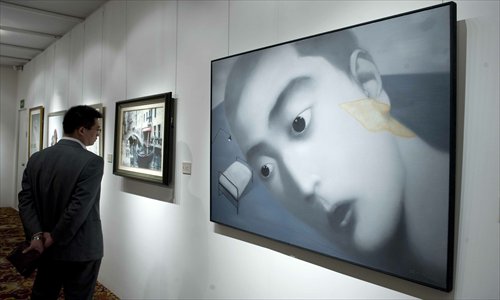
In 2011 autumn auctions, Beijing Tranthy auction house was selling the Zhang Xiaogang contemporary artwork Little Girl. A netizen asked Zhang Xiaogang through Weibo about that particular painting. The reply was negative. Earlier that spring, the same painting had sold for 1.8 million yuan.
Last year, oil painter Yang Zhiguang found 42 fake paintings that were said to be his works at several auctions in May. His daughter, Yang Hong, reviewed the information about these copies through Weibo. "Less than two months, so many copycats at auctions. Horrible!" she wrote.
Pat said that in most cases, both sides would argue and respond to the issue, but after a few rounds, it usually just ends without any real solution or result.
Who's responsible?
The authenticity of paintings at auctions has long been a hot topic. In 2009 at a Sotheby's spring sale, Li Luping, an expert from Jiangsu Province, pointed out that four Chinese paintings, including works by famous Chinese painter Dong Qichang and Hui Shouping, were imitations. A great deal of controversy was also stirred up at the same year's spring auction by the sale of Qi Baishi's painting Tiger, which sold for 32 million yuan, as well as famous painter Lin Fengmian (1900-91)'s Yu Huo (fish harvest), which sold for 14 million yuan. Similar cases happen every year.
"It is too complicated to explain," said William Chak, an antique appraiser. According to Chak, auction houses like Sotheby's made it clear 20 years ago that they would not be responsible for the authenticity of paintings they sell due to the fact that judgments on paintings can be too controversial.
But is that an appropriate excuse for auction houses to profit from the sale of unauthenticated works, not to mention those trade fairs where artwork presenters seem to carry even less responsibility regarding the realness of their items?
Art critic Zhu Qi commented about Fu's case on his Weibo on February 7. He said, "Making fakes is common in the industry. Sometimes both the seller and the buyer know the work is counterfeit but still continue with the transaction, leaving the media and audience aside."
The real situation might not be as grim as Zhu has described. Chak told the Global Times that he once met the buyer who bought a Xu Beihong portrait of his first wife, Jiang Biwei, for 72.8 million yuan in 2010, which was later called a fake. "He was very certain that he had bought the real piece. He somehow has a source of information that makes him believe so," said Chak.
It is hard to prove if auction houses intentionally include some copied artworks in their auctions or just make mistakes. Both Chak and Pat believe few auction houses would risk deliberately selling counterfeit items. "If two experts write to the auction house, the seller still has the responsibility to drop the deal and withdraw the artwork," said Pat.
Weibo as a platform
Weibo now seems to play more and more of a supervisory role, making the process of evaluating and discovering "wrong items" easier. Shi Jiandong, editor of the collection channel at sina.com said in an interview with 99.com, an art website, that whether someone is an expert, artist, family member or manager of the artist, the privilege of judging a piece of art should not be limited to one person or any particular organization. Everyone should have the right to take part. The more people involved in [the process], the less conflict each work has."
Many argue that judgment based on a photo is not fair. Pat has about 10 years experience in the industry and has worked in the painting department at Christie's.
"When I worked for the auction house, I judged 90 percent of the items through photos in e-mails. When it is not a real piece, you can tell directly from a photo. But if you need to certify that it is a real piece, you probably need to see the real thing," said Pat.
Many people who love art and antiques do not have enough knowledge or resources to tell the actual validity of an item. Weibo provides a channel for wider communication and education. Yet, it cannot solve the problem of who should make the final judgment about an artwork. At least it helps the public to know where the controversy lies.