Unlocking the city's prison doors
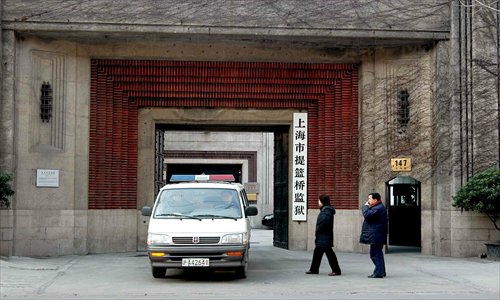
For more than a century, Tilanqiao Prison has been a household name in Shanghai. Once regarded as East Asia's first major prison, the vast stone complex at today's No.147 Changyang Road in Hongkou district, housed 8,000 inmates in its heyday. Only 1.5 kilometers from the Bund, the building of the American-styled jail began in 1901 and it began operation two years later under the Shanghai Municipal Council of the International Settlement at the time.
The prison covers an area of more than 30,000 square meters, or four and half football fields. It was originally intended to hold foreign prisoners of the International Settlement, but later its inmates included both Chinese and foreigners.
It has been the detention and the execution site for thousands of political prisoners and dissenters who have spent time there or were killed there at different periods - revolutionaries from the Qing Dynasty (1644-1911), communists arrested by the Kuomintang government, and Japanese war criminals.
Some of the famous prisoners were Cao Diqiu, the former Shanghai mayor, Zhang Aiping, the former Secretary of Defense of the People's Republic of China, Ren Bishi, one of prominent early leaders of the Communist Party of China and a founding member of the People's Republic of China, and Chen Bijun, the wife of Wang Jingwei, the president of the Japanese-backed puppet regime in Nanjing from 1940 to 1944.
After 1949, the prison was taken over by the Communist Party of China and it has continued as a major city prison until now. In 1994 the Shanghai municipal government listed it as a cultural relic.
Jewish refugees
The streets around Tilanqiao in the 1920s were some of the busiest areas in the International Settlement, and, during World War II the area became known as the Jewish Noah's Ark when some 30,000 Jewish refugees from Europe came to Shanghai and lived there.
The area is much more than just the prison but the prison, has in recent years, been a source of discord for many of the residents who live close by. Soon they will be able to live at peace as the prisoners leave and the old stone walls undergo a makeover for the next 100 years.
Very few prisons in China can match Tilanqiao, not just because of its age but because of its unique position in China's modern history. It brought a Western prison system into China and became a witness to Shanghai's history and many social upheavals and progress. As Shanghai developed, more people and housing came to the area around the prison.
"Every time a bunch of new prisoners were escorted here or were being transferred somewhere else, the whole street was filled with police cars and non-stop sirens, which really interfered with daily life," Zhang Guoyue, a local representative, told the Global Times.
According to Miao Xiaobao, a former director of the Shanghai Justice Bureau, the number of prisoners held at Tilanqiao Prison has been decreasing in recent years. Currently there are just 3,000 prisoners in the jail.
"The prison has fallen behind the city's progress in recent years. On the one hand, because of its design, it was almost impossible to renovate. And on the other hand, its immediate proximity to the community created increased security concerns," Miao told the Global Times.
According to Guan Weiyong, the head of Hongkou District Committee of the Chinese People's Political Consultative Conference (CPPCC), the prison has become the trademark for the Tilanqiao area. "Because of the prison and its special requirements, other unique historical and cultural resources in the area could not be fully developed," Guan said.
In 2011, Guan and seven other Shanghai CPPCC members proposed to the municipal government that the prison be relocated because it could not match the redevelopment of the rest of the area for Shanghai's development plan. Shanghai's 12th Five-Year Plan (2011-15) sees the North Bund area in Hongkou district developing as an international shipping center and international financial center.
By the end of 2012, 3,000 or so shipping-related businesses and 300 international and domestic financial institutions had been established in the area, according to an official report.
An undeveloped island
"With the reconstruction and development of Tilanqiao speeding up, Tilanqiao Prison will be the only 'undeveloped island' in the area and it will prevent the local economy from moving forward," Guan said in his proposal.
"But if the prison can be relocated, this will not only remove the negative affects on the local economic development, but will also create an opportunity to build a new heritage highlight in the North Bund," Guan said.
Last June, the Shanghai urban planning authority told Guan that the proposal had been officially approved and the prison was set to be relocated to a remote area while the prison buildings would be preserved as historical artifacts.
The official response revealed that the old Tilanqiao Prison buildings would be transformed and developed for commercial, cultural and business purposes.
"The old jail building will most probably be modified to include a prison museum and education center, and provide other community services," Guan said.
When the Global Times approached the city's urban planning department, officers there said they were still working on details of the project including looking for a new location for the prison itself and canvassing opinions for the project. When the plan has been completed, the municipal government will review it but there is to date no indication of exactly when this will occur.
"We also want to move as soon as possible because the residents who live nearby have been complaining about the searchlights we use through the night which keeps them awake. We have to do this to maintain the prison's security," an officer from the Tilanqiao Prison management office told the Global Times.
Special significance
Professor Ruan Yisan of the national historical and cultural research center at Tongji University said the prison was known throughout the world and had a special significance for Shanghai so that the relocation and redevelopment plans must be carefully evaluated.
"First we should respect and cherish our historical heritage. In recent decades, Shanghai has destroyed many historic buildings and replaced them with high-rise constructions. It appears now that some of these were mistakes and the century-old buildings can never be reproduced when they are gone. This is the basis for the discussions of the Tilanqiao Prison project," said the professor.
Ruan doesn't oppose commercialization and modernization in the city but believes it has to be handled carefully when history and business development plans clash. "We should consider a range of opinions from architects, experts, the public and even people who oppose it to avoid making the wrong decisions."
The deputy director of the Shanghai Overseas Chinese Affairs Office under the Shanghai municipal government, Cai Jianguo, said the biggest challenge for the redevelopment was keeping the prison building structures which could limit redevelopment possibilities.
Professor Han Sheng, the principal of the Shanghai Theatre Academy, agreed that the prison had to be relocated but said the entire structure had to be preserved, not split into sections. "We must ensure that we make use of this rare historical resource in the redevelopment."
Han believes the marketing of the prison would be the key to its successful redevelopment. He said that former Western prisons like the Tower of London, and the Bastille in Paris had become major tourist attractions. "Another good example is the Château d'If in France which was one of the settings for Alexandre Dumas' novel The Count of Monte Cristo. It was once a major prison but today has been reformed as a major tourist attraction. Shanghai could learn from this experience and put these ideas into practice for Tilanqiao.
"If you look at most of the major international cities in the world, you can see that they do not just rely on material development but are based on history and culture. We must think about how many of the city's unique memories we have lost already and prevent this from happening again. A city without a soul is a dead city," said Han.