Migration of a myth

"Surrender thyself to Buddha, surrender thyself to Duty and surrender thyself to Collectives": This is the "threesome" prayer of an Indian Buddhist monk when he or she travels far and wide as well as when praying at a shrine. Even ordinary people chant these words when visiting a monastery. The lines convey great values such as knowledge, principles and work.
Being a feminist, I always look forward to listening to such a prayer since it has been the religion that made a difference to the lives of ordinary women of the contemporary society. Buddhism came as a reaction to the Brahminical tradition of Hinduism. It promoted social equality and created some space for women who were otherwise getting marginalized in economic, social and political spheres. Thus whenever I hear about the Buddha, I become eager to visit the place.
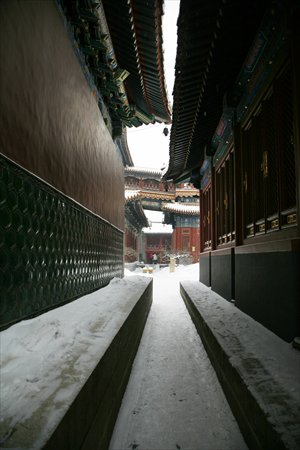
In one of our visits to Beijing, we learned about the Yonghe Temple or the Palace of Peace and Harmony. It is popularly known as Lama Temple. My excitement could not be contained to find out about Buddha in the land of Confucianism and Taoism. Thus we darted off to see the temple.
The 17th-century temple was initially used as the official residence of court eunuchs. But gradually the place was converted into a monastery. We were also told that it was one of the largest and most important Tibetan Buddhist monasteries in the world. The entire area of the monastery is 480 meters long and has been divided into five big halls and five courtyards.
As soon as I entered the main hall of the temple, I started chanting the prayer and expected the monk present there to sing with me either in Chinese or at least similar types of prayer. Alas, I had forgotten that the religion had traveled a long way across the high mountains of great Himalayas and by different saints and different intellectuals for different purposes. In the process the religion as well as the meaning and appearance of Buddha himself had undergone a metamorphosis.
Being a curious traveler I asked the monk present there if he had heard that "threesome" prayer to which he replied, "No." I was further to see images of demons that were very familiar in India but associated with Tantra. I had noticed similar images in the Wenshu monastery of Chengdu in China, as well as in the Buddhist temple of Sikkim in India. (Sikkim is an Indian state bordering China.) Immediately, it dawned on me that only one branch of Buddhism - namely Mahayana in which souls are punished or rewarded according to their deeds - had traveled to China. Another indicator is that in the Mahayana tradition practitioners did not have to observe vegetarianism.
Originally, Buddhism preached nonviolence, piety on all living beings, self sacrifice, repentance and forgiveness. The concepts of hell and heaven are perhaps not an essential part of that philosophy. The Buddhist tradition tells us the stories of Buddha in previous incarnations before achieving nirvana. These are known as Jatak stories.
All these stories tell how Buddha made the absolute sacrifices before achieving enlightenment. In other words, the Buddha was the final Buddha unlike that of Lama Temple, Beijing in which Buddha representing three different ages have been kept.
Besides visiting the temple we wanted to buy some small statues of Buddha. There were many shops selling those little statues, but two small statues attracted my attention. One was the fat, happy Buddha and the other Guan Yin.
The laughing Buddha looked too prosperous: he had a bloated belly and was carrying a load of money. Our guide said he was very popular among the locals. It is believed that his presence at home would bring wealth to the family. Again Buddha who had tried to renounce all worldly desires was being wooed to fulfill the desire of showering wealth on the family. Indeed, witnessed his popularity because many people were buying that statue. I felt that the laughing Buddha did not mind fulfilling their desires. I also bought one for myself, not exactly for wealth but out of curiosity. I should also mention that many Indians have also started keeping the statue to get rich.
The story of the Guan Yin is again very enthralling. In India she is known as Avalokiteshvara and appears in male form. But in China she is worshipped in feminine form in some places. As the story goes she is one of the Bodhisattva that is one of the forms of Buddha before he becomes the Buddha. She has been depicted as having thousand hands with an eye on each. She is known as the goddess of mercy, compassion and fertility who keenly observes the entire world and tries to help whoever seeks help. It is observed that her male form became a female form in China under the influence of Taoism and Tantric thoughts. My heart went out to her and I wanted to listen to her story since as a student of Jatak tales I have read stories of Bodhisattva. Fortunately, the clerk was able to relate her tragic tale of sacrifice.
I started looking for the counterpart of Guan Yin in Indian Jatak tales, but none of the tales relate to feminine form of Bodhisattva. Of course, during Buddha's lifetime many women disciples played important roles. Women also became important monks during his period, but Buddha was never born in the form of a woman. However, in China Buddha became a woman Bodhisattva perhaps to adapt to the social environment. I also came to know that as the religion migrated north and east, Tibetan Buddhism had already generated female Buddha in the form of Tara before reaching eastern China.
According to the history narrated to us, Buddhism is a religion that had to struggle a lot to carve out a space for itself in China. In the process, some of the characteristics of the religion itself have undergone a drastic change.
I was reminded of Angkor Watt in Cambodia, where one finds a unique mixture of Hinduism and Buddhism. So of course, I immediately bought that little Guan Yin statue for my small collection at home.