Charity schools go missing as govt consolidates education
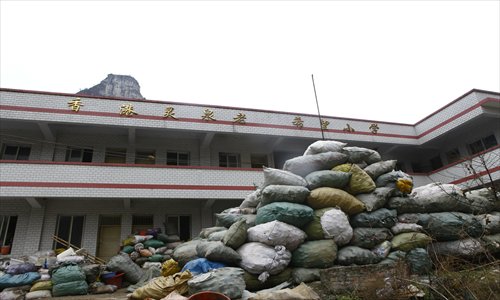
In Laoshan village, near Kaili, Guizhou Province, there stands a new two-storey building. Boasting eight classrooms, it was once intended to be a school for the disadvantaged children of this mountainous region, but now it stands in ruin. Garbage and foul odors now litter the halls, and soon the building will be discarded for the second time, when the building is leveled to make way for a highway.
"I'm sad to see this," remarked Chen Baoguo, secretary-general with the Guizhou Provincial Youth Development Foundation, when he recently visited the school to investigate the situation after it was exposed in the media.
According to local residents, the Lingchuan Laoshan Hope Primary School has been abandoned for a long time, and is currently being used by a third-party contractor to process waste. This was confirmed by the China Youth Development Foundation (CYDF), one of the groups behind the Hope school project in its latest investigation report into the school, which was sent to the Global Times.
In an effort to replace old school buildings damaged in natural disasters in 2008, construction of the 460-square-meter school was completed in 2009 with a 200,000 yuan ($32,100) donation from the Hong-Kong-based Lingchuan Charitable Foundation and a 150,000 yuan fund from the Kaili city government. It planned to enrol students from the neighboring five villages and kids whose parents work at nearby coal mines.
When the school was opened in March 2009, the number of students dropped after 30 families moved to nearby Longchang town and the coal mines were closed by the local government. This left the school with just 30 students across five grades, the report said.
One year later, the remaining 11 students in the school were transferred to the Longchang Primary School – eight months before the whole school was expropriated for a new highway. The empty school was used as a chicken farm and then a garbage dump for half a year, the investigation said.
The Kaili city government provided a 549,900 yuan compensation fund after acquiring the land for a highway. This, along with an additional 3.35 million yuan from the city government, is being provided for the construction of a new building at the Longchang Primary School, which will be named "Lingchuan Hope" and provide more favorable conditions for boarding students, the report said.
This was in line with CYDF regulations that stipulated that they "not lose the name of the Hope school and not lose donated assets," according to Tu Meng, the general secretary of CYDF.
"The Kaili city's youth league committee informed the Lingchuan Charitable Foundation and it agreed with our decision," Tu told the Global Times.
Missing schools
The CYDF, a non-governmental and non-profit national organization, launched Project Hope in 1989 to help improve teaching conditions in impoverished rural areas and have built about 17,574 Hope schools, according to its website.
In Guizhou Province alone, 1,900 charity schools were built between 1990 and March 2012, making Guizhou the province with the most Hope schools, the China News Service reported in April 2012.
However, with charity of this scale problems have emerged, fueled by government moves to amalgamate smaller schools into larger ones. An increasing number of Hope schools have disappeared, sometimes with those who provided the funds being unaware.
Ng Hong-mun, a former NPC deputy in Hong Kong, donated 200,000 yuan through the CYDF to build a Hope school in a county-level city Zengcheng in Guangdong Province in 1996, in memory of his decreased mother. In 2011, he was told by one of his friends that the school had become a leather factory, the China News Service reported.
Ng confirmed the news by himself by visiting it in July 2011. He met a former student from the school, who told him the school had been closed two years earlier and all the students were moved to another primary school, the report said.
The CYDF is responsible for building schools but not managing them. The Hope schools are managed by local education authorities, Tu said. "Even the CYDF doesn't know when some Hope schools are closed down," he added.
Later, the CYDF instituted a regulation that stipulated that Hope schools must formulate local education plans and can't be closed unless they have been used for 10 years, according to Tu.
This wave of Hope school closures came after the State Council issued a regulation in 2001, which consolidated school resources via mergers, it claimed would more efficiently distribute resources.
Enough students?
"Some Hope schools are not well planned when they are built and there is no consideration of their long-term plans," Chu Zhaohui, a researcher at the National Institute of Education Sciences, told the Global Times. "And the pace of mergers is too fast. These two factors make things worse."
From 2000 to 2010, the number of rural schools decreased from 550,000 to 260,000. Many Hope schools built over the preceding century were shut down, Cai Dafeng, a deputy president of Fudan University, said in March 2012, china.com.cn reported.
Across the country, 800 Hope schools have been closed down, accounting for 5 percent of the total number. In addition, the heads of 3 percent of currently operating Hope schools told the CYDF that their schools might be closed down and merged with other schools, according to Tu.
As a result, some very young children often have to go to schools far away from their homes.
Many Hope schools are located in remote areas with limited government services or infrastructure. With increasing urbanization more students are seeking better quality education in more developed city areas, An Heping, a sociology professor with Guizhou University, told the Global Times.
"Project Hope solves the problem of a lack of school buildings. But if it doesn't provide a good education, a school has no hope," Chu said.
Decreasing birth rates due to development and China's family planning policies have also exacerbated the problem.
"With fewer students, it costs more to run a school. The decrease in the number of Hope schools will continue," An said. "Whatever changes have happened, as public resources, Hope schools should be well managed and make sure they can continue to be used as training schools for farmers or other public affairs," he said.
However, Tu said he is optimistic about the Hope schools, saying he believes they are still urgently needed and welcomed in many impoverished areas.