Web of charity
To his family and friends, Zhao Zilong is an optimistic 24-year-old man. Hailing from Dongying, Shandong Province, he is known among his friends as a talented singer and dancer.
However, Zhao is facing a potentially fatal leukemia diagnosis, which can only be averted if the family raises enough money.
It was this tragic news, which the family discovered earlier this year, that led Web users to new forms of online charity which draw their funding from Weibo.
The most recent example, Sina Micro-charities, was launched in February this year and has already attracted donations from more than 1.7 million Web users.
According to a report released by Alipay, a third-party online payment platform in China, earlier this March, the amount of donations made via its charity platform increased to a total of 35.2 million yuan ($5.66 million), 70 percent higher than the 2011 figure.
Shock and desperation
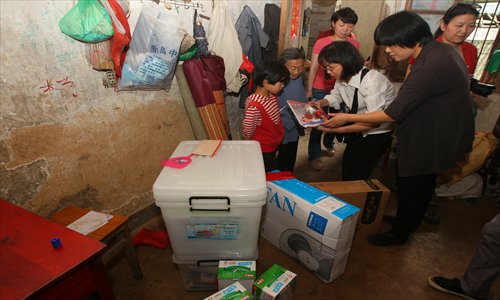
Together with his two elder sisters and his mother, Zhao lives in a 140-square-meter house, which the family took out a loan to buy three years ago at a price of about 3,000 yuan ($478) per square meter at that time.
The family lived a contented life, but that all ended earlier this year when Zhao Zilong was diagnosed with leukemia.
"Why did my brother get this deadly disease? Will he leave us soon?" Zhao Fang asked desperately.
A bone marrow transplant had the potential to save Zhao Zilong's life. But their happiness with this news didn't last long when the family discovered that the operation could cost upwards of 700,000 yuan.
In desperation, the family turned to their friends and relatives.
On the evening of March 12, a post about Zhao Zilong's difficulties attracted attention on Sina Weibo. The post was verified to have been written by one of his friends, Li Yingzhi, a renowned model who shot to fame at the 2012 Beijing International Automotive Exhibition when she wore a diamond-studded dress.
Within just two days of Li's post, which was verified by Sina Micro-charities, Zhao had received over 80,000 yuan in donations. He is still collecting donations to pay for the operation.
Competition and cooperation
After Li's post on Sina Weibo, a team of volunteers, randomly chosen from among 255 senior micro-bloggers who lived near Dongying, were sent to verify and publicize Zhao Zilong's situation. His sister said the team made phone calls to verify their identity and income situation, in cooperation with local media outlets.
The platform also helped Zhao's family get in touch with the China Youth Development Foundation, which supervised Zhao's case.
"We aim to bring together individuals in need with charitable individuals and organizations," a staff member of the Public Relation department of Sina responsible for Sina Micro-charities, told the Global Times.
She added that in order to ensure the credibility of the information, the platform only allows verified users to access charity programs.
The Alipay platform works differently. It simply offers a platform for the recipients and the charity organizations to call for help and provides a payment platform for donors.
Although Sina Micro-charities and Alipay are separate companies, they cooperate with one another. Other organizations, as opposed to just individuals, have begun to make arrangements with them as well.
"We switched to these charity platforms for fundraising from 2012, as it can help improve the transparency of the charity programs," Chen Mingcai, the president of Chongqing Small Animal Protection Association, told the Global Times, adding that after the changeover donations increased rapidly.
The development of charity platforms and charity groups rely heavily on public trust, Chen added.
Deng Guosheng, director of the NGO Research Center at Tsinghua University, echoed Chen's opinion, saying that public supervision is pushing charity groups to ensure transparency.
Transparency vs privacy
"We want to be honest to the public online as we are more than thankful for their help. But sometimes we just want some privacy," Zhao Fang said.
After Zhao's family started to receive donations, the family had to reveal not only the details of the hospital bills online but also the details of their personal lives, such as how much they were spending on lunch or what kind of clothes they wear.
Sina staff said they tried to protect the privacy of the recipients by hiding their phone numbers or home addresses. But the platform cannot deal with Web users' requests for more details.
"We have to do that, otherwise some people would start to call us liars and bother those famous verified Weibo users who reposted Li's comments," Zhao Fang told the Global Times.
Deng said the public required that information because they wanted to verify the program, which also reflected the fact that the public lacks trust in the charity industry in China.
"In order to rebuild trust in charity programs after scandals within recent years, charity groups and the platforms have to ensure transparency. But this doesn't mean the privacy of the recipients isn't important," Deng said.
Xu Bing, a staff member of Shilehui, a donation platform affiliated with the Jinhua Charity Federation in Zhejiang Province, said that donation recipients are required to reveal information about their families for public scrutiny. "Compared with the potential to receive help, I don't think the recipients should care that much about their privacy," Xu said.
Controversial problems
As with almost all charity organizations in China, controversy has never been far away from the public's consciousness.
Shilehui was criticized after giving volunteers a cut of up to 15 percent of the money donated in 2012. In 2011, some subscribers to the Alipay service discovered some money had been transferred from their accounts to charity foundations without their consent.
Deng believes that online charity platforms need to solve the problems of online payment safety and improve their management.
Chinese law states that the civil affairs departments, Red Cross societies and charitable foundations attached to the government can collect charitable donations from the public, but it doesn't mention whether individuals or other non-government organizations are permitted to establish their own fundraising projects.
"Online charity is still a grey area in legislation in China, which brings difficulties to the management and supervision of online charities," Shi Changkui, a charity expert and vice director of the management research center of the Beijing Academy of Social Sciences, told the Global Times.