What a carve up!
A line by the well-known Song Dynasty (960-1279) poet Su Shi may best illustrate the role of bamboo in Chinese culture: "We cannot live without bamboo for a single day, as we eat bamboo shoots, build our roofs with bamboo tiles, sail on bamboo rafts, cook using bamboo as firewood, make coats out of bamboo skin, write on bamboo sheaves, and walk in shoes made of bamboo fibers."
Home to the most diverse array of bamboo products and uses in the world, China has cultivated an art of bamboo that stretches back thousands of years. A bamboo skin mattress, believed to be 7,400 years old, is regarded as the earliest known example of Chinese bamboo handicrafts.
Dozens of techniques
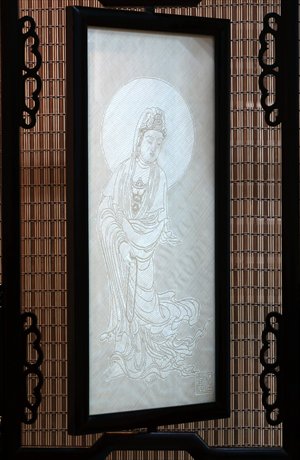
Shanghai's Jiading district is famous for its bamboo-carving culture for which craftsmen have developed dozens of carving techniques, among them shallow-carving, deep-carving, hollowed-out carving and deep relief.
Meanwhile, in Sichuan Province, bamboo is commonly used for weaving practical daily items such as baskets and bucket as well as for decorating porcelain wares. Sichuan residents also use bamboo in the structure of their oil-paper umbrellas.
The art of bamboo root carving has also blossomed in Xiangshan, Zhejiang Province and in Putian, Fujian Province, where you can find a variety of vivid bamboo carvings of Buddhas, ancient Chinese beauties and animals considered auspicious. Meanwhile, bamboo carvers from Changzhou, Jiangsu Province have also made their own distinctive mark with their extraordinary liuqing technique, a kind of shallow-carving that is applied to very fine bamboo skin.
And now a bamboo handicrafts exhibition being held at the Shanghai Folk Art Museum has gathered together items from all the aforementioned locations, presenting hundreds of exquisite works by nine contemporary bamboo art masters.
Weaving skills
Cheng Li is one of the featured artists who has innovated new weaving skills in the Sichuan bamboo tradition. On display are a number of Cheng's latest works including bamboo-weaving paintings and calligraphy scrolls.
Cheng creates her works with what is known as a bamboo "thread," a special bamboo-made tool that can be as thin as a human hair. According to Cheng, only the species known as bambusa emeiensis is good enough for this job, with roughly 100 kilograms of this bamboo being able to produce a mere 100 grams of usable bamboo thread.
Born into a family of bamboo weaving masters in Sichuan Province, Cheng formerly made teaware decorations with bamboo threads, examples of which are also on show. Today, she creates Chinese calligraphy art and ink-and-wash paintings using these same skills. The bamboo weaving skill was recognized as a national intangible heritage in 2008.
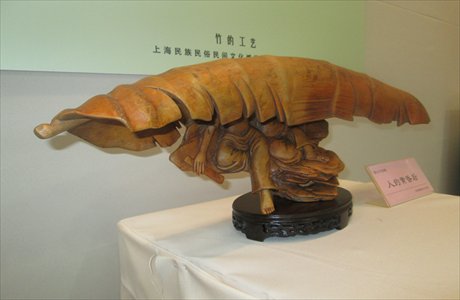
Wang Qun is another critically acclaimed artist whose works are on display at the exhibition. Born in 1972 in Xiangshan, Zhejiang Province, Wang first recognized his talent for bamboo root carving in the 1990s. Wang carves on both the outside and inside of bamboo roots, a development which heralds a new era in the history of bamboo root carving in China.
On show is a series of works using this new technique, among them Ren Yue Huanghun Hou (A Date in the Dusk) which vividly recreates the scene of a young couple under a giant leaf.
Innovative trials
Unlike Cheng and Wang who are both recognized bamboo art masters, 80-year-old Zheng Renxiang describes himself as an "amateur" of the craft. However, the ink-and-wash paintings on bamboo "paper" (a paper-thin board made of bamboo), created by Zheng and his colleagues from the Nanxiang Bamboo Culture Salon in Jiading district, have won them widespread acclaim.
"We found that using bamboo as paper creates an artistic effect that goes beyond that achieved with rice paper; this is because bamboo embodies a spirit of integrity and humility in Chinese culture," Zheng told the Global Times. A long scroll of bamboo paper by Zheng on which he has copied the contents of the Buddhist classic book Diamond Sutra (more than 5,000 Chinese characters) is also on show.
Also on view is Xi Tianzheng's photography works printed on bamboo paper, which perfectly blend an ancient tradition with modern-day technology.
The Nanxiang Bamboo Culture Salon, founded in 2004 and which is dedicated to promoting bamboo art in local communities, is also displaying dozens of examples of still-living bamboo "bonsai" cultivated in flowerpots.
Date: Until April 22, 10 am to 4:30 pm (closed on Mondays)
Venue: Shanghai Folk Art Museum
上海民族民俗民间文化博览馆
Address: 216 Chengshan Road
成山路216号
Admission: Free
Call 5056-5186 for details