A language less ordinary

Author avoids literature homogeneity by writing in Shanghai dialect
Following Mo Yan's Nobel Prize last October, the usually dreary Chinese literary circle got warmed up again. A Shanghai writer named Jin Yucheng surprised nearly everyone by making his new novel full of Shanghai dialect. Now, the circle is buzzing with hot debates over writing in dialect.
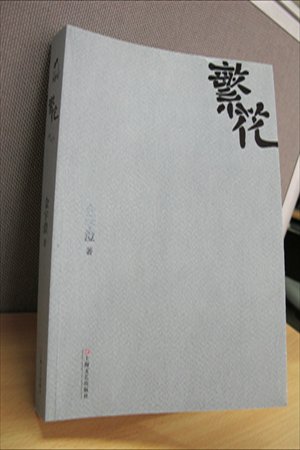
Published last month, the 350,000-word Blossoms (Fan Hua) is a novel about Shanghai life, and naturally, its use of the local language gives it the right flavor. While Putonghua (Mandarin) is the standard choice for Chinese literature today, Jin's use of the Shanghai dialect appears both different and bold.
"Chinese literature is getting monotonous both in language and form. I want to be special with my own language," Jin told the Global Times.
Innovative touch
Blossoms depicts in detail the daily life of ordinary Shanghai people in two periods - from the 1960s to the end of Cultural Revolution (1966-76) and from the 1980s to the start of the 21st century - that appear alternately throughout the novel.
Boasting over 100 characters with several main ones spanning the entire timeline, the novel tells about the changes in Shanghai over 30 years, drawing clear images of the city through the stories of numerous obscure characters. There is no main story like most novels, but every story in it could run independently.
Since its publication, the book has been widely recommended on Sina Weibo with many netizens rating the novel high for its unique use of dialect and vivid depiction of life using plain speech.
In the novel, Jin makes a breakthrough in narration by mainly using dialogues to unfold the plot and portray characters. He also abandons the use of some punctuation like quotation marks, showing a return to the traditional Chinese huaben genre. Many readers have noted that this arrangement feels particularly interesting with the Shanghai dialect dominating the text.
Before publication, part of the novel was serialized last year in the literary bimonthly magazine Harvest and attracted attention for its bold choices.
Blossoms ranked first in 2012's list of Novels of the Year held by China Novel Association.
Jin told the Global Times that he got the idea of writing the novel while chatting in an online forum where people use the Shanghai dialect. The praise he received from the netizens encouraged him to continue writing the random stories.
Jin said he noticed other writers like Jia Pingwa and Cao Naiqian using their dialects, giving him even more reason to write in the Shanghai dialect, which has a long-standing tradition in literature.
At nearly 60 years old, Jin is the author of several novels, has won many literary prizes and has been an editor for Shanghai Literature magazine for over two decades.
"I have seen too many novels that look similar to each other. They are in danger of homogenizing," Jin said.
Putonghua vs. dialect
Jin's Blossoms looks eye-catching particularly against the background that novels in Shanghai dialect used to be a popular genre in Chinese literature. Legend of Flowers of Shanghai in late Qing Dynasty (1644-1911) was one famous novel that falls into the category. But the tradition has been cut off for a long time, so Jin was destined to arouse much discussion with his attempt.
At a seminar on March 26 at the Shanghai Writers' Association, literary critic Li Jingze said, "Choosing between dialect or Putonghua is essentially a matter of taste." The two languages represent two different modes of thinking, and will lead to different content. Jin chose Shanghai dialect because he wanted to fill the book with the flavor of old Shanghai, Li explained.
Cheng Yongxin, executive chief editor of Harvest, said that in the creation of literature, some things are hard to say in Putonghua and using a dialect is the only choice if one is to maintain regional cultural elements.
As a matter of fact, more and more writers are attempting to put dialect in their works, particularly in dialogues. Writers such as Jia Pingwa, Chen Zhongshi and Yan Lianke all have added local color to their works by using Shaanxi or Henan dialects.
"For writers beyond Beijing, Putonghua is like a second language," Jin said, "I found it much easier to write dialogues in my native language."
"Writers will feel freer to write in their 'native tongue' and it will increase distinction," Zhong Hongming, vice chief editor of Harvest told the Global Times. She stressed that Putonghua and dialect are not set against each other. "They will co-exist in literature."
Risky endeavor
Though Jin believes that the Shanghai dialect can express as much as Putonghua in literature, it is not easy. He admitted that this first attempt was difficult.
"Many things that can be expressed in Putonghua cannot be said in the dialect and I had to write in a roundabout way," he said, "It means more preparation and challenges."
It also means risk. Writer Su Tong used to say that few writers like to write in dialect because "such books do not sell well and will lose readers." Though the works themselves have value, "you have to pay the price," he said.
Previous efforts, such as Hu Baotan's 2011 novel about old Shanghai called Lane, have encountered a cold reception after publication.
As reported, Hu said that the book failed to find its audience because entries to the genre are too rare. Even modern Shanghai people found it hard to understand. Jin avoided that obstacle in Blossoms. He stayed conscious of the readership beyond Shanghai when writing the novel, striking a subtle balance. To him, language must serve the novel.
"The dialect in my novel is refined and revised a lot, so that readers beyond Shanghai can understand it," he said, "but Shanghai locals will find it more interesting. They will laugh at some parts, knowingly."
Jin told the Global Times that he would like to see more writers to follow his lead. "Writing in dialect should be encouraged. It enriches our literature and makes it diversified." But for those who will try, he has some advice.
"If you want your works to get read, first of all, it should be understandable for readers in other regions. It is not to amuse oneself," he said, "besides, you should grasp the features of the dialect and put the best in front of readers."